Summary
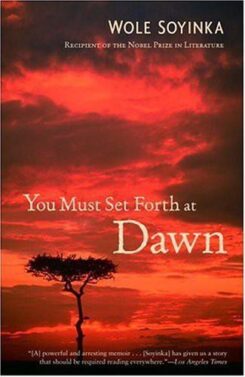
You Must Set Forth at Dawn is a sprawling memoir by Nobel laureate Wole Soyinka, serving as a sequel to his childhood memoir, Aké. It chronicles Soyinka’s adult life, focusing intensely on his political activism and his relentless struggle against a succession of Nigerian military dictatorships. The book is less a traditional autobiography and more a “chronicle of modern Africa and its troubles,” weaving together personal reminiscences with the turbulent political history of Nigeria from its independence in 1960 through the death of the dictator Sani Abacha in 1998. It explores the heavy personal cost of dissent, including imprisonment and exile, while reflecting on the nature of justice and the enduring strength of human friendships.
Plot
The narrative follows a non-linear structure, often using a homecoming in 1998 as an anchor to flash back to earlier decades.
- The Early Years and First Arrest: After returning from the UK in 1960, Soyinka becomes a “truth crier” against the corruption of the new political elite. In 1965, he famously held up a radio station at gunpoint to replace a rigged victory speech by the premier of the Western Region with a call for the government to drop its “stolen mandate”.
- The Civil War and Imprisonment: During the Nigerian Civil War, Soyinka undertakes a peace mission to Biafra to meet with secessionist leader Odumegwu Ojukwu. Upon his return, he is arrested by the federal government and spends twenty-eight months in prison, much of it in solitary confinement.
- The Struggle Against “The Evil Genius”: The narrative detail’s Soyinka’s complex relationship with General Ibrahim Babangida, whom he dines with but also opposes during the long, eventually annulled transition to democracy in 1993.
- Exile Under Abacha: Following the rise of the “Diminutive Demented Dictator” Sani Abacha, Soyinka is forced into a hazardous flight into exile in 1994 via a motorcycle through the forest. From abroad, he leads the National Liberation Council of Nigeria (NALICON), operates an opposition radio station, and lobbies international governments for sanctions against the regime.
- The Return: The plot culminates with the sudden death of Abacha in 1998 and Soyinka’s triumphant return to Nigeria under the successor General Abdulsalami Abubakar, ending his five-year restless exile.
Setting
- Nigeria: The primary setting, specifically Lagos (the “urban nightmare”), Ibadan (his intellectual base), Abeokuta (his birthplace and retreat), and the Kaduna prison.
- International: The narrative shifts to the United Kingdom, France, Jamaica, Italy, and the United States (Harvard, Emory, and California) as Soyinka moves through various spells of voluntary and forced exile.
- The “Bush”: The Nigerian forests and grasslands serve as a recurring physical and spiritual setting where Soyinka retreats for solace and hunting.
Themes
- Justice and Equity: Soyinka’s central life philosophy is that “Justice is the first condition of humanity“. Much of the book explores the struggle for political parity among Nigeria’s constituent parts.
- The Corruption of Power: The memoir serves as a scathing critique of the “imbeciles, psychopaths, and predators” who held power in post-independence Nigeria.
- The Burden of Activism: It highlights the “interjection of the categorical imperative” into his life—the sense of duty that forced him to choose strife over his natural craving for tranquillity.
- Friendship and Loss: A major emotional thread is the “pockmarked craters of loss” caused by the deaths of his close friends and allies, including Femi Johnson (OBJ) and Ojetunji Aboyade (Oje).
- Identity and Exile: The text grapples with the “ethereal zone” of living outside one’s country and the psychological trauma of becoming a “wanted” man.
Characters
Major Characters
- Wole Soyinka: The protagonist; a Nobel-winning playwright, poet, and “warrior for justice”.
- Femi Johnson (OBJ): Soyinka’s closest friend, an insurance broker whose infectious vitality and shared love for hunting and fine dining are central to the memoir.
- Ojetunji Aboyade (Oje): An intellectual partner and former vice chancellor who often acted as a peace broker between Soyinka and various heads of state.
- General Sani Abacha: The primary antagonist; a “psychopath” whose brutal rule drove Soyinka into exile and oversaw the execution of Ken Saro-wiwa.
- General Ibrahim Babangida (IBB): The “Evil Genius” and “Artful Dodger” who ruled for eight years and annulled the 1993 democratic elections.
- General Olusegun Obasanjo: A complex figure of “fluctuating destinies” who was sometimes an ally and other times an adversary to Soyinka.
Minor Characters
- Moshood Abiola: The president-elect of Nigeria who died in detention after his mandate was stolen.
- Christopher Okigbo: A poet and friend who died fighting for the Biafran side during the Civil War.
- Ken Saro-wiwa: An “ecowarrior” and writer whose judicial murder by Abacha was a turning point for the international opposition.
- Victor Banjo: A Yoruba officer in the Biafran army who led the incursion into the Midwest and was later executed for treason by Ojukwu.
- Bola Ige: A lawyer, politician, and lifelong friend of Soyinka who was later assassinated.
- Nelson Mandela: The “avatar” whom Soyinka admired and with whom he dined in Paris while attempting to broker peace in South Africa.
Literary Devices
- Metaphor: “The Road” is used as a consistent metaphor for self-discovery and the violent history of the nation. The “Dying Calf” is a recurring image used to describe a failing theatrical production.
- Symbolism: Ogun, the Yoruba deity of iron, war, and creativity, is the governing symbol of Soyinka’s dual nature as an artist and a combatant.
- Irony: The book is rich with situational irony, such as the “wanted” man Soyinka being awarded the Nobel Prize or his use of an “insolent” New York taxi for a secret diplomatic meeting.
- Satire and Humor: Soyinka uses biting wit to lampoon the “imbecility” of military rulers and the absurdities of protocol.
- Non-Linear Narrative: The story uses flashbacks and interjections, moving from the 1990s back to the 1960s to illustrate how history repeats itself in Nigeria.
- Lyrical Realism: His evocations of African landscapes and the “furtive breath” of the bush provide a poetic contrast to the gritty descriptions of political turmoil.