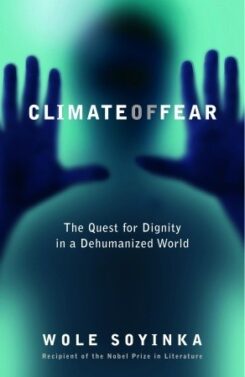
Climate of Fear: The Quest for Dignity in a Dehumanized World is a non-fiction work by Nobel Laureate Wole Soyinka, based on his 2004 Reith Lectures. The book explores the global atmosphere of terror and the systematic erosion of human dignity in the 21st century.
Summary
The book examines the shift from state-sponsored fear, common during the Cold War and under African dictatorships, to a new, invisible fear generated by “quasi-states”—non-territorial entities like al-Qaeda that operate without boundaries. Soyinka argues that the modern world is trapped in a cycle of “rhetorical hysteria” where both political and religious leaders use dehumanizing language to justify atrocities. Central to the work is the “Quest for Dignity,” which Soyinka identifies as a fundamental human need that is often the first casualty of power and fanaticism. He concludes by advocating for collective global action and dialogue rather than unilateralism to dismantle the “creeds of fear” that currently polarize humanity.
Plot (Structure of the Lectures)
As a collection of lectures rather than a novel, the “plot” follows a thematic progression across five chapters:
- A Changing Mask of Fear: Defines the nature of modern fear, contrasting the tangible threat of past dictatorships with the furtive, unpredictable power of today’s terrorists.
- Of Power and Freedom: Analyzes the “Ecstasy of Power” and how quasi-states mimic the structures of formal states to dominate the human will.
- Rhetoric That Binds and Blinds: Explores how mantras and monologues (such as “Weapons of Mass Destruction” or religious fatwas) lead to mass hysteria and the suspension of rational thought.
- The Quest for Dignity: Argues that humiliation is the primary driver of conflict, specifically referencing the Israeli-Palestinian struggle and the psychological need for self-worth.
- “I Am Right; You Are Dead”: Confronts the dead-end of fanaticism, where absolute conviction replaces dialogue with a homicidal imperative that recognizes no innocents and no sanctuaries.
Setting
- Temporal: The lectures were delivered in March 2004, reflecting on the immediate aftermath of September 11, 2001, the Iraq War, and the 2004 Madrid train bombings.
- Geographical: The work is global in scope, moving between Nigeria (under the Abacha dictatorship), Chechnya (the Beslan massacre), Algeria, Palestine, Israel, the United States, and Iraq.
Themes
- The Climate of Fear: The transition from the “fear of the midnight knock” by state police to the ubiquitous, invisible threat of the sachet of sarin or the shopping bag bomb.
- The Erosion of Dignity: The idea that humiliation is as destructive as physical violence and that the quest for self-worth is a primary human motivator.
- The Quasi-State: Shadowy corporations of power that mimic state hierarchies but lack geographic boundaries or accountability.
- Fanaticism and the “Chosen”: The danger of exclusive ideologies (religious or secular) that divide the world into “us” and “them,” leading to the doctrine that “there are no innocents”.
- Monologue vs. Dialogue: The conflict between unilateralism (one-way communication that blinds) and collective global engagement.
Characters
Since this is non-fiction, these “characters” are real-world figures used to illustrate Soyinka’s points: Major Figures
- Wole Soyinka: The author and narrator, who draws on his personal experiences as a political prisoner in Nigeria and a frequent traveler.
- Shamil Basayev: A Chechen warrior whose massacre of children in Beslan is cited as the nadir of human impotence and the “end of discourse”.
- George W. Bush: Used to illustrate the power of political rhetoric (specifically regarding “Weapons of Mass Destruction”) and the dangers of unilateral action.
- Osama bin Laden: Representing the quasi-state’s religious fanaticism and the polarization of the world into “believers” and “infidels”.
Minor Figures
- President Khatami (Iran): Cited as a proponent of the “Dialogue of Civilizations” in contrast to the theocratic monologues of his predecessors.
- Yasser Arafat and Shimon Peres: Used to discuss the role of dignity and humiliation in the Middle East conflict.
- Naguib Mahfouz and Salman Rushdie: Writers who became targets of “terminal censors” (religious fanatics).
- General Sanni Abacha: The Nigerian dictator whose reign of terror is used as a case study for state-sponsored fear.
- Adolf Hitler: An “iconography” of past universal fear and the quest for world domination.
Literary Devices
- Metaphor: Soyinka uses evocative imagery, such as the “Changing Mask of Fear” to describe evolving threats and the “poisoned garden of impiety” to describe Basayev’s actions.
- Anecdote: The author personalizes his arguments through stories, such as the California wildfires to distinguish between natural and human-imposed fear or his experience on a diverted flight during 9/11.
- Allusion: The text is rich with references to philosophy (Hegel, Locke, Marx), literature (William Blake, Jean Genet), and history (The Red Brigades, Rwanda, the Spanish Civil War).
- Rhetorical Questions: Used to engage the reader’s “moral compass,” such as asking, “What exactly is this democracy… Is it something we can put in the mouth and eat like food?”.
- Irony: Soyinka points out the “grim irony” of events, such as the “Right to Life” crusaders who commit murder.
- Syllogism/Catchphrases: He deconstructs dangerous mantras like “All property is theft” evolving into “All life is theft” to show the logical progression of extremist thought.