Table of Contents
Summary
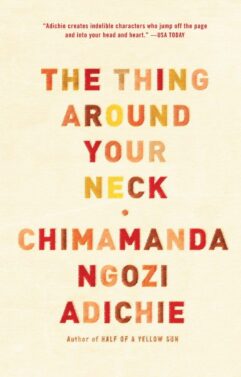
The Thing Around Your Neck is a collection of twelve short stories that explore the complexities of the Nigerian experience. The narrative spans various perspectives, focusing heavily on the tensions between tradition and modernity, the impact of political corruption in Nigeria, and the struggles of the Nigerian diaspora in the United States. The stories often center on female protagonists navigating patriarchal structures, cultural displacement, and the haunting legacy of the Biafran War.
Plot Overviews
- “Cell One”: A young man named Nnamabia is arrested during a period of cult violence on a university campus and experiences a moral awakening after witnessing the police’s brutal treatment of an innocent old man.
- “Imitation”: Nkem, living in a wealthy Philadelphia suburb, discovers her husband has moved his girlfriend into their home in Lagos; she eventually asserts herself by deciding to move back to Nigeria.
- “A Private Experience”: During a violent riot in Kano, an Igbo Christian woman and a Hausa Muslim woman find temporary refuge together in an abandoned store, sharing a moment of shared humanity despite the ethnic conflict outside.
- “Ghosts”: James Nwoye, a retired professor, encounters a colleague he believed had died decades earlier during the Biafran War, leading to a meditation on loss, the corruption of the present, and the “ghosts” of the past.
- “On Monday of Last Week”: Kamara, a Nigerian woman working as a nanny in America, becomes infatuated with her employer’s wife, an artist, only to realize the woman’s interest in her is purely superficial and artistic.
- “Jumping Monkey Hill”: At an African writers’ workshop in South Africa, Ujunwa confronts the condescending and sexualizing gaze of the British organizer, eventually using her fiction to challenge his “expert” views on “the real Africa”.
- “The Thing Around Your Neck”: A young woman navigates a relationship with a white American man while feeling a suffocating sense of loneliness and cultural isolation—the “thing” around her neck.
- “The American Embassy”: A mother stands in line for an asylum visa after her son is killed by government agents looking for her journalist husband, ultimately choosing her son’s memory over “hawking” his death for a visa.
- “The Shivering”: Two Nigerians in Princeton bond over a plane crash back home; the story explores themes of faith, sexuality, and the different ways people “perform” their lives.
- “The Arrangers of Marriage”: Chinaza arrives in New York for an arranged marriage, only to find her husband is obsessed with “mainstreaming” into American culture, forcing her to change her name and abandon her heritage.
- “Tomorrow Is Too Far”: A woman returns to Nigeria and reflects on the summer her brother died, revealing the dark truth of her own involvement in the accident and the poisonous effects of favoritism.
- “The Headstrong Historian”: This multi-generational saga follows Nwamgba, who sends her son to a missionary school to gain the power to fight for her family’s land, eventually seeing her granddaughter Afamefuna reclaim their history.
Setting
- Nigeria: Locations include the university campus at Nsukka, the bustling city of Lagos, the northern city of Kano, and ancestral hometowns like Umunnachi and Mbaise.
- United States: Stories are set in various American locations, including Philadelphia, Princeton, Connecticut, and Maine.
- South Africa: “Jumping Monkey Hill” is set at a resort outside Cape Town.
- Time Period: The stories range from the colonial era (early 20th century) to the post-Biafran War years and the present day (late 1990s/early 2000s).
Themes
- Cultural Displacement and Immigration: Characters struggle with the “give-and-take” of America, the pressure to assimilate, and the longing for home.
- Gender and Patriarchy: The sources highlight the restricted roles of women in both traditional Nigerian and modern contexts, often seen through arranged marriages or the privileging of male heirs.
- Political Corruption and Violence: Stories depict the brutality of the police, the terror of government agents, and the senselessness of ethnic/religious riots.
- Legacy and History: The importance of reclaiming one’s name and history against the erasure of colonialism is a central pillar.
- Class and Power: The distinction between “Big Men” and those they exploit is a recurring motif.
Characters
Major Characters
- Nnamabia: A handsome, initially selfish youth who finds his conscience in a prison cell.
- Nkem: A wife in America who realizes she must return home to reclaim her dignity.
- Chika: A medical student whose encounter with a Muslim woman during a riot changes her perspective on faith and ethnicity.
- James Nwoye: A retired mathematics professor haunted by the Biafran War and the “visits” of his dead wife, Ebere.
- Akunna: The protagonist of the title story who navigates a complex cross-cultural relationship in the US.
- Nwamgba: A headstrong traditional woman who fights to preserve her husband’s legacy through her son and granddaughter.
- Afamefuna (Grace): Nwamgba’s granddaughter who becomes a historian to reclaim the narrative of her people.
Minor Characters
- Obiorah: A wealthy Nigerian businessman who maintains a “plastic” life for his family in America while keeping a mistress in Lagos.
- Ikenna Okoro: A man thought dead for 37 years who reappears, embodying the weight of “what could have been”.
- Dave (Ofodile): A Nigerian doctor in the US who forces his new wife to assimilate completely.
- Edward Campbell: A patronizing British academic who organizes an African writers’ workshop.
- Tracy: A seductive but ultimately self-absorbed African-American artist.
Literary Devices
- Second-Person Narration: “The Thing Around Your Neck” uses “you” to create an intimate, immediate sense of the protagonist’s alienation.
- Symbolism:
- The Benin Mask: Represents “noble” imitations of a lost or stolen culture.
- The Scarf: In “A Private Experience,” it symbolizes a moment of cross-cultural aid and a “ghoulish souvenir” of grief.
- The “Thing” around the neck: A metaphor for the suffocating anxiety and loneliness of the immigrant experience.
- Foreshadowing: In “Tomorrow Is Too Far,” the description of the echi eteka (“Tomorrow Is Too Far”) snake foreshadows the sudden, irreversible nature of the brother’s death.
- Irony: The “headstrong historian” sends her son to school to fight the white man, only for him to become a devout Christian who rejects his own culture.
- Juxtaposition: Adichie frequently contrasts the “serene” university campuses with the sudden “senseless” violence of cults and riots.