Summary
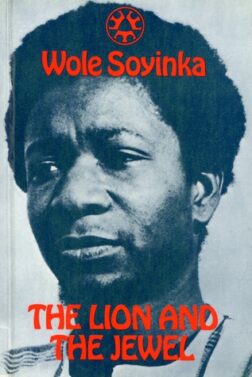
The Lion and the Jewel is a comedic play set in the Yoruba village of Ilujinle, centered on the rivalry between two men for the hand of a beautiful village girl named Sidi. Lakunle, the village schoolteacher, represents a clumsy and often condescending push for modernity, refusing to pay Sidi’s bride-price because he deems the custom “barbaric”. Conversely, Baroka, the village chief or “Bale,” represents tradition and possesses a cunning intellect that he uses to protect his way of life and win Sidi. The play explores themes of vanity, gender power dynamics, and the clash between African heritage and Western influence through a series of mimes, dances, and sharp-witted dialogue.
Plot
- Morning: The play begins with Lakunle attempting to woo Sidi while she carries water, lecturing her on her “unwomanly” habits and his desire to turn the village “inside out” with modern ways. Their interaction is interrupted by news that a photographer has returned with a magazine featuring beautiful images of Sidi, which makes her realize she is now more famous and esteemed than the Bale himself. The villagers perform a mime of the photographer’s first arrival in the village.
- Noon: Baroka’s head wife, Sadiku, arrives to propose marriage on behalf of the Bale. Empowered by her beauty in the photos, Sidi refuses the proposal, mocking Baroka as “spent” and “old”. Baroka, anticipating this rejection, tricks Sadiku into believing he has lost his manhood (impotence), knowing she will spread the gossip to Sidi.
- Night: Sadiku celebrates the “defeat” of the Lion, and Sidi decides to visit Baroka’s palace to mock him to his face. During her visit, Baroka displays his cunning by showing Sidi a machine that will print stamps with her face on them, effectively “marketing” her beauty. He successfully seduces her. The play concludes with Sidi rejecting Lakunle’s offer of a “price-less” marriage to instead wed the “Lion” of Ilujinle.
Setting
The play takes place in the village of Ilujinle, Nigeria, in the year 1963. The specific locations include:
- A clearing on the edge of the market, dominated by a large “odan” tree and the village school.
- A road by the market where the villagers gather and gossip.
- Baroka’s bedroom, a space filled with animal skins, weapons, and traditional luxury.
- The action is divided chronologically into three segments: Morning, Noon, and Night.
Themes
- Tradition vs. Modernity: This is embodied by the conflict between Baroka, who wants to preserve “virgin plots” of life, and Lakunle, who dreams of “cocktail parties,” “motor roads,” and the abolition of the “barbaric” bride-price.
- Vanity and Beauty: Sidi’s transformation from a “village belle” into a self-absorbed “jewel” occurs after she sees her photographs, leading her to believe her beauty makes her superior to the Bale.
- Cunning and Deception: The “Fox” (Baroka) uses psychological manipulation to win his “Jewel,” proving that traditional wisdom and strategy can outmaneuver shallow “book-learning”.
- Male vs. Female Power: The women, led by Sadiku, believe they have “scotched” the male ego, but the ending suggests a more complex reality where tradition still holds sway through the Bale’s strength.
Characters
Major Characters
- Sidi (The Jewel): The beautiful village belle whose vanity is ignited by a photographer’s magazine. She is initially skeptical of both her suitors but is eventually won over by Baroka’s craftiness.
- Baroka (The Lion): The 62-year-old Bale of Ilujinle. He is a “wiry” and “tough” traditionalist who values his culture and uses his “Fox”-like wit to secure his desires.
- Lakunle: A 23-year-old schoolteacher dressed in a threadbare English suit. He is a “book-nourished” idealist who despises village customs but is often portrayed as a “clown” or “madman” by the locals.
Minor Characters
- Sadiku: Baroka’s head wife who has served in the harem for forty-one years. She acts as a go-between and a representative of the collective female voice in the village.
- The Favourite: Baroka’s latest wife at the start of the play, who is tasked with plucking his armpit hairs until she is replaced by Sidi.
- The Wrestler: A muscular figure who serves as Baroka’s sparring partner and demonstrates the Bale’s physical vigor.
- The Surveyor: A white official in a flashback who was bribed by Baroka to divert the railway away from the village.
- Village Girls and Mummers: Groups who provide the rhythmic and theatrical background to the village’s social life through dance and mime.
Literary Devices
- Mime and Play-within-a-Play: The “dance of the lost Traveller” and the “dance of virility” are used to provide backstory and commentary on the characters without the need for traditional dialogue.
- Symbolism:
- The Lion: Represents Baroka’s strength, authority, and predatory nature.
- The Jewel: Represents Sidi’s beauty, rarity, and her status as a prize to be won.
- The Fox: Represents Baroka’s cunning and deceptive intelligence.
- Metaphor: Lakunle uses many Western-influenced metaphors (e.g., “pigs” and “jewels”) to criticize the village, while Baroka uses nature-based metaphors (e.g., the “monkey sweats”) to explain the burdens of leadership.
- Satire: The play satirizes Lakunle’s blind devotion to “progress” and “civilization,” often highlighting how his “big loud words” have no practical meaning in his environment.