Summary
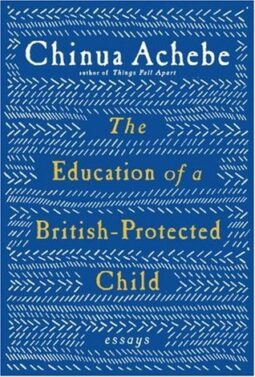
The Education of a British-Protected Child is a collection of autobiographical and critical essays that span Chinua Achebe’s career as a writer. The book is described by Achebe as personal and eclectic, aiming to “shine the torch of variety” on his life experiences and explore the intersection between his writing and personal life. The essays delve into his upbringing in colonial Nigeria, his family history, the development of modern African literature, and his reflections on the political struggles and leadership failures of Nigeria. While it touches on his time as a “British Protected Person” before Nigeria’s independence, it also addresses his later life as a world-renowned author and academic living in the United States.
Plot
As a collection of essays rather than a novel, the book does not follow a traditional fictional plot; however, it traces a thematic and chronological trajectory of Achebe’s life.
- Early Life: It begins with his childhood in the village of Ogidi, where he was raised at the crossroads of traditional Igbo culture and the Anglican mission.
- Education and Career: It follows his education at Government College, Umuahia, and University College, Ibadan, leading to his career in broadcasting and the publication of his masterpiece, Things Fall Apart.
- Conflict and Exile: The narrative arc includes the trauma of the Biafran War, which forced him to flee his home in Lagos and eventually led to a long period of teaching in the United States.
- Later Reflections: The later “plot” points involve his reflections on global events, such as the election of Barack Obama, and personal challenges, including a motor accident in 1990 that cost him the use of his legs.
Setting
The setting shifts across various locations and time periods:
- Colonial Nigeria: Specifically the village of Ogidi and the river town of Onitsha during the 1930s and 40s.
- Academic Institutions: Government College in Umuahia and University College in Ibadan.
- Lagos and Biafra: The political and cultural center of Nigeria during the 1960s and the “smoldering rubble” of the Republic of Biafra after the civil war.
- The United States: Locations such as Amherst, Massachusetts, and Annandale-on-Hudson, New York, where Achebe lived and taught later in life.
Themes
- The “Middle Ground”: Achebe celebrates the Igbo preference for duality over fanaticism, viewing the middle ground as a place of “playfulness, of the unpredictable, of irony”.
- The Impact of Colonialism: He critially examines the “gross crime” of colonial rule, where aggressors imposed their history on victims while claiming to offer “protection”.
- Identity and “Proper Names”: A recurring theme is the struggle of colonized people and the African diaspora to reclaim their story and “spell their proper name” against derogatory Western labels.
- Literature as Restoration: Achebe views African literature as a means to restore the humanity of Africans, countering centuries of European writing that portrayed the continent as a “void” or a place of “savagery”.
- Leadership and Governance: He argues that “the trouble with Nigeria is simply and squarely a failure of leadership,” specifically the inability of leaders to provide a personal example of responsibility.
Characters
Major Characters
- Chinua Achebe: The narrator and subject, who reflects on his evolution from a “British-Protected Child” to a “British Protected Person” and finally a global literary figure.
- Isaiah Achebe: The author’s father, a staunch Christian evangelist who valued education and filled his home with “educational material”.
- Udoh Osinyi: Achebe’s great-uncle, a leader in his community who “stood fast in what he knew” (traditional Igbo ways) while allowing his nephew to seek new answers in Christianity.
- Nnamdi Azikiwe (“Zik”): The “legend” and nationalist leader who “bestrode the world of this child like a colossus” and later became the first president of Nigeria.
Minor Characters
- Christie Achebe: The author’s wife, who put her professional life on hold to care for him after his paralyzing accident.
- The Achebe Children: Chinelo, Nwando, Ikechukwu, and Chidi, who appear in personal anecdotes regarding their education and their role in the author’s recovery.
- James Baldwin: A “brother” and fellow writer with whom Achebe discussed the “African conundrum” and the shared struggle against oppression.
- Miss Edith Ashley Warner: A Victorian missionary teacher whose “unspared rod” and struggle with the Igbo language provided early, humorous, yet stern lessons on colonial education.
- William Simpson: A Cambridge-educated principal at Umuahia who enacted the “Textbook Act” to encourage students to read for pleasure rather than just for exams.
Literary Devices
- Anecdote: Achebe uses personal stories, such as his mother seeing her mistress’s dentures or his daughter’s “Nwando-haven,” to illustrate broader cultural points.
- Proverbs and Folk Wisdom: The text is rich with Igbo proverbs, such as “Wherever Something Stands, Something Else Will Stand Beside It,” to convey traditional philosophy.
- Metaphor: He uses metaphors like “Zik’s Kitchen” to describe national independence or the “Middle Ground” to describe a balanced worldview.
- Allusion: He frequently alludes to other literary works and figures—notably Joseph Conrad’s Heart of Darkness and James Baldwin—to critique the Western canon’s portrayal of Africa.
- Irony: Achebe employs irony to highlight the contradictions of colonialism, such as the fact that the first passport to “protect” him also defined him as a subject of an empire he wished to be free from.