Summary
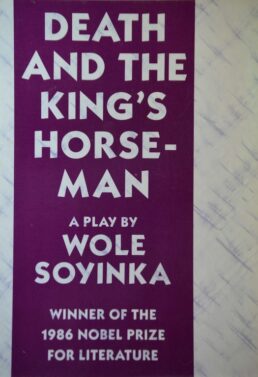
Death and the King’s Horseman is a play by Wole Soyinka based on real events that occurred in Oyo, Nigeria, in 1946. The narrative centers on Elesin Oba, the King’s Horseman, who is traditionally required to commit ritual suicide thirty days after the King’s death to accompany his ruler into the afterlife and ensure the spiritual equilibrium of the community. However, the British colonial District Officer, Simon Pilkings, views the act as a “barbaric custom” and intervenes by arresting Elesin. This intervention, combined with Elesin’s own momentary hesitation and “weight of longing” for the living world, leads to a catastrophic failure of the ritual. The play concludes with a tragic reversal: Elesin’s son, Olunde, who had been studying medicine in England, performs the ritual in his father’s stead to redeem their family honor, leading a devastated Elesin to eventually take his own life in prison.
Plot
- Act 1: The play opens in a vibrant Oyo market. Elesin Oba arrives with his Praise-Singer and drummers, celebrating his final day of life. Despite his impending death, Elesin is full of vitality and demands to marry a beautiful young girl he sees in the market, a request Iyaloja and the women grant to ensure he leaves a “seed” behind and travels “light”.
- Act 2: At the District Officer’s bungalow, Simon and Jane Pilkings are practicing the tango while wearing confiscated egungun costumes for a fancy-dress ball. They receive a report from Sergeant Amusa about Elesin’s planned suicide. Pilkings orders Elesin’s arrest to prevent the “criminal offence” and ensure no disturbances occur during the upcoming visit of the Prince.
- Act 3: In the market, Sergeant Amusa and his constables are humiliated and driven away by market women and girls who protect Elesin while he is in his bridal chamber. Elesin emerges and enters a deep trance-dance, spiritually preparing to cross the “abyss of transition” as the drums signal the King’s burial has begun.
- Act 4: During a colonial masquerade ball, Olunde, Elesin’s eldest son, unexpectedly appears. He has returned from England specifically to bury his father, believing the ritual suicide to be an honorable necessity. When he discovers that Pilkings has arrested Elesin and prevented the death, he is filled with contempt and disowns his father, calling him an “eater of left-overs”.
- Act 5: Elesin is imprisoned in a cellar. He confesses to his new bride and Iyaloja that his will failed him, partly because of the “alien hand” of the British but also because of his own lingering attachment to the world. Iyaloja reveals that Olunde has killed himself to fulfill the duty Elesin abandoned. Upon seeing his son’s body, Elesin strangles himself with his chains. Iyaloja rebukes Pilkings, stating that his interference has left the world “tumbling in the void”.
Setting
The play is set in the ancient Yoruba city of Oyo, Nigeria, during the Second World War (specifically 1943–1946). The action moves between the native market, a site of traditional spiritual energy and community, and the British colonial Residency, which represents the “tawdry decadence” and detachment of the imperial administration.
Themes
- Metaphysical Transition: Soyinka emphasizes that the play is not merely a “clash of cultures” but a metaphysical confrontation involving the Yoruba concept of the universe—the world of the living, the dead, the unborn, and the “numinous passage” of transition.
- Honor and Duty: The central conflict revolves around the burden of tradition. Elesin’s failure to fulfill his duty is seen as a betrayal of his race, whereas Olunde’s sacrifice is viewed as an act of supreme honor.
- The Colonial Factor: The British administration acts as a catalytic incident, intervening in indigenous customs they do not understand, which ultimately triggers the tragic outcome.
- Life vs. Death: The play explores the “threnodic essence” of life through the lens of ritual death, suggesting that self-sacrifice can be an “affirmative commentary on life”.
Characters
Major Characters
- Elesin Oba: The King’s Horseman, a man of enormous vitality and sensual appetite. His failure to complete his ritual suicide brings shame upon his people.
- Simon Pilkings: The District Officer, an administrator who believes he is doing his duty by “saving” Elesin’s life, despite his complete ignorance of the spiritual consequences.
- Olunde: Elesin’s eldest son. Despite his Western medical training, he remains deeply rooted in Yoruba tradition and eventually sacrifices himself for his people’s honor.
- Iyaloja: The “Mother” of the market and spokesperson for the community’s traditional values. She is wise, stern, and unyielding in her demands for ritual integrity.
Minor Characters
- Jane Pilkings: Simon’s wife, who is more curious and empathetic than her husband but ultimately views African traditions through a superficial colonial lens.
- Praise-Singer: A spiritual figure who serves as a foil to Elesin, guiding him through his final hours and eventually lamenting his failure.
- Sergeant Amusa: A native policeman and Muslim convert who is caught between colonial duty and his lingering fear of traditional “juju”.
- Joseph: The Pilkingses’ houseboy, a Christian convert who struggles with the contradictions between his new faith and tribal memory.
- The Bride: A young woman who becomes Elesin’s final earthly tie; she remains a silent, symbolic presence at the end.
Literary Devices
- Threnodic Essence: The play functions as a lament (threnody) for a world whose spiritual rhythm has been violently disrupted.
- Tragic Irony: The most significant irony is that Olunde, the son whom Pilkings “saved” from tradition by sending him to England to become a doctor, is the one who ultimately commits the ritual suicide Pilkings sought to prevent.
- Allegory (The “Not-I” Bird): Elesin uses the story of the “Not-I” bird to boast that, unlike others who fear death, he welcomes it. This later becomes ironic when his own will fails.
- Metaphor and Imagery: Soyinka uses rich metaphors related to the river, the elephant, and the market to describe the Yoruba worldview and the weight of Elesin’s duty.
- Total Theater Traditions: The play incorporates Yoruba “total-theater”, using music, drumming, dance, and poetry to move the plot and convey metaphysical depth.