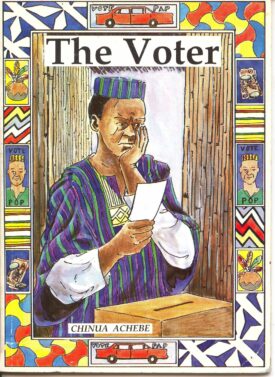
Summary
“The Voter” is a satirical short story that explores the corruption and cynicism within the electoral process of a village named Umuofia. The narrative follows Rufus “Roof” Okeke, a popular and clever campaigner for the incumbent Minister of Culture, Marcus Ibe. While Roof is expert at manipulating the villagers and distributing bribes on behalf of his wealthy employer, he finds himself in a moral and spiritual bind when an opposition party offers him a large bribe to vote against Marcus. The story culminates on election day, where Roof must find a way to honor a fearsome traditional oath while maintaining his loyalty to his patron.
Plot
- Exposition: Rufus “Roof” Okeke is introduced as a highly popular man in Umuofia who has chosen to stay in his village rather than seek work in the city. He serves as the lead campaigner for Chief the Honourable Marcus Ibe, the Minister of Culture.
- Inciting Incident: As the election approaches, the villagers realize how much wealth politics has brought to Marcus while they remain poor. Consequently, they decide they will no longer give their votes for free, leading Roof to distribute “shining shillings” to the elders to secure their support.
- Rising Action: Roof is visited at night by the campaign team of the rival Progressive Organization Party (POP). They offer him five pounds—a massive sum compared to the shillings he distributes—to vote for their candidate, Maduka.
- Climax: To ensure his compliance, the POP campaigner makes Roof swear an oath on a fearsome iyi from Mbanta, a traditional deity. Roof, terrified of the spiritual consequences of breaking the oath but still wanting to remain loyal to Marcus, is torn.
- Falling Action: On election day, Roof is the first to enter the voting booth at Marcus’s request. Inside, he faces the two ballot boxes—one for the “motor-car” (Marcus) and one for the “man’s head” (Maduka).
- Resolution: In a moment of quick thinking, Roof tears his ballot paper in two. He puts one half into Maduka’s box to satisfy the iyi and the other half into Marcus’s box, leaving the booth “as jauntily as he had gone in”.
Setting
The story is set in the village of Umuofia, Nigeria, during a time of transition between traditional life and modern politics (mid-1960s). Specific locations include the modest, dimly lit huts of village elders and the “Umuofia Mansions,” Marcus Ibe’s grand, electrified house which stands in stark contrast to the rest of the village. The atmosphere is defined by the tension of an upcoming national election.
Themes
- Political Corruption: The story highlights how democracy is subverted by bribery and the pursuit of personal wealth. Both the incumbent and the opposition rely on buying votes rather than policy.
- Tradition vs. Modernity: This is exemplified by the contrast between the “shining shillings” of modern currency and the “fearsome” iyi from Mbanta. Roof uses modern political tactics but is still deeply afraid of traditional spiritual retribution.
- Cynicism and Greed: The villagers, once “naive,” have become cynical, viewing their votes as a commodity to be sold to the highest bidder (“we have climbed the iroko tree today and would be foolish not to take down all the firewood we need”).
- Individual Morality: Roof’s struggle represents the individual’s attempt to navigate a corrupt system while trying to preserve some form of personal integrity or safety.
Characters
Major Characters
- Rufus “Roof” Okeke: The protagonist; an energetic, “real expert in election campaigning” who is well-liked and highly manipulative.
- Chief the Honourable Marcus Ibe: The Minister of Culture; a former mission school teacher who has used politics to amass great wealth and status.
Minor Characters
- Ogbuefi Ezenwa: A village elder of high traditional title who negotiates the price of the village’s votes with Roof.
- The POP Campaigner: A cold, business-like man who bribes Roof with five pounds and forces him to swear on the iyi.
- Maduka: The opposition candidate from the POP; though he does not appear personally, his campaign challenges Marcus’s dominance.
- Marcus’s Wife: A former teacher who is skeptical of Roof’s behavior but is ultimately silenced by her husband.
Literary Devices
- Irony:
- Situational Irony: Roof, the man responsible for ensuring everyone votes for Marcus, is the one who technically “splits” his vote.
- Verbal Irony: The villagers call Marcus “our son” and a “good man” while simultaneously squeezing him for as much money as possible.
- Symbolism:
- The Motor-car: Represents wealth, status, and the “progress” promised by Marcus’s party (PAP).
- The Iyi: Symbolizes the lingering power of traditional African religion and the fear it still commands.
- The Torn Ballot: Symbolizes the fractured nature of political loyalty and the “half-measures” taken in a corrupt system.
- Simile/Metaphor:
- The opposition to Marcus is described as a “proverbial fly trying to move a dunghill,” emphasizing the perceived futility of challenging him.
- Roof is described as being “mesmerized by the picture of the cocoa farmer harvesting his crops” (the imagery on the five-pound notes), illustrating his greed.
- Satire: Achebe uses humor to mock the absurdity of the democratic process in a place where votes are bought with shillings and secured with “medicine” from a clay pot.