Summary
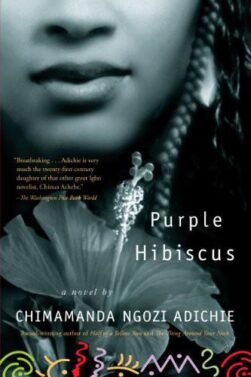
Purple Hibiscus is a coming-of-age story narrated by fifteen-year-old Kambili Achike, who lives in a wealthy but oppressive household in Nigeria. Her life is governed by her father, Eugene (Papa), a fanatically religious and strictly disciplined man who uses violence to enforce Catholic perfection within his family. The narrative explores the contrast between the rigid, silent world of Kambili’s home in Enugu and the liberated, intellectually vibrant atmosphere of her Aunty Ifeoma’s home in Nsukka. Through her exposure to her traditionalist grandfather, Papa-Nnukwu, and the progressive Father Amadi, Kambili begins to find her own voice and witness the literal and metaphorical “cracking” of her father’s control.
Plot
The novel follows a non-linear structure that begins with a climax on Palm Sunday, when the domestic stability of the Achike family shatters.
- Beginning (The Breaking of the Figurines): The story opens with Jaja (Kambili’s brother) refusing to go to communion. In a rage, Papa flings a missal that misses Jaja but breaks Mama’s cherished ceramic figurines, signaling that “things started to fall apart”.
- The Past (Before Palm Sunday): The narrative flashes back to describe the family’s strict life under Papa, who is a wealthy factory owner and publisher of the pro-democracy newspaper, the Standard. Despite his public image as a hero of human rights, he physically abuses Mama, Kambili, and Jaja for perceived religious failings, leading to Mama suffering miscarriages.
- Nsukka and the Awakening: During a trip to Nsukka to visit Aunty Ifeoma, Kambili and Jaja are exposed to a world where laughter and questioning are encouraged. Kambili falls in love with Father Amadi, a young priest who helps her shed her silence. Jaja becomes fascinated by Aunty Ifeoma’s purple hibiscuses, which symbolize a new kind of freedom.
- Climax and Resolution: After returning home, the tension between Papa’s control and the children’s newfound independence culminates in Papa nearly killing Kambili in a beating. Eventually, the political climate worsens and Papa’s editor, Ade Coker, is assassinated by a letter bomb. In the novel’s final act, Mama poisons Papa’s tea, leading to his death. Jaja takes the blame to protect Mama and is imprisoned.
- The Present: Almost three years later, Jaja is about to be released from prison following a change in the Nigerian government. Kambili and Mama await his return with a cautious sense of hope for the future.
Setting
- Enugu, Nigeria: The primary location of the Achike family’s lavish but stifling estate, characterized by high compound walls topped with electric wires.
- Abba: The family’s hometown visited during Christmas, where the divide between Papa’s colonial Catholicism and Papa-Nnukwu’s traditionalism is most evident.
- Nsukka: A university town where Aunty Ifeoma lives in a small, cramped flat. It is a space of intellectual discourse, academic struggle, and the birthplace of the defiant purple hibiscuses.
- Political Context: Post-colonial Nigeria during a period of military coups, government corruption, and civil unrest, which directly impacts the characters’ safety and freedom.
Themes
- Religion and Faith: The conflict between Papa’s rigid, Western-centric Catholicism and Papa-Nnukwu’s traditional Igbo spirituality. Aunty Ifeoma and Father Amadi represent a middle ground that embraces both faith and culture.
- Freedom and Defiance: Jaja’s journey is defined by his transition from obedience to defiance, mirrored by the experimental purple hibiscuses that represent a “freedom to be”.
- Silence vs. Voice: Kambili begins as a character who can only speak in whispers or through an “asusu anya” (language of the eyes) with Jaja, eventually learning to speak and laugh aloud in Nsukka.
- Colonialism and Identity: Papa is described as a “colonial product” who views everything indigenous as “pagan” or “heathen,” even preferring to speak with a British accent to white clergy.
- Domestic Violence and Power: The private terror of the Achike household contrasts with Papa’s public charity, highlighting the complexity of abuse and the corruption of patriarchal power.
Characters
Major Characters
- Kambili Achike: The 15-year-old protagonist and narrator. Quiet and observant, she seeks her father’s approval while struggling to find her own identity.
- Jaja (Chukwuka) Achike: Kambili’s 17-year-old brother. He is the first to openly defy Papa and eventually sacrifices his freedom by taking the blame for Papa’s murder.
- Papa (Eugene Achike): A complex antagonist; he is a wealthy businessman and philanthropist who is also a religious zealot and a violent domestic abuser.
- Aunty Ifeoma: Papa’s sister and a widowed university professor. She provides a nurturing, liberal environment for her children and her niece and nephew.
- Father Amadi: A young, handsome priest in Nsukka. He encourages Kambili to be herself and becomes the subject of her first romantic feelings.
- Mama (Beatrice Achike): Kambili’s mother, who suffers quietly under Papa’s abuse until she finally poisons him to save her children and herself.
Minor Characters
- Papa-Nnukwu: Papa and Ifeoma’s father, a “traditionalist” whom Papa rejects as a “pagan”.
- Amaka, Obiora, and Chima: Aunty Ifeoma’s children. Amaka is a sharp-tongued artist, Obiora is intellectually precocious, and Chima is the youngest.
- Ade Coker: The brave editor of the Standard who is killed for his political activism.
- Father Benedict: The white British priest at St. Agnes who supports Papa’s rigid religious views.
Literary Devices
- Symbolism:
- Purple Hibiscus: Represents freedom, defiance, and the possibility of a different way of living.
- Ceramic Figurines: Symbolize Mama’s submissiveness and the fragile peace of the house; their breaking marks the end of Papa’s control.
- Tea (“Love Sips”): A metaphor for Papa’s painful and destructive version of love.
- Allusion: The opening line, “Things started to fall apart,” is an allusion to Chinua Achebe’s novel Things Fall Apart.
- Foreshadowing: The frequent mentions of Papa’s tea and the sound of Mama polishing the figurines foreshadow the eventual poisoning and the breaking of the family structure.
- Simile and Metaphor: Adichie uses vivid imagery, such as comparing Papa’s smile to a “coconut with the brilliant white meat inside” or Nigeria to a “Big Man with the spindly legs of a child”.
- Non-linear Structure: The use of flashbacks (“Before Palm Sunday”) allows the reader to understand the weight of the silence and abuse that leads to the climactic events.