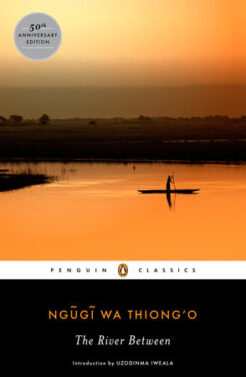
Ngũgĩ wa Thiong’o’s novel The River Between is a tragic exploration of a community divided by the arrival of colonialism and Christianity, centered on a young leader’s failed attempt to bridge two irreconcilable worlds,.
Summary of the Novel
The story is set in the ridges of Kameno and Makuyu in Kenya, which are separated by the Honia River,. The ridges have a long-standing rivalry over spiritual leadership,. Chege, an elder and descendant of the seer Mugo wa Kibiro, takes his son Waiyaki to a sacred grove to reveal an ancient prophecy: a savior will arise from their lineage to lead the people against the “white man” who will come like “butterflies”. Chege sends Waiyaki to the Siriana Mission to learn the white man’s wisdom while remaining true to tribal secrets,.
Tension escalates when Muthoni, the daughter of the fanatical Christian leader Joshua, decides to undergo female circumcision to become a “real woman” in the eyes of the tribe,. Her father disowns her, and she eventually dies from medical complications following the rite,. Her death sparks a total break between the Christians in Makuyu and the traditionalists in Kameno.
Following the split, the mission schools expel children of “pagan” parents. Waiyaki leads a massive independent school movement, founding Marioshoni and becoming a revered figure known as “The Teacher”,. However, he becomes so obsessed with education that he fails to see the rising political danger from Kabonyi, who forms the Kiama, a secret society dedicated to tribal purity.
Waiyaki falls in love with Nyambura, Joshua’s other daughter, who is uncircumcised,. Kabonyi and his son Kamau use this relationship to brand Waiyaki a traitor for breaking his oath to the tribe. In the final scene, Waiyaki attempts to preach unity to a massive gathering at the Honia River, but the crowd, manipulated by Kabonyi, demands he be judged for his “betrayal” with Nyambura. The novel ends with the couple handed over to the Kiama as the two ridges remain hidden in darkness,.
Setting
- The Two Ridges (Kameno and Makuyu): Represent the physical and ideological divide; Kameno is the home of tradition, while Makuyu becomes the stronghold of the new Christian faith,.
- The Honia River: Meaning “cure” or “bring-back-to-life,” it is the “soul” of the ridges, joining them together even as they remain antagonists,.
- Historical Context: Set during the early 20th century in Gikuyu country, Kenya, during a period where the British colonial religious infrastructure attempted to eradicate traditional rites.
Themes
- Tradition vs. Christianity: The central conflict involves the collision of the Gikuyu way of life (specifically the rite of circumcision) with Western religious doctrine,.
- Unity and Division: Waiyaki’s ultimate goal is to bridge the “gulf” between the ridges, but he discovers that education alone cannot heal the political and religious rifts.
- The Role of Education: While seen by some as “magic” to defeat the white man, education is also shown to be a tool that can alienate an individual from their roots.
- Betrayal: The novel explores what it means to be a “traitor” to one’s community, as both Muthoni and Waiyaki are condemned for trying to live in two worlds at once.
Major and Minor Characters
- Waiyaki: The protagonist, a “Messiah” figure who seeks to save the tribe through education,. He is torn between the prophecy of his father and his love for Nyambura,.
- Joshua: The antagonist of the traditionalists; a rigid Christian convert who Views his tribe’s ways as “pagan” and “evil”.
- Kabonyi: The antagonist of Waiyaki; a former Christian who breaks away to lead the Kiama. He is motivated by jealousy and a desire for political power.
- Muthoni: A “rebel” who dies attempting to reconcile her Christian faith with her desire for tribal initiation.
- Nyambura: Joshua’s daughter who loves Waiyaki. She represents a “religion of love” that transcends the strictness of her father and the Kiama,.
- Chege: Waiyaki’s father, a weary prophet and elder who represents the “ancient wisdom” of the ridges,.
- Kinuthia: Waiyaki’s loyal friend who warns him about Kabonyi’s plots.
- Kamau: Kabonyi’s son and Waiyaki’s rival, who harbors deep malice and helps orchestrate Waiyaki’s downfall,.
Literary Devices
- Symbolism:
- The Honia River: Symbolizes the life-force and potential for reconciliation,.
- The Sacred Grove/Fig Tree: Represents the permanence and holiness of Gikuyu traditions,.
- Butterflies: A metaphor used in the prophecy to describe the seemingly fragile but invasive white settlers,.
- Foreshadowing: The ancient prophecy of Mugo wa Kibiro sets a tone of inevitable conflict and the rise of a savior,.
- Allegory: The introduction notes the use of Plato’s Cave as an allegory for a society chained in darkness, struggling to see the light of new ideas.
- Biblical Parallelism: Joshua is often compared to the Biblical Job or a “soldier of Christ,” while Waiyaki is seen as a black Messiah.