Summary
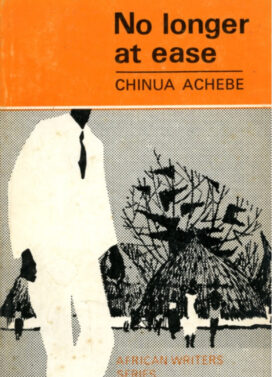
No Longer at Ease follows the story of Obi Okonkwo, a young Nigerian who returns to his country in the 1950s after receiving a Western education in England on a scholarship provided by the Umuofia Progressive Union (UPU). Upon his return, Obi secures a prestigious “European post” in the civil service as the Secretary to the Scholarship Board. Despite his initial high ideals and vow to resist the systemic corruption of the Nigerian bureaucracy, he finds himself overwhelmed by the financial pressures of his social status, the demands of his family, and his debt to the UPU. His personal life collapses when he falls in love with Clara, an osu (outcast), leading to a bitter conflict with his parents and his community. Ultimately, crushed by debt and emotional loss, Obi abandons his principles, begins accepting bribes, and is eventually caught and tried.
Plot
- The Trial: The novel opens in media res with Obi standing trial in a Lagos court for accepting a twenty-pound bribe, leaving those who knew his “brilliant promise” confused by his fall.
- Return to Nigeria: The narrative flashes back to Obi’s return from England after four years. He is celebrated by the UPU but immediately feels a disconnect between his idealistic views and the reality of Lagos life.
- Forbidden Romance: On the voyage home, Obi reconnects with Clara, a nurse. Their relationship deepens in Lagos, but she eventually reveals she is an osu, a member of a forbidden caste.
- Financial Strain: Obi moves into a luxury flat in Ikoyi and buys a car, but he struggles to pay for insurance, taxes, and his brother’s school fees while sending money home to his parents and repaying the UPU.
- Social and Family Conflict: The UPU and Obi’s father, Isaac Okonkwo, a devout Christian, vehemently oppose his marriage to Clara. His mother, Hannah, threatens to kill herself if he marries an osu while she is alive.
- The Downward Spiral: Clara becomes pregnant, and Obi pays for a secret, illegal abortion that leads to her hospitalization and their eventual breakup. Shortly after, Obi’s mother dies, and his grief is compounded by his inability to attend her funeral due to lack of funds.
- The Fall: Numbed by his losses and desperate for money, Obi begins accepting bribes from scholarship applicants. He is eventually caught in a police sting operation, bringing the story back to the opening trial.
Setting
The novel is primarily set in Nigeria during the late 1950s, a period just before the country gained independence from British colonial rule. The action shifts between:
- Lagos: A bustling, divided city. It features the “European” reserve of Ikoyi, characterized by luxury and silence, and the crowded, noisy slums of the mainland where the majority of the population lives.
- Umuofia: Obi’s ancestral village in the Eastern Region, representing traditional Igbo culture and the roots of the community’s expectations.
Themes
- Corruption: The novel explores how systemic bribery becomes a necessity for those caught in the gap between low wages and high social expectations.
- Tradition vs. Modernity: Obi represents the “Been-to” generation, caught between Western education/individualism and the communal, traditional values of his people (such as the osu taboo).
- Identity and Alienation: Obi feels like a stranger in both England and Nigeria, unable to fully belong to either the old world of his parents or the new world of the corrupt elite.
- The Burden of the Elite: The sources highlight the “ordeal” of the educated class, who are expected to support their entire extended community while maintaining a Western standard of living.
Characters
Major Characters
- Obi Okonkwo: The protagonist; an idealistic, Western-educated civil servant whose moral decline forms the core of the story.
- Clara Okeke: An osu nurse who loves Obi but is realistic about the social barriers preventing their marriage.
- Isaac Okonkwo: Obi’s father; a retired Christian catechist who rejects his own father’s “heathen” ways but cannot accept the osu marriage.
- Hannah Okonkwo: Obi’s mother; she shares a deep bond with Obi but uses a suicide threat to prevent his marriage to Clara.
Minor Characters
- Joseph Okeke: Obi’s childhood friend in Lagos who represents a more pragmatic, “bush” perspective on Nigerian life.
- Christopher: Obi’s friend, a London School of Economics graduate who serves as a cynical, realistic foil to Obi’s idealism.
- Mr. Green: Obi’s English boss; a hardworking but prejudiced colonial officer who believes Africans are “corrupt through and through”.
- The President of the UPU: The leader of the Umuofia Progressive Union in Lagos, who oversees Obi’s scholarship and his moral conduct.
- Hon. Sam Okoli: A popular and wealthy Minister of State who represents the glamorous, albeit sometimes corrupt, political elite.
- Marie Tomlinson: Mr. Green’s English secretary who becomes a friend and confidante to Obi.
Literary Devices
- Non-Linear Narrative: The book uses a flashback structure, starting with the trial to establish a sense of inevitable tragedy before explaining how Obi reached that point.
- Epigraph: The novel begins with a quote from T.S. Eliot’s “The Journey of the Magi,” symbolizing the discomfort of those who return to their old homes after a life-changing experience.
- Proverbs: Achebe uses traditional Igbo proverbs (e.g., “if you want to eat a toad you should look for a fat and juicy one”) to illustrate the cultural wisdom and the clash of values.
- Irony: There is deep situational irony in the fact that the UPU, which spent money to make Obi a “man of promise,” ultimately contributes to the financial pressure that leads to his downfall.
- Symbolism: The “two cities” of Lagos symbolize the dual identity of the nation, and the story of the “Sacred He-Goat” represents the disruptive impact of Western religion on traditional village life.