Summary
Half of a Yellow Sun is a narrative that follows the lives of five major characters before and during the Nigerian Civil War in the 1960s. The story centers on Ugwu, a village boy who becomes a houseboy for a radical professor; Olanna and Kainene, twin sisters from a wealthy and influential Lagos family; Odenigbo, an intellectual revolutionary at the University of Nigeria, Nsukka; and Richard, an English writer who falls in love with Kainene and the burgeoning nation of Biafra. The novel contrasts the hope and intellectual fervor of post-independence Nigeria with the brutal reality of the 1967–1970 conflict. As the war progresses, the characters are forced to abandon their lives of privilege and academic debate for a desperate struggle against starvation, air raids, and the loss of loved ones. Through their intertwined experiences, the book explores themes of ethnic identity, personal and national betrayal, and the resilience of the human spirit amidst mass violence.
Plot
In the early 1960s, Ugwu begins working for Odenigbo, a mathematics professor in the university town of Nsukka. Olanna soon leaves her glamorous life in Lagos to live with Odenigbo, while her twin sister, Kainene, manages their father’s businesses and begins a relationship with Richard, a shy British expatriate. Their personal lives are complicated by infidelity: Odenigbo’s mother tricks him into sleeping with a village girl, Amala, who becomes pregnant, leading a hurt Olanna to have a brief retaliatory affair with Richard. Despite these betrayals, Olanna and Odenigbo reconcile and eventually adopt Amala’s daughter, whom they call Baby.
The political situation in Nigeria deteriorates as ethnic tensions lead to two military coups and the horrific massacre of Igbos in the North, which both Olanna and Richard witness. The Eastern Region secedes to form the Republic of Biafra, and the characters are swept up in the patriotic fervor of the new nation. However, the Nigerian army quickly advances, forcing the group to evacuate Nsukka and flee to Umuahia and later Orlu.
As the war drags on, the blockade leads to widespread starvation and disease, particularly kwashiorkor among children. Ugwu is eventually conscripted into the Biafran army, where he experiences the trauma of combat and commits a disturbing act of violence before being severely wounded in an explosion. Near the war’s end, Kainene disappears after crossing enemy lines to trade for food. After Biafra’s surrender, the surviving characters return to a looted Nsukka and continue a painful, unresolved search for Kainene, whose disappearance remains a symbol of the war’s lasting scars.
Setting
The novel is primarily set in post-colonial Nigeria and the short-lived Republic of Biafra. Key locations include:
- Nsukka: A university town representing intellectual idealism and the initial fervor for independence.
- Lagos: The site of wealth, political maneuvering, and high-society parties.
- Kano: A city in the North where the horrific massacres of Igbos occur, changing the course of the characters’ lives.
- Umuahia and Orlu: Wartime settlements that highlight the progression of the war from organized resistance to a humanitarian crisis marked by refugee camps and kwashiorkor.
Themes
- Identity and Tribalism: The novel explores how the colonial creation of Nigeria forced disparate groups into a fragile unity. Characters grapple with their identity as either “Nigerians” or “Igbos/Biafrans”.
- The Brutality of War and Starvation: Adichie emphasizes that starvation was used as a weapon, leading to the widespread death of children.
- Social Class and Inequality: The disparity between the “book people” (intellectuals) and the servants or rural poor is evident in how they experience both peace and war.
- The Role of the Western Outsider: Through Richard and various journalists, the book critiques the Western gaze, which often reduced the conflict to “ancient tribal hatreds” or focused on the lives of white expatriates over black victims.
- Love and Forgiveness: Personal infidelities mirror the national betrayals, yet the characters’ ability to reconcile highlights human resilience.
Characters
Major Characters
- Ugwu: Initially an uneducated thirteen-year-old village boy from Opi, he becomes the loyal houseboy for Odenigbo in Nsukka. Throughout the story, he demonstrates “innate intelligence,” eventually becoming a teacher and a soldier in the Biafran army.
- Odenigbo: A radical mathematics professor at the University of Nigeria, Nsukka, known for his revolutionary socialist views and fierce intellectual debates. He is Olanna’s partner and the biological father of Baby.
- Olanna: The beautiful and idealistic daughter of Chief Ozobia, a wealthy Lagos businessman. She abandons her life of privilege to live with Odenigbo in Nsukka and becomes a sociology instructor. She is the emotional anchor of her family during the war.
- Kainene: Olanna’s twin sister, described as cynical, sardonic, and highly successful in business. During the war, she runs a refugee camp in Orlu and displays pragmatic compassion before disappearing while trading across enemy lines.
- Richard Churchill: A shy British expatriate and writer who falls in love with Kainene and Biafra. Fascinated by Igbo-Ukwu art, he eventually works for the Biafran Propaganda Directorate.
Minor Characters
- Baby (Chiamaka): The daughter of Odenigbo and Amala, she is adopted and raised by Olanna.
- Amala: A village girl and Odenigbo’s mother’s housegirl; Odenigbo’s mother tricks him into sleeping with her, leading to the birth of Baby.
- Odenigbo’s Mother (Mama): A traditional woman from Abba who strongly opposes Odenigbo’s relationship with Olanna, viewing her as a “witch” due to her Western education.
- Major Madu: A childhood friend of Kainene and a high-ranking officer in the Biafran army. He shares a complex, intimate history with Kainene, which often sparks jealousy in Richard.
- Mohammed: Olanna’s former boyfriend in Kano, a handsome and gentle man from a line of “holy warriors” who remains a loyal friend to her.
- Arize: Olanna’s bubbly and affectionate cousin in Kano who is murdered alongside her husband and parents during the 1966 massacres.
- Harrison: Richard’s houseboy, who takes immense pride in his ability to cook “foreign recipe” dishes like beet salad and rhubarb crumble.
- Jomo: Odenigbo’s gardener who claims to be a great hunter and has a rivalry with Harrison.
- Miss Adebayo: A sharp-tongued Yoruba lecturer and a member of Odenigbo’s intellectual circle.
- Okeoma: A talented poet and friend of Odenigbo who dies as a commando during a mission to recapture Umuahia.
- Professor Ezeka: A supercilious Nsukka academic who later becomes the Biafran Director for Mobilization.
- Alice: A reclusive neighbor in Umuahia and a talented pianist who carries deep trauma from a past relationship and the loss of her family in Asaba.
- Mrs. Muokelu: A robust and fearless primary school teacher who becomes Olanna’s friend and later an “attack trade” merchant.
- Chief Ozobia and Mrs. Ozobia: Olanna and Kainene’s parents; Chief Ozobia is a wealthy, corrupt businessman who flees to London during the war.
- Susan Grenville-Pitts: Richard’s former British girlfriend in Lagos who holds condescending, colonial-era views of Nigeria.
- High-Tech: A young, hardened child soldier who specializes in “reconnaissance missions” and serves in Ugwu’s unit.
- Special Julius: An army contractor and flamboyant friend of Odenigbo known for providing supplies and forged passes.
- Professor Ekwenugo: A scientist in the Research and Production Directorate who is killed by his own land mines.
- Dr. Patel: An Indian lecturer at Nsukka and a regular guest at Odenigbo’s house.
Literary Devices
- Non-linear Narrative: The alternating timeline heightens the tragedy by showing the characters’ vibrant pasts just as the reader witnesses their bleak present.
- Book-within-a-Book: Excerpts from “The World Was Silent When We Died” provide historical and political context. While initially attributed to Richard, the ending reveals that Ugwu is the true author, reclaiming the right of the African to tell their own story.
- Symbolism:
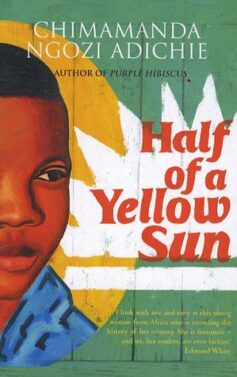
- Half of a Yellow Sun: The Biafran flag symbol represents a glorious, albeit fleeting, future.
- The Roped Pot: An Igbo-Ukwu bronze symbolizing the deep, sophisticated history of the region that predates colonial contact.
- Imagery: Adichie uses stark, visceral imagery to describe the physical toll of war, such as the “ashen tone” of skin and “toothpick” limbs of starving children.