Summary
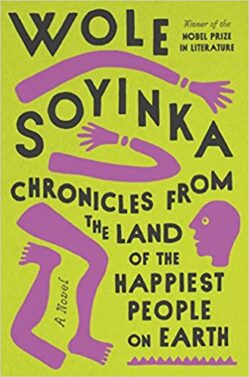
The novel is a scathing satire set in a fictionalized version of modern-day Nigeria, ironically branded the “Land of the Happiest People on Earth”. The narrative explores the systemic rot of a society where institutionalized corruption, political maneuvering, and a gruesome trade in human body parts euphemistically termed “Human Resources” flourish under the guise of religious and nationalistic fervor. At its core, the story follows the tragic dismantling of the “Gong of Four,” a group of once-idealistic friends whose bond is destroyed by a society that has commodified the human form. Soyinka uses this landscape to expose how both the pulpit and the corridors of power are leveraged to mask a predatory culture of greed and betrayal.
Plot
The plot is initiated when Dr. Kighare Menka, a surgeon, is approached by a business combine looking to expand their “Human Resources” trade: a network marketing human organs for ritual and commercial purposes. Menka shares this horrifying discovery with his lifelong friend, Duyole Pitan-Payne, a brilliant engineer poised to join the United Nations Energy Commission. As Duyole prepares for his relocation, he discovers that his own son, Damien, has been recruited into the organ trade and has turned Duyole’s Badagry factory into a hub for the “Codex” transactions.
Before Duyole can expose the full extent of the network, he is assassinated by a bomb in his studio. He is flown to Salzburg for emergency surgery but dies there, leading to a bitter conflict between his opportunistic siblings and his widow over whether his body should return to Nigeria. Dr. Menka eventually succeeds in bringing Duyole’s body back to Badagry for a final resting place. The novel concludes with a confrontation between the Prime Minister, Sir Goddie, and the religious leader Papa Davina, revealing that Davina is actually Farodion, the fourth member of the Gong of Four. Farodion is revealed as the mastermind behind the organ trade, having betrayed his friends to build a morbid commercial empire.
Setting
- Lagos and Badagry: The primary urban settings, representing the chaotic heart of commerce and the site of Duyole’s Millennium Towers.
- Abuja (Villa Potencia): The seat of political power where Sir Goddie orchestrates national “happiness” while managing deep-seated corruption.
- Jos and Gumchi: The temperate northern highlands and Menka’s natal village, which is discovered to sit atop a seam of gold.
- Salzburg, Austria: The location of Duyole’s university days and the site of his eventual death and contentious first burial.
Themes
- The Commodification of Humanity: The literal trade in human body parts (“Human Resources”) serves as a metaphor for the ultimate stage of societal greed.
- Political and Religious Hypocrisy: Leaders like Sir Goddie and Papa Davina use the branding of “happiness” and ecumenical faith as a smokescreen for predatory activities.
- Betrayal of Idealism: The collapse of the Gong of Four represents the failure of youthful dreams of “giving back” when confronted with a corrupted national character.
- Truth vs. “Branding”: The novel highlights how reality is constantly manipulated by “image-makers” and “Fake News” to preserve the status quo.
Characters
Major Characters
- Duyole Pitan-Payne: A brilliant, gregarious engineer and central figure of the Gong of Four who is murdered for uncovering his son’s involvement in the organ trade.
- Dr. Kighare Menka: A principled northern surgeon and national award winner who investigates the “meat mall” and fights to bring Duyole’s body home.
- Papa Davina (Farodion): The ultimate antagonist; a member of the Gong of Four who fakes his disappearance to build a morbid business empire disguised as a spiritual ministry.
- Sir Godfrey Danfere (Sir Goddie): Known as “The Presence” or “The People’s Steward,” a manipulative and ruthless Prime Minister.
Minor Characters
- Badetona: A member of the Gong who suffers a mental breakdown after witnessing a ritual decapitation.
- Damien: Duyole’s son, a “prodigal” who is recruited by Farodion to facilitate the organ trade within his father’s company.
- Bisoye: Duyole’s loyal widow who is marginalized by his biological family after his death.
- Kikanmi & Teahole: Duyole’s siblings who prioritize family prestige and “Family Honour” over his final wishes.
- Otunba Pitan-Payne: The eccentric, status-conscious patriarch of the Pitan-Payne family.
- Godsown: Duyole’s devoted steward who eventually flees the family home due to the “fire ants” of corruption.
Literary Devices
- Satire: The central device used to critique the farcical nature of governance and religion in a society that ignores rampant atrocities.
- Irony: Duyole is killed by a bomb disguised in a gift, and his “Millennium Towers” becomes a warehouse for “human remains”.
- Symbolism: The four-headed Benin gong represents the lost unity of the four friends and the four elements of the land.
- Foreshadowing: Dr. Menka’s nickname “Absent-Minded Butcher” (AMB) serves as a dark precursor to the organ harvesting themes.
- Cryptic Coding: The Codex Seraphinianus and the “Medina” system represent the sophisticated, technological layer of modern crime.