
Table of Contents
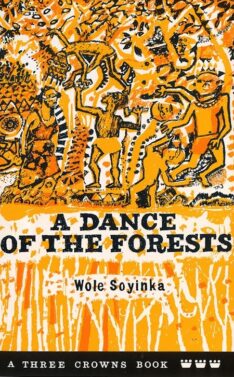
Wole Soyinka’s A Dance of the Forests is a complex, multi-layered play that was first performed in 1960 as part of the Nigerian Independence Celebrations. The play serves as a profound critique of the tendency of new nations to romanticize their past while ignoring the repetitive patterns of human cruelty and failure. The central dynamic of the work is a conflict between the desire of the dead for judgment and the desire of the living to avoid it, all while being manipulated by the mysterious Forest Father.
The Frame Story: The Gathering of the Tribes
The play begins during a major festivities referred to as the “Gathering of the Tribes,” which serves as an analogue for Nigerian Independence. The human community, led by figures like the Old Man, decides that they must invite their “illustrious ancestors” to participate in this historical moment of rejoicing. They ask the spirits of the forest to send them great forebears warriors, sages, and builders of empires hoping to “drink from their resurrected glory”.
However, the spirits, specifically Aroni the Lame One, choose to send two “restless dead” who are not the idealized figures the townspeople expected. These ancestors, known simply as the Dead Man and the Dead Woman, push their heads up from the “understreams” of the earth, appearing as mouldy, bloated, and “obscenity”-like figures rather than glorious heroes. The townspeople are horrified by their arrival and immediately attempt to drive them out, shunning them as “unpleasant looking” mad creatures.
The Living Protagonists and the “Dream Count” of Sin
Forest Father, masquerading as a human named Obaneji, selects four specific living people to follow him into the forest to confront their true selves and their links to these dead guests. Each of these characters represents a different facet of the contemporary society’s moral failings:
- Demoke the Carver: A man of immense talent who was elected to carve the “totem” for the Gathering of the Tribes. However, his creative act is marred by violence; he carved the totem from a sacred araba tree belonging to the spirit Oro. Because he suffered from “giddiness” at heights, he plucked his apprentice, Oremole, down to his death when the apprentice mocked him for being “tied to earth”. Demoke is a servant of Ogun, the god of iron and carvers, who protected him during this act of sacrilege.
- Rola (Madame Tortoise): A beautiful and wealthy courtesan who is described as a “whore” who “drains the life from men”. She is notorious for driving her lovers to madness and self-destruction, yet she remains utterly unrepentant, claiming to be the “master of her fate”.
- Adenebi the Court Orator: A man obsessed with “accumulated heritage” and the “glory” of ancient empires like Mali and Songhai. Despite his lofty rhetoric, he is revealed to be a man of weak character who is “oblivious to the real presence of the dead”.
- Obaneji (Forest Head): Initially appearing as a “Senior Clerk” for the courts who keeps records of human crimes, he is actually the Forest Head in disguise, leading the others toward a judgment they do not relish.
The Incinerator and Corporate Corruption
While in the forest, the characters engage in a revealing conversation about the modern world’s moral decay. Obaneji recounts the story of a passenger lorry called the “Incinerator”. The lorry was originally built to carry forty men, but a council official took a “substantial bribe” to change its legal capacity to seventy. Consequently, when the lorry overturned and caught fire, sixty-five souls were burnt to death because it was “dry and brittle” in the Harmattan season. This story serves as a contemporary mirror to the ancient crimes they are about to face, illustrating that the “small-time murderer” of today is no different from the executioners of the past.
Part Two: The Court of Mata Kharibu
The play shifts back eight centuries to the Court of Mata Kharibu, where the historical identities of the protagonists are revealed. In this past life, the characters were involved in a cycle of violence and blood that mirrors their current circumstances:
- The Dead Man was a Captain in the army of Mata Kharibu. He is the play’s moral anchor, a man who refused to lead his men into an unjust war. The war was being fought merely to recover the “trousseau” of a queen who had been stolen from another chieftain. The Captain argued that a leader should “turn the unnatural pattern of men always eating up one another” and refused to waste his soldiers’ lives for a “stranger”.
- The Dead Woman was the Captain’s wife, who was pregnant at the time.
- Madame Tortoise (Rola) was the queen whose “capricious” nature drove the conflict. She treated the Captain and his wife with fiendish cruelty when the Captain spurned her sexual advances.
- The Historian (Adenebi) was the court official who justified the war, arguing that “nations live by strength” and that the cause of war is irrelevant as long as it provides “the Destiny” of greatness.
- The Court Poet (Demoke) was a man who, like his modern counterpart, was “eager to earn the good graces” of the queen and allowed his apprentice (the Novice) to fall to his death from a dangerous roof.
Because of the Captain’s refusal to fight, Mata Kharibu and the Historian labeled him a traitor. At the urging of the Physician, they decided not to execute him but instead sold him and his men into slavery to a slave-dealer who promised to transport them in a vessel that was a “true palace” but actually a “slight coffin” of torment. The Captain’s wife was left in despair, and the “hundred generations” of her pregnancy began there as she sought a chance for the “living to save” her.
The Welcome of the Dead and the Spirits of the Future
The climax of the play is a cosmic ritual known as the “Welcome of the Dead,” presided over by Forest Head. During this ritual, various forest spirits are summoned to “chorus the Future” through the possessed bodies of the living protagonists:
- The Spirit of the Palm speaks of a future where the palm will “course red” with blood.
- The Spirit of Precious Stones laments being a “traitor to the guardian tribe” as men strip the earth for gold and diamonds.
- The Spirit of the Rivers warns that men will “stain my bowels red” from Limpopo to the Nile.
- The Ant Leader represents the “ever legion of the world,” the nameless victims who are “tread underfoot” whenever nations build with “tombstones” in the name of progress.
The most terrifying figures in this ritual are The Triplets, who represent the perversions that occur when humans acquire power over one another:
- The First Triplet is “The End” that justifies any means.
- The Second Triplet is “The Greater Cause,” which excuses the “crimes of today for tomorrow’s mirage”.
- The Third Triplet is “Posterity,” a fanged and bloody creature nourished on the “milk” of human suffering.
The Half-Child and the Dance of Sacrifice
The ritual focuses on the Half-Child, the spirit of the Dead Woman’s unborn son. The child plays a game of ‘sesan’ with a Figure in Red (Eshuoro in disguise), who represents the cycle of doom and the “branded womb” of history. The child is tossed between spirits in a “furious” game that resembles a “dance of the child acrobats”.
Eshuoro, the wayward spirit of the araba tree, seeks to claim the child as vengeance for the desecration of his forest. Ogun, however, intervenes to protect Demoke and the child. In a moment of crucial choice, Demoke dashes forward to intercept the child and eventually restores it to the Dead Woman, defying the “encrustations of soul-deadening habit”.
As a final act of expiation, Demoke is forced by Eshuoro’s Jester to undergo a “Dance of the Unwilling Sacrifice”. He is made to climb his own totem while a sacrificial basket is clamped to his head. Eshuoro sets fire to the tree, and Demoke falls, only to be caught and saved by Ogun.
Conclusion: Dawn and the Path of Expiation
As dawn breaks, the forest spirits flee, and the human characters are left in a clearing, exhausted and changed. The Old Man and Agboreko find them, and they realize they have “paid dearly for this wisdom newly acquired”. Rola appears “chastened,” and Demoke reflects that the lightning of the night has “seared us through the head,” ending her identity as “Madame Tortoise”.
The play ends with the characters reflecting on their ordeal in a series of cryptic verses. They have “felt enough for the memory of our remaining lives,” having been forced to see the “mirror of original nakedness” provided by Forest Head. Though Forest Head despairs that his labors will effect any “real improvement in human conduct,” the characters emerge from the forest with a newfound awareness of the “secrets of Earth” and the weight of their historical inheritance.