Table of Contents
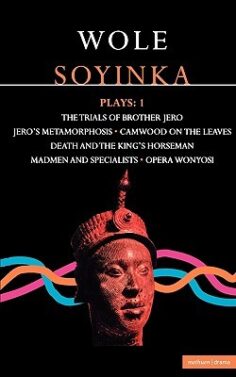
Wole Soyinka’s Six Plays offers a representative range of his dramatic work spanning twenty years, exploring themes of religious charlatanism, the aftermath of war, and the tension between colonial rule and indigenous tradition.
The Trials of Brother Jero
- Summary: A classic comedy of modern Nigerian life that satirizes religious hypocrisy through a “Beach Divine” who uses manipulation to maintain his following.
- Plot: The prophet Jeroboam (Jero) narrates an eventful day in which he narrowly escapes the “curse” of his old mentor. He is hounded by Amope, a relentless trader to whom he owes money for a velvet cape. To distract his assistant, Chume (who is Amope’s husband), from realizing Jero is the debtor, Jero finally grants Chume permission to beat his nagging wife. However, Chume eventually realizes Jero is the man his wife has been pestering for money and, suspecting the prophet of adultery, chases him with murderous intent.
- Setting: A fishing village and the Bar Beach in Nigeria.
- Themes: Religious charlatanism, hypocrisy, and the manipulation of the vulnerable.
- Characters:
- Major: Brother Jeroboam (a smooth-talking prophet) and Chume (his assistant).
- Minor: Amope (Chume’s wife), Old Prophet (Jero’s mentor), a Member of Parliament, and various worshippers.
- Literary Devices: Satire of religious institutions, use of Pidgin English to denote social class, and parables.
Jero’s Metamorphosis
- Summary: A sequel to the first Jero play, this comedy follows Jero as he attempts to institutionalize his beach ministry into a more powerful organization.
- Plot: Jero, now established in a comfortable office, learns that the Tourist Board intends to reclaim the beach for public executions. To preserve his territory, he invites rival beach prophets to form a united “Army of the Lord”. He uses a confidential file provided by his secretary, Sister Rebecca as a “secret weapon” to blackmail officials and ensure his new religious army receives official recognition.
- Setting: Brother Jero’s office and headquarters.
- Themes: Institutional corruption, the pursuit of power, and religious militarism.
- Characters:
- Major: Brother Jeroboam and Sister Rebecca.
- Minor: Chume (now a Salvation Army corporal), Ananaias, Shadrach, Caleb, and Isaac (beach prophets).
- Literary Devices: Irony (the adoption of military titles by prophets) and satire.
Camwood on the Leaves
- Summary: A haunting radio play centered on a deep-seated generational and religious conflict within a family.
- Plot: Isola, the teenage son of a strict minister, Reverend Erinjobi, has impregnated his childhood friend, Morounke. Refusing to submit to his father’s rigid religious discipline and frequent floggings, Isola flees to a hidden “chapel” in the rocks. The parents of both teenagers, joined by a mob, hunt Isola through the bush. The play concludes tragically when Isola, armed with his father’s gun to kill a predatory snake he calls “Erinjobi,” shoots his father as the Reverend enters his hiding place.
- Setting: A small Yoruba town in West Africa and the surrounding woods.
- Themes: Generational conflict, religious fanaticism, loss of innocence, and the breaking of family bonds.
- Characters:
- Major: Isola, Morounke, Reverend Erinjobi, and Moji (Isola’s mother).
- Minor: Mr. and Mrs. Olumorin (Morounke’s parents) and Bimpe (a wise maid).
- Literary Devices: Sound motifs (church bells, drums), symbolism (the “Erinjobi” snake), and flashbacks to Isola’s childhood.
Death and the King’s Horseman
- Summary: Based on real events from 1946, this play explores the metaphysical confrontation between a Yoruba tradition of ritual suicide and colonial intervention.
- Plot: Following the death of the King, his horseman, Elesin Oba, must commit ritual suicide to accompany him to the afterlife. Elesin delays the act to marry a new bride, which saps his will. Simon Pilkings, the District Officer, intervenes to stop the “criminal” act, leading to a cosmic imbalance. To save the honor of his race, Elesin’s son Olunde who had been studying medicine in England takes his father’s place and commits the suicide himself. Upon seeing his son’s corpse, Elesin finally kills himself in his cell.
- Setting: Ancient Yoruba city of Oyo, Nigeria, during the last years of colonial rule.
- Themes: Duty and honor, cultural conflict, and metaphysical transition.
- Characters:
- Major: Elesin (the King’s Horseman), Olunde (his son), Simon and Jane Pilkings (the colonial couple), and Iyaloja (Mother of the market).
- Minor: The Praise-singer, Sergeant Amusa, Joseph, and the Resident.
- Literary Devices: Parables (the Not-I bird), choral dirges, and tragic irony.
Madmen and Specialists
- Summary: Inspired by the Nigerian civil war, this play examines the dehumanization and corruption of the human spirit in a post-war society.
- Plot: Dr. Bero, a medical specialist turned intelligence officer, returns from the war and imprisons his father (the Old Man) in a cellar. The Old Man had subverted Bero’s authority by teaching wounded soldiers to “think” and introducing them to the philosophy of “As” a doctrine of absolute, unchangeable power. While Bero’s sister, Si Bero, tries to preserve a world of healing through herbalism, Bero uses his “specialist” knowledge to control and destroy. The play ends with Bero shooting his father as the Old Man attempts a mock surgery on a mendicant.
- Setting: Dr. Bero’s home and his basement surgery/cellar.
- Themes: Power and control, the brutality of war, and the corruption of science.
- Characters:
- Major: Dr. Bero, the Old Man, Si Bero, Iya Agba, and Iya Mate (two earth mothers/herbalists).
- Minor: Aafaa, Blindman, Goyi, and Cripple (mendicants), and the Priest.
- Literary Devices: Absurdist dialogue, grotesque imagery, and wordplay surrounding the concept of “As”.
Opera Wonyosi
- Summary: A modern African adaptation of The Beggar’s Opera, it portrays the “oil-boom society” of the 1970s as an amoral jungle.
- Plot: Set in an expatriate colony, the play follows the rivalry between Chief Anikura, who controls the beggars’ union, and Macheath (Mack the Knife), a charismatic bandit leader. Macheath secretly marries Anikura’s daughter, Polly, leading Anikura to blackmail Commissioner Brown into arresting Macheath. After a series of betrayals involving various mistresses, Macheath is sentenced to death. He is only saved at the last moment by a pardon from the “extraordinary courier” of the tyrannical Emperor Boky.
- Setting: A Nigerian expatriate colony in the Central African Empire.
- Themes: Societal corruption, materialism (the Wonyosi cloth), and the injustice of the judicial system.
- Characters:
- Major: Macheath, Polly Anikura, Chief Anikura, De Madam, and Commissioner Tiger Brown.
- Minor: Emperor Boky, Lucy, Prophet Jeru, and a gang of bandits.
- Literary Devices: Musical numbers (opera), satire, parody, and the breaking of the fourth wall by the Disc-Jockey (dee-jay).