
You can listen to the Book Summary Below
Table of Contents
The Sacred Origins and the Day of the First Sun
The narrative of the Kingdom of Oru is intrinsically tied to the Day of the First Sun, an era-defining event where the gods allegedly placed a drop of the sun into the cores of the people. Before this day, the continent was home to seven disparate tribes, small settlements constantly engaged in inter-tribal warfare. A legendary king sought a weapon from his High Priest to unite these tribes, leading to the discovery of a way to summon magic from the sun itself. This power, known as agbára oru (the magic of the sun), became a hereditary gift passing from mother to child, ensuring a spiritual connection to the gods that was intended to burn undyingly. However, this gift came with a vicious cost: the stripping ceremonies and the trials of the Àlùfáà (priests). To keep the sun power strong in the bloodlines of the kingdom, brave men were called to the Red Stone to return their heat energy to the gods, a sacrifice that ensured their descendants would possess the most potent magic in the land. This system created a rigid social hierarchy where the Sovereign was the firstborn of a Lord Regent, and the Holy Order of the Sun Temple maintained absolute authority over the spiritual and political life of the six rings of Oru.
The Secret Birth of the Firstborn (1313 FS)
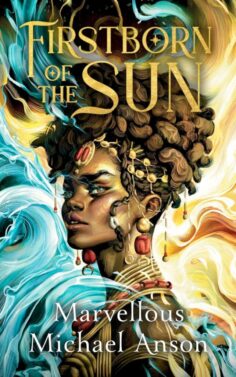
The core conflict of the story begins in 1313 FS within the Sun Temple on Royal Island. Moremi, a woman from the northern snow mountains of Òtútù who had infiltrated the temple as a handmaiden, found herself in the throes of a agonizing labor that lasted nine blood moons and one day. Moremi was the wife of the High Priest and Lord Regent, Babátúndé, but she carried a secret that threatened the very foundations of Oru. She possessed agbára òtútù, a forbidden magic of ice and shadows that the Holy Order had spent a thousand years trying to erase from existence. When the midwife declared that the child had no heartbeat and was lost, Moremi performed a desperate act of northern sorcery, calling upon the gods of her ancestors to save the infant. The baby girl, L’ọrẹ, was revived, but the midwife was horrified to see the child’s eyes they were not of the sands. Moremi realized that her child was a “glitch in a loophole,” born of a mother with ice magic and a father who had been stripped of his sun power, making her potentially the most powerful person in the land. Fearing the wrath of the Elder Priest, Àlùfáà-Àgbà, who viewed northern magic as a rot and a curse, Moremi used an illusion of ice to hide from the priests before fleeing the temple. Although Àlùfáà-Àgbà eventually hunted Moremi down and killed her, she had already placed the infant L’ọrẹ in the care of Ẹniìtàn, a priest who had defected from the Order and became known as the kingdom’s greatest “coward”.
Life in the Shadows of Ìlú-Ìmọ̀ (1330 FS)
By 1330 FS, L’ọrẹ has grown up in the second ring, Ìlú-Ìmọ̀ (the Home of Knowledge), believing herself to be the daughter of a simple royal guard who died before her birth. She lives as an outcast with Baba-Ìtàn (Ẹniìtàn) in a crumbling library-turned-house, working as his bookbinding apprentice. The people of the kingdom are forbidden from helping them, and L’ọrẹ grows up enduring scorn and stones, her true identity hidden behind a necklace that Baba-Ìtàn used to suppress her latent ice powers. Her only solace is her relationship with Prince Alawani, the son of the late King Aláàfin Ọlátúnjí and Queen Atinúkẹ́. Alawani, though a prince, is considered “no one” in the eyes of the law, as the children of a Sovereign do not inherit titles or the throne. Together, they train in the capital city’s arena, Gbàgede, under Commander Títí (Command), a woman who secretly loves L’ọrẹ and prepares her to fight for a position in the elite royal guard as a way to rise above her status as a traitor’s daughter. L’ọrẹ and Alawani share a profound bond and a blood oath, promising to choose each other over the demands of the gods and the Holy Order.
The Call and the Red Stone Trials
The fragile peace of their lives is shattered when Alawani is “called” to the Holy Order of the Sun Temple. A temple maiden named Milúà arrives in the night to deliver the summons, informing Alawani that the gods have chosen him for the trials. Despite his initial refusal and his oath to L’ọrẹ, Alawani is compelled by his father’s dying wish a promise that their bloodline would never end and the realization that a prince who rejects the call would be hunted as a coward. Milúà, who is later revealed to be the daughter of the maiden Àdùnní and possessed of the “true sight” to see agbára oru, becomes Alawani’s bound maiden. Alawani undergoes the first stripping ceremony on the Red Stone, a ritual of excruciating pain where his powerful sun magic is drained into the stone to be returned to the gods. He survives the ordeal, but he is left weakened, dehydrated, and feeling as though the very core of his soul has been dulled. Unknown to Alawani, his grandfather, Àlùfáà-Àgbà, has orchestrated the entire “call” to bypass the traditional laws of Oru and establish a permanent royal bloodline on the throne, viewing Alawani as the vessel for this new era.
The Siege of the Sun Temple
L’ọrẹ, fueled by a mixture of fury and desperation, refuses to let the Holy Order take Alawani. She confronts him in the palace while he is praying to the sacred flames, but he insists that fate has decided his path. Determined to save him, L’ọrẹ steals an ancient map of the Sun Temple from a hidden compartment under Baba-Ìtàn’s worktable and enlists the help of their friend Kíyà, whose older brother is a royal guard. They infiltrate the temple during the chaos of a public execution of “Idán mages” who had defied the crown. Inside the temple ruins, they encounter Máy wá, another chosen Àlùfáà from the third ring, who is intoxicated by the promise of glory and riches. When they find Alawani, he shockingly refuses to leave, claiming he is now Àlùfáà and bound to the Order. As the temple maidens and guards descend upon them, L’ọrẹ’s suppressed agbára òtútù erupts for the first time, creating a massive wall of ice crystals that blocks the priests’ magic. In the frantic escape, Máy wá is killed, begging L’ọrẹ with his last breath to tell his parents he died with honor on the Red Stone rather than as a deserter. L’ọrẹ, Alawani, and Kíyà flee the royal island on a stolen battle rhino, leaving behind a trail of ice and death.
The Secret Twelve and the Fifth Ring
The fugitives flee through the concentric rings of Oru, pursued relentlessly by Milúà and the royal guards. They are aided by Márùn (Five), a woman who reveals herself to be a member of the Order of the Secret Twelve, a clandestine group that has protected the true heirs of the sun since the kingdom’s founding. Márùn reveals that the Twelve exist outside the laws of the court and the Holy Order, serving only the sovereign. As they journey through the Fifth Ring (Ìlú-Oníṣọ̀nà, the Land of Artisans), L’ọrẹ is horrified to discover that the state has been turned into a dismal wasteland of prison houses and servitude where people are sent for life sentences for crimes like dabbling in old magic. Márùn eventually departs the group to return to the capital to rescue Baba-Ìtàn and Kíyà, who have been arrested and thrown into the palace dungeons by Àlùfáà-Àgbà’s guards.
Revelations of Identity at Ìlú-Idán
The group seeks refuge in the Fourth Ring (Ìlú-Idán, the Land of Magic), at the home of Àdùkẹ́ (Ìyá-Idán), an old friend and former lover of Baba-Ìtàn. It is here that the full weight of L’ọrẹ’s history is revealed. Ìyá-Idán reveals that Moremi was her best friend and that they had both been in love with Baba-Ìtàn. She explains that on the night of the transition of power eighteen first suns ago, Moremi took Ìyá-Idán’s place in the wedding bed of the new High Priest, Babátúndé. L’ọrẹ is not the daughter of a guard, but the firstborn daughter of the Lord Regent Babátúndé and Moremi, making her the legitimate heir to the gilded throne of Oru. Ìyá-Idán explains that L’ọrẹ is the “Firstborn of the Sun” and that Àlùfáà-Àgbà wants her dead because he knows she possesses the forbidden northern magic and because her existence threatens his plans for his own bloodline to rule. Furthermore, Ìyá-Idán reveals that Àlùfáà-Àgbà was the one who personally found and killed Moremi all those years ago.
Palace Machinations and the Twin Heirs
While L’ọrẹ is on the run, the political situation in the palace reaches a boiling point. The crown heir, Tofaratì (Tofa), and his twin sister, Kẹhindé (Kẹni), navigate a world of shifting loyalties. Kẹni lives a life of “death-sentence” as the Abóbakú, the one destined to die with the king, a role imposed by the Holy Order to prevent twins from fighting over the throne. Tofa, unaware of the family’s dark secrets, is shocked when the Lord Regent discovers that his wife, Aya’ba Oyíndà, and Àlùfáà-Àgbà conspired to murder Moremi and hide the existence of his firstborn daughter. The Lord Regent strips Oyíndà of her crown and title, but in the ensuing chaos, Kẹni is accidentally stabbed by a royal guard while attempting to protect a servant girl accused of practicing old magic. Tofa, consumed by grief and the realization that his mother lied to him about his birthright, becomes determined to find L’ọrẹ, though his grandfather urges him to kill her to protect his claim to the throne.
The Final Confrontation at Ìlú-Òdì
The narrative converges in the Sixth Ring (Ìlú-Òdì, the Stronghold), the military heart of the kingdom. A massive sandstorm, the worst in Oru’s history, engulfs the state as L’ọrẹ, Alawani, and a keep guard named Rì mí (who is later revealed to be an outsider with his own gods) attempt to reach the border wall to escape the kingdom. They are intercepted by Milúà and Tofa. In the middle of the storm, Milúà reveals to Alawani that L’ọrẹ is a “murderer” who killed Commander Títí, though L’ọrẹ insists it was a tragic accident during a struggle where Command tried to kidnap her back to the capital. The revelation of Command’s death and her last words that Alawani’s father, the king, was actually murdered by his own grandfather shatters Alawani’s resolve.
Despite their love for each other, Alawani ultimately chooses to remain in Oru. He makes a secret deal with Milúà to help L’ọrẹ escape the kingdom in exchange for his own return to the Holy Order to fulfill his oath. He believes that as Àlùfáà, he can somehow protect L’ọrẹ from the shadows or change the kingdom from within. L’ọrẹ, heartbroken and feeling betrayed by Alawani’s “self-righteous” commitment to the gods who want her dead, is forced into a tunnel that leads out of the kingdom. As she crawls towards freedom, she reflects on how she has lost everything her father, her friends, and her love yet she finally embraces her identity as the Firstborn of the Sun and a child of the north.
Conclusion and the Awakening of the North
As the story ends, Alawani returns to the capital with Milúà and the injured Tofa, only to discover through Márùn that she was never bound to his mother, but was a spy sent by Àlùfáà-Àgbà to ensure his return. Alawani realizes that his grandfather has a horrific plan to dismantle the entire system of Oru and establish a permanent, hereditary monarchy based on his own bloodline, with Alawani as the first permanent king. Meanwhile, L’ọrẹ emerges from the kingdom of Oru into a world of snow and ice, carrying the secrets of her mother and the truth of her father’s murder. Moremi’s spirit, which has been trapped between life and death for eighteen first suns, finally hears her daughter’s call as the north begins to awaken for a war that has been a thousand years in the making. The Kingdom of Oru, built on broken oaths and stolen magic, stands on the precipice of ruin as its true queen walks into the cold.