
You can listen to the Book Summary Below
Table of Contents
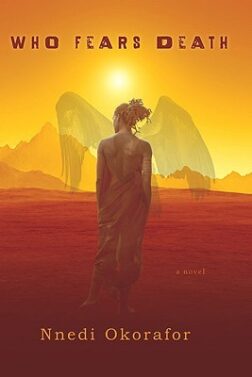
The book Who Fears Death by Nnedi Okorafor is a complex, post-apocalyptic fantasy set in a future Sudan, framed as the life story of a young woman named Onyesonwu, who sits in a jail cell awaiting execution for a crime she believes was her destiny. She tells her story to a Nuru man with a laptop, seeking to correct the lies told about her and to leave a legacy for the child growing in her womb, whom she names Enuigwe.
The Origin: Najeeba’s Trauma and the Desert
Onyesonwu’s existence begins in violence. Her mother, Najeeba, was an Okeke woman living in a peaceful village during a time of genocide. The world is divided between the Okeke (the “created ones,” dark-skinned) and the Nuru (skin the color of the sun, who believe they came from the stars). According to the Great Book, the Okeke are meant to be slaves to the Nuru due to an ancient transgression.
During a spiritual retreat where Okeke women “held conversation” with the goddess Ani in the desert, they were ambushed by Nuru militants on scooters. The men systematically raped the women, intending to plant “poison” in the form of Ewu children children of violence who belong neither to the Okeke nor the Nuru. Najeeba’s attacker was a tall, powerful Nuru sorcerer who recorded the assault on a digital device, singing as he violated her.
While the other survivors returned to their burning village, Najeeba, feeling dead inside, wandered into the desert to die. However, when she realized she was pregnant, she chose to survive for the sake of the child. Living as a nomad, she taught herself to use a capture station for water and to hunt desert creatures. She gave birth alone in a tent to a girl with sand-colored skin and “tiger eyes”. She named the child Onyesonwu, which means “Who fears death?“.
The early years were spent in isolation until Onyesonwu fell ill with a fever at four months old, forcing Najeeba to seek a healer in the Okeke town of Diliza. There, they were met with hostility and stoned by the Okeke residents, who saw the Ewu baby as a “Nuru concubine’s” spawn. This established a lifelong pattern of Onyesonwu being an outcast.
The Integration: Finding Fadil and a Home in Jwahir
When Onyesonwu was six, Najeeba decided she needed to live among people to go to school, and they traveled to the town of Jwahir, the “Home of the Golden Lady”. In Jwahir, young Onyesonwu befriended a blacksmith named Fadil Ogundimu. Fadil was the first person other than her mother to love her without judgment, famously stating that the way a child is conceived is not the child’s fault. He eventually married Najeeba, providing Onyesonwu with the only “Papa” she would truly know.
Onyesonwu’s childhood was marked by her volatile nature and the growth of strange, suppressed power. At age eleven, a pivotal event occurred: while watching a storm, she touched a sparrow’s feather and suddenly found herself naked at the top of a giant iroko tree in the center of town. She had unknowingly shape-shifted into a bird and flown there. This event prompted Najeeba to finally tell Onyesonwu the truth about her biological father and the circumstances of her birth.
The Awakening: The Eleventh Rite and Eshu Powers
Against her mother’s wishes, Onyesonwu chose to undergo the Eleventh Year Rite, a traditional circumcision intended to mark the transition to womanhood. She hoped the ritual would make her “normal” and stop the strange occurrences. During the ceremony, performed by the priestess known as the Ada, Onyesonwu experienced a profound spiritual transport. As she was cut, she entered the wilderness (a spirit realm) and saw herself as a blue mist. In this realm, she encountered a terrifying red and white oval eye the spiritual manifestation of her biological father, Daib, who began to hunt her through her dreams and visions.
The ritual also bound Onyesonwu to three other girls: Luyu, Binta, and Diti. This bond became a central support system as they navigated the complexities of Jwahir’s social rules. Onyesonwu also met Mwita, another Ewu teenager who had witnessed her in the iroko tree. Mwita became her mentor and eventually her lover. He identified her as an Eshu a fundamental shape-shifter and taught her simple sorcery, such as calling butterflies or changing into a vulture.
The Master: Aro and the Mystic Points
Onyesonwu eventually learned that Mwita was the apprentice of a powerful sorcerer named Aro. She demanded to be taught, but Aro initially refused her because she was a woman, believing that female “emotions” and “woman blood” made them dangerous and unstable sorcerers. Onyesonwu’s fury at this rejection culminated in a physical and spiritual attack on Aro when she was sixteen, nearly killing him with her raw, untrained power.
However, when Onyesonwu’s stepfather Fadil died, her grief caused her to accidentally resurrect his body at the funeral, an act of such immense power that Aro realized he had no choice but to train her to prevent her from becoming a danger to the world. He agreed to teach her the Great Mystic Points:
- Uwa: The physical world and the body.
- Mmuo: The wilderness or spirit realm.
- Alusi: The realm of deities and non-human spirits.
- Okike: The Creator, a point that cannot be touched or manipulated.
Aro’s training was rigorous and often cruel. To test her, he sent her into the desert for an initiation overseen by an ancient sorcerer named Sola. During this initiation, Onyesonwu was forced to experience a vision of her own death: being buried to her neck and stoned by a mob of Nuru. She survived the trauma, and the experience broke the “juju” placed on her during the Eleventh Rite, allowing her to finally experience physical intimacy with Mwita without the magical pain intended to enforce “purity”.
The Exodus: The Journey West
As Onyesonwu’s powers grew, so did the threat of her biological father, General Daib, who was leading a massive Nuru military campaign to exterminate the remaining Okeke in the West. After Onyesonwu used her voice to project a horrific vision of the genocide into the Jwahir market an act that caused a town-wide panic it was decided she had to leave.
Onyesonwu, Mwita, Luyu, Binta, Diti, and Diti’s husband Fanasi set out on a journey west to confront Daib. The journey was grueling and marked by internal strife. The group was plagued by the shifting dynamics of their relationships, particularly the infidelity of Fanasi with Luyu, which caused a rift with Diti.
Along the way, they encountered Banza, an Okeke town of art and culture, where Onyesonwu was nearly raped by a group of Nuru men. She escaped by transforming into a sphinx, a terrifying creature from the Great Book, establishing her reputation as a powerful and dangerous figure. In Banza, she also met the children of the Ada twins whom the Ada had abandoned decades earlier. Onyesonwu attempted to heal the daughter, Nuumu, of a twisted spine, but Nuumu ultimately chose to die and enter the wilderness.
The journey turned tragic in the town of Papa Shee. When the residents recognized Onyesonwu and Mwita as Ewu, they began stoning them. In the chaos, Binta was killed by a brick thrown at her head. Devastated, Onyesonwu used her power to strike the entire town blind, a permanent curse for their violence against her friend.
The Encounter: The Red People and the Masquerade
The survivors were eventually taken in by the Vah (the Red People), a nomadic tribe that lived inside a perpetual, protective dust storm. The Vah sorcerers, Ssaiku and Ting, recognized Onyesonwu’s potential and helped her complete a crucial part of her training. Sola appeared to her again within the Vah storm, revealing that Daib was actually his former student who had gone “wrong”.
During her time with the Vah, Onyesonwu experienced a massive spiritual “release” during a retreat. She also learned that her mother, Najeeba, possessed the rare ability to alu (to travel within the spirit world as an Alusi), and had been secretly protecting and guiding her in the form of a Kponyungo (a giant fire-breathing lizard).
Driven by arrogance and a need for revenge, Onyesonwu attempted to attack Daib in the spirit world. She failed miserably; Daib was waiting and inflicted horrific spiritual injuries upon her, branding her right hand with a “slow and cruel poison” symbol. Ting was forced to work a permanent Nsibidi juju on Onyesonwu’s hands to stop the poison, which rendered her right hand dangerous to use for healing.
The Climax: Reaching Durfa and the Rewrite
The group was reduced to Onyesonwu, Mwita, and Luyu after Fanasi and Diti deserted them to return to Jwahir. They finally reached Durfa, the seat of Daib’s power. Under the cover of “ignorability,” they infiltrated Daib’s headquarters a building with a blue door.
There, they confronted Daib, who revealed his plan to fulfill the prophecy of a “tall bearded Nuru sorcerer” who would rewrite the Great Book to finalize the Okeke’s destruction. A brutal battle ensued. Daib shape-shifted into a tiger and killed Mwita, tearing his throat open. In a state of pure grief and desperation, Onyesonwu chose to conceive Mwita’s child at the moment of his death, an act that triggered a massive magical shockwave. This shockwave killed every fertile man in Durfa and made all the women pregnant, effectively ending Daib’s army before it could march.
Onyesonwu and Luyu fled to a small island in the lake with no name to find the Seer Rana. There, Onyesonwu found the original Great Book. Using her “poisoned” right hand and her desert songs, she rewrote the book in Nsibidi, lifting the ancient curse from the Okeke and fundamentally changing the reality of the world.
Outside the hut, Nuru men arrived and brutally murdered Luyu. Onyesonwu surrendered to them, resigned to the fate she had seen in her initiation.
The Transfiguration: Who Fears Death?
Onyesonwu was taken back to Durfa, where she was kept in a concrete cell. She spent her final days dictating her story to the Nuru twins who had come to witness her execution. She showed no fear, even as she was dragged to the hole to be stoned.
At the moment of her execution, as the rocks hit her, a blinding light flowed from her, melting the sand around her into glass. However, the epilogue reveals that Onyesonwu did not simply die. As the expert Eshu she had become, she used the moment of death to shape-shift into a Kponyungo. She blasted her executioners with fire and flew into the sky, heading toward the “green place” of hope she had once seen in a vision, where she believed she would find the spirit of Mwita.
Her sacrifice and her rewriting of the book transformed the world. Slavery was abolished, and women across the kingdom suddenly found themselves possessed of thousands of magical abilities. While the Nuru in the square waited for her blood, Onyesonwu was already gone, having given birth to a new world in her death.