
Table of Contents
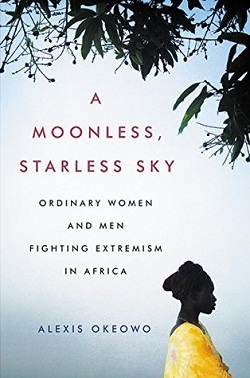
Alexis Okeowo’s A Moonless, Starless Sky: Ordinary Women and Men Fighting Extremism in Africa is a work of narrative journalism that examines the personal and political dimensions of religious and cultural fundamentalism across four African nations: Uganda, Mauritania, Nigeria, and Somalia. Through deeply reported portraits, Okeowo explores how “everyday, complicated Africans” resist extremism not just through activism or arms, but through the “subtler forms of resistance” found in preserving one’s way of life and reclaiming personal liberty.
The book is structured into two parts for each geography, tracking the characters’ initial encounters with extreme circumstances and the long, often painful process of survival and aftermath.
I. Uganda: The Lord’s Resistance Army (LRA) and the Legacy of the Bush
The Ugandan narrative centers on Eunice and Bosco, whose lives were inextricably linked by the violence of the Lord’s Resistance Army (LRA). Founded by Joseph Kony in 1987, the LRA conducted a decades-long “reign of terror,” abducting an estimated 30,000 children and displacing 2 million people while claiming to fight for Acholi dominance and the Ten Commandments.
Abduction and Life in Captivity
Eunice was a fifteen-year-old schoolgirl in 1996, visiting her sister at St. Mary’s College in Aboke, when rebels surrounded the dormitories and abducted 139 girls. Although a nun, Sister Rachele Fassera, successfully negotiated the release of 109 girls, Eunice was among those forced to stay. Bosco had been kidnapped three years earlier at age nineteen and trained to be a soldier. In a “moonless, starless sky” in the forests of southern Sudan, a commander nudged Bosco toward Eunice and declared, “This will be your wife”.
Life in the bush was a “spiderweb” of violence and survival. Bosco, hardened by his own trauma including being forced to handle the remains of his murdered brother, Patrick initially viewed Eunice as a “gift” and a chance to start a new family. Eunice, however, was “repulsed” and “paralyzed,” particularly after Bosco raped her on their first night together. Over time, their relationship shifted from captor and captive to a fragile partnership. Eunice realized that Bosco was often “kind” and sought to protect her from other commanders and the horrors of combat. After the birth of their son, Edimon, in 2000, Eunice became “resigned to her fate,” finding in Bosco the only person who truly understood what she had endured.
Escape and the “Transgenerational” Aftermath
The couple eventually plotted their escape. Eunice walked away from camp in 2004 while gathering firewood; Bosco followed a year later after shooting fellow rebels who refused to defect with him. Returning to Gulu, however, did not mean an end to their trauma. They faced extreme prejudice from their community, who viewed returnees as “cursed” or “rebel-minded”. Eunice’s own mother, Margaret, initially refused to recognize the union, blaming Bosco for Eunice’s misery.
The ultimate cost of their survival manifested in their son, Edimon, who suffered from mysterious “shaking spells” and catatonic seizures beginning at age seven. The community believed Edimon was possessed by “cen” (bad spirits of those his parents killed), but Okeowo explores this through the lens of intergenerational trauma. Like the “hibakusha” (atomic bomb survivors) of Hiroshima, Eunice and Bosco’s trauma was “contagious,” affecting a son who overheard his parents’ stories and internalized their guilt.
II. Mauritania: Slavery and the “Mind-Chains” of the Haratin
In Mauritania, the extremism is rooted in a centuries-old racial hierarchy where White Moors (Arab-Berbers) enslaved the Haratin (black Africans). Though slavery was officially abolished in 1981, it persisted through a culture where “the master is the slave’s idol” and “the slave is chained to a mentality that outside of their masters they are nothing”.
Haby’s Enslavement and Biram’s Awakening
Haby Mint Rabah was born into slavery in 1974. From age eight, she was forced to herd animals, fetch water, and cook, all while enduring regular physical abuse and being “raped on so many occasions that she lost count” by her master, Abdoulaye. She was told her soul was “not worthy of prayer” and remained illiterate and isolated.
Her path to freedom was paved by Biram Dah Abeid, an activist who became the “first authentic Haratin candidate for president”. Biram’s father, though born to a slave, was freed before birth and instilled in Biram a lifelong “bitterness” toward the institution. Biram founded the Initiative for the Resurgence of the Abolitionist Movement (IRA), adopting a “civil resistance” style modeled after Martin Luther King Jr. and Gandhi.
The Ritual of Fire
The pivotal moment of Biram’s career occurred in April 2012, when he performed a public book burning of Islamic legal texts in the Riyadh quarter of Nouakchott. These texts, written as far back as the eighth century, were used by imams to justify the ownership and rape of slaves. Biram’s goal was to “purify the faith” and force the government to arrest him, thereby informing the world of Mauritania’s “hidden” slavery.
The backlash was swift: Biram was labeled an “Israeli agent” and “terrorist” by the elite and imprisoned for months, facing calls for his execution for apostasy. However, the arrest triggered a “revolution among Haratin,” who began marching alongside Afro-Mauritanians in unprecedented numbers. Haby, who was liberated by Biram and her brother Bilal in 2008, eventually became a “human being” with her own home and children, though she noted that “as long as there is slavery in Mauritania, I will always feel that I am not fully free”.
III. Nigeria: Vigilantism and the Stolen Girls of Chibok
The Nigerian section investigates the moral vacuum created by Boko Haram, a group whose name translates to “Western education is forbidden” and which sought to create a fundamentalist Islamic state in the north.
Elder and the Civilian JTF
Abba Aji Kalli, known as “Elder,” was a government auditor who became a commander in the Civilian Joint Task Force (CJTF). The CJTF was a grassroots militia of volunteers armed with machetes and muskets who grew tired of the military’s failure and Boko Haram’s random slaughters. Elder’s commitment to “justice” was so extreme that when his own eighteen-year-old nephew was caught with AK-47s after confessing to thirty murders, Elder personally turned him over to the military to be executed, stating he had “no regret”.
Rebecca and the Chibok Abduction
Rebecca Ishaku was a student at the Government Secondary School in Chibok on the night of April 14, 2014, when Boko Haram abducted over 300 girls. She recounts the men in military uniforms breaking into the dorms, the smell of burning buildings, and the “animals” who debated whether to kill or sell the girls. While being transported on a truck toward the Sambisa Forest, Rebecca found a “surge of bravery” and jumped into the dark foliage, fleeing for her life as militants shot at her.
The tragedy of Chibok was compounded by the Nigerian government’s “mockery” of the parents’ grief and the military’s initial lies about a rescue. Okeowo highlights that “nobody rescued” the girls who returned; they “escaped on their own accord”. Rebecca eventually resettled in Abuja, seeking to reclaim her future through education despite the recurring nightmares of the “tentacled ghosts” in the forest.
IV. Somalia: Basketball in a Land of Ruins
In Somalia, the extremism is represented by al-Shabaab (“the Youth”), which seized power in the early 1990s and declared sports to be “satanic acts”. For women, the simple act of playing basketball became a life-threatening political statement.
Aisha and the Constant Threat
Aisha was a fourteen-year-old in Mogadishu when she began receiving anonymous phone calls from men threatening to kill her for wearing pants and playing sports. She argued back, telling them that “only God was in control of their souls”. The threats were not just verbal; she survived a kidnapping attempt in a tuk-tuk and an incident where a man on a bus recognized her from a Facebook photo of a game and pointed a gun at her.
Aisha was mentored by women like Nasro Mohamed and Mulki Nur, who recalled a “peaceful time” in the 1970s and 80s when women played in shorts and Afros without fear. By 2016, women had to hide their jerseys under burqas and niqabs to enter and leave the courts.
The Garowe Tournament
The climax of Aisha’s journey was the December 2016 nationwide tournament in Garowe. Despite a fatwa from the Somali Religious Council calling the sport a “threat to their faith” and promising to cut the girls’ throats, Aisha and hundreds of other girls from across the country played. They compromised by wearing hijabs and long layers on the court to satisfy the clerics’ demands for “modesty,” but the act of playing was a profound “feeling of being free” from the eyes of the city.
Conclusion: The Ethics of Resisting
Okeowo concludes that “fighting extremism each victory, tiny and large, can feel monumental”. The book is a testament to the resilience of those who resort to “radical measures” not out of a desire for violence, but because it is “the only way to resist, and to live”. Whether it is Eunice choosing to stay with her bush husband, Biram burning legal texts, or Aisha refusing to stop playing basketball, the narrative reveals that the “Moonless, Starless Sky” of extremism is constantly challenged by the “sliver of light” found in human choice and conscience.