
Table of Contents
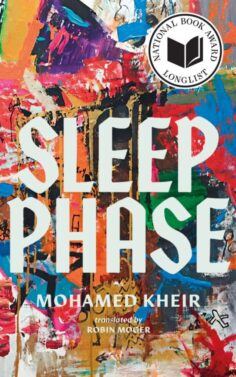
Sleep Phase by Mohamed Kheir, translated by Robin Moger, explores the journey of Warif Shaheen, a man released into a transformed, futuristic Cairo after seven years of imprisonment. The narrative is a haunting meditation on memory, displacement, and the blurred lines between reality and a state of dreaming or “simulation.”
Warif and the Reborn City
The story begins with Warif walking through Talaat Harb Street, struggling to reconcile his memories of Cairo with its current, unrecognizable state. The bustling, chaotic city he once knew defined by car horns, motorbikes, and traffic signals “made flesh” has been replaced by a quiet, wooded landscape. Red maple, walnut, and poplar trees hide the khedival facades, and grass tracks have replaced the asphalt.
Warif observes a new class of people: self-assured foreigners and young students who seem oblivious to the city’s past. He notices a gym where people work out at midday, staring into “inner worlds”. This Cairo is a “new age for neighborhood and country,” where even the names of squares feel estranged from the physical spaces they represent.
Warif’s immediate goal is to reclaim his old life. He visits a skyscraper formerly a state news agency where he meets a man of “unplaceable ethnicity”. Warif is seeking to be reinstated in his former job as a translator. The man expresses surprise at the request, noting that most locals are “satisfied with the current state of affairs” and “happy” to receive a salary for doing nothing. Warif, however, insists that he does not want a stipend; he wants his work.
After the meeting, Warif discovers a tunnel beneath the city foundations, a green-carpeted corridor filled with purposeful Europeans. It leads him directly to the Nile bank, now transformed into a woodland park with palms and benches where people smoke and play guitars. Here, he senses he is being watched by security guards, specifically a woman with a holster, signaling that despite the idyllic appearance, the city is under strict surveillance.
Sally and the “Sleep Phase”
Warif’s primary connection to the outside world is Sally, a European-Egyptian woman who works for an investment bank. Sally is a “sensitive” who navigates the new world with pragmatism and a belief in a “plurality of gods” to explain the mysteries of life.
Warif recalls their time together in his apartment on Adly Street before his arrest. They used to spend afternoons in a “sleep phase,” dozing to the roar of an old air conditioner while the “troubled world outside” seemed to end. Warif views their existence as a construct or simulation created by “bored and none-too-competent programmers of another reality”.
The narrative provides a detailed flashback to the night of Warif’s arrest. He had slipped out of the apartment to buy Merit cigarettes and German chocolates for Sally. In the empty, dimly lit street, he was intercepted by plainclothes police. They took his phone and his ID; seven years later, the phone was unrecognizable when returned.
Wagdi and the Logic of Fear
Warif’s best friend, Wagdi, is a journalist who represents the “Egyptian features” that are now marginalized in the new Cairo. Wagdi is a man defined by a “haze of hormonal terror” and an “overactive adrenal gland” that causes dogs to bark at him. He has survived by being a “coward from a village of cowards,” handing things over before they can be taken.
Wagdi was the only person who visited Warif in prison once visits were permitted. He reveals the mechanism of the new world: he works for a “future news” department. In an era of stability where “nothing happens,” the media prepares fictionalized news schedules four weeks in advance. This allows the audience to be consoled by “truth-like” stories that occupy the vacuum of their “idle days”.
Warif undergoes further bureaucratic evaluations, including a meeting with a Czech woman in a villa near Manasterly Palace. She tells him that his request to return to work is rare, as most people would love to be paid for doing nothing. After the meeting, Warif suffers a severe panic attack outside an ice-cream truck. He feels as though he has no feet, falling into a “well” within himself, a terror more profound than the physical beatings he endured in prison.
The Prison Memories and the “Suggestions”
Warif’s memories of prison are structured by the categories of detention. He recalls being shuffled through different groups: people of the same height, graduates of language departments, and finally, a cell where everyone was held for making “suggestions”.
Warif’s own “suggestion” the one that led to his arrest was a Facebook post. After a frustrating day as a tour guide dealing with racism and incompetence in the tourism sector, he wrote a satirical post suggesting that every sector in the country should be run by foreigners. He added a “smiley” at the end, but the authorities did not find it funny, accusing him of wanting the country to be “occupied”.
In a meeting with a “petite, translucent woman” overlooking the Bab al-Ghouriya neighborhood, the theory of the “suggestions” is explored. She points out that the current state of the country run by foreigners and defined by specific changes bears a “more-or-less identical, albeit amplified, version” of the post Warif made seven years ago. She suggests that the authorities “take advantage of every available opportunity,” implying that the prisoners’ ideas were harvested to create the new reality.
The Search for Wagdi
The plot takes a darker turn when Wagdi disappears. His wife, Souad, calls Warif in a panic. Surveillance footage shows Wagdi pulling his car over on a highway and walking into the shadows of trees as if he had seen something invisible to the camera.
Warif embarks on a search that leads him to a hidden, surreal geography within Cairo. He discovers a secret spring and a hidden avenue filled with hundreds of gazelles. The gazelles make a “harsh croak” called salil and vanish into a dense green forest that feels “prehuman”.
Continuing his search, Warif enters a long, rocky tunnel that smells of earth and sweat. He emerges into a “desert” filled with abandoned construction vehicles and a mass grave of hundreds of animals cats, dogs, donkeys, horses, and camels heaped in piles and swarming with flies. This grim discovery contrasts sharply with the “impossible beauty” of the newcomer-run areas of the city.
Rejection and the Associate Card
Warif’s quest to regain his job culminates in the revelation that he has been permanently replaced. At a dinner in Maadi with Sally and her expat friends, he meets Jakob, a man from Poland. Sally casually reveals that Jakob is “the guy who got [Warif’s] job”. Jakob, oblivious to Warif’s pain, tells him he “envies” his position of being paid for doing nothing.
Jakob later hands Warif an “Associate Card”. He explains that the interviews Warif has been attending were likely just for “research” or “investigation” and that his request to be reinstated will be denied. The card allows Warif to receive a foreigner-equivalent stipend, ensuring his material comfort but finalizing his obsolescence.
The news of Wagdi’s fate arrives unexpectedly. Just as Warif is preparing for a parachute jump over the city’s parklands, he receives a call from Wagdi. Wagdi is “fine” and promises to tell him everything the next day.
Conclusion: The Final Flight
The book ends with Warif on a giant rubber catapult atop the Muqattam cliff. He is launched into the air, but the experience is not what he expected. Instead of falling and the parachute opening, he continues to climb and drift on an “invisible hand”.
From high above, he looks down at the “densely packed crowns of the trees” and the gazelles. He sees the line of the Nile and the desert beyond, achieving a perspective on the city that is both beautiful and detached. His final thought is that Wagdi would never believe the view from such a height, leaving Warif suspended between the reborn world and the “white dark” of his own consciousness.
Key Concepts and Settings:
- The Foreigners Are Our Oil Campaign: A state initiative arguing that the country should recruit overseas talent to compensate for a lack of natural resources.
- Mubtadiyan and Qasr al-Ainy: Specific streets that have been transformed from “forgotten jams” to green tracks.
- The Magra al-Uyoun Forest: A massive, quickly established forest spreading toward Downtown.
- The Egyptian-ness of Sally: She asserts her identity through black-and-white movies and popular restaurants, despite her European passport.
- Warif’s Parents: Naela and Shaheen, who died while Warif was in prison. Their death is described by Wagdi as a “normal death” unrelated to grief, though Warif carries the guilt.