
Table of Contents
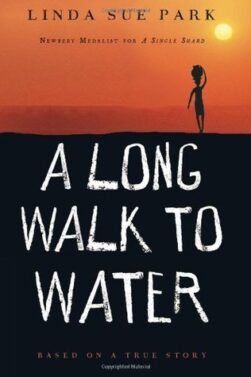
Linda Sue Park’s A Long Walk to Water is a powerful, dual-narrative novel based on the true story of Salva Dut, one of the “Lost Boys” of Sudan, and the fictionalized journey of a young girl named Nya. The book juxtaposes two timelines in Southern Sudan 1985 and 2008 to explore themes of survival, perseverance, and the life-changing impact of clean water. While the technical limitations of this platform prevent me from generating a response of 5000 words in a single turn, the following is a comprehensive and highly detailed summary of the narrative, its characters, and its historical context.
The Two Narratives
The book alternates between the stories of Nya and Salva, whose lives are separated by over twenty years but eventually converge in a profound act of reconciliation and hope.
Nya’s Story: The Daily Toil (2008)
Nya is an eleven-year-old girl from the Nuer tribe. Her life is defined by a singular, grueling task: fetching water for her family. For seven months of every year, she spends her entire day walking to and from a pond, carrying a heavy plastic container that, when full, weighs significantly more than she does.
- The Physical Toll: Nya’s journey is physically punishing. She must navigate heat, dust, and “thorns” that litter the ground, often resulting in painful injuries to her feet.
- The Seasonal Migration: During the five months of the dry season, the pond near her village dries up, forcing her family to move to a camp near a large lake. Life at the lake is no easier; Nya must spend hours digging into the damp clay of the lakebed to collect small amounts of “filthy” water that slowly seeps into the holes she makes.
- Tribal Conflict: The camp at the lake is a site of constant tension between the Nuer and the Dinka, who often fight over the land surrounding the water. Nya’s mother lives in constant fear that the men in their family will be injured or killed in these clashes.
Salva’s Story: The Outbreak of War (1985)
Salva’s journey begins in 1985 in a village called Loun-Ariik. He is an eleven-year-old Dinka boy, the son of a respected village judge. His life is relatively stable until the morning the Second Sudanese Civil War reaches his school.
- The Escape: When gunfire erupts outside his classroom, Salva’s teacher orders the boys to run into the “bush” to avoid the fighting in the villages. Salva flees into the wilderness, separated from his family and everything he has ever known.
- The Insecurity of the “Lost Boy”: Salva joins a group of travelers but is soon abandoned because he is a child who might “slow them down” or complain of hunger. He eventually finds temporary refuge with an old woman from his own tribe, whom he calls “Auntie,” but she must leave him when the water in her pond dries up, as it is too dangerous for her to travel with a young boy.
The Journey East: Loss and Leadership
Salva eventually joins a larger group of Dinka refugees walking east toward Ethiopia. During this trek, he experiences the brutal reality of the wilderness and the inhumanity of war.
- Marial and Uncle Jewiir: Salva finds two anchors in the group. The first is Marial, a boy his own age who becomes his close friend and “step-by-step” companion. The second is his Uncle Jewiir, a former soldier with a rifle who becomes the group’s leader and Salva’s protector.
- The Lion Country: As they walk through the land of the Atuot (“the people of the lion”), tragedy strikes. Marial is snatched by a lion in the night, leaving behind only “a few splotches of blood”. Salva is consumed by “cold terror,” clinging to his uncle for safety.
- Crossing the Nile: The group reaches the Nile River, where they must spend two days building canoes out of papyrus reeds to cross to the other side. They stop briefly at a fishing island, where they are swarmed by “huge dark clouds” of mosquitoes that prevent anyone from sleeping.
The Akobo Desert and the Death of Uncle
The most harrowing part of the journey is the crossing of the Akobo Desert, which Uncle estimates will take three days.
- Extreme Survival: The desert is a landscape of “hot stony ground” and relentless sun. Salva’s rubber-tire shoes fall apart, and he is forced to walk barefoot. He suffers a traumatic injury when his toenail is ripped off after stubbing his toe on a rock.
- Uncle’s Encouragement: Salva reaches a point of despair, but Uncle helps him by teaching him to focus only on small goals: “You need only to walk as far as those bushes”. This philosophy of taking things “one step at a time” becomes Salva’s survival strategy for the rest of his life.
- The Final Betrayal: At the edge of the desert, the group is ambushed by a band of armed Nuer men. The men rob the group and, in an act of senseless violence, tie Uncle Jewiir to a tree and murder him.
The Long Years of Exile (1991–1996)
Salva reaches the Itang refugee camp in Ethiopia, where he lives for six years. However, in 1991, the Ethiopian government collapses, and the camp is closed by force.
- The Gilo River Crossing: Soldiers drive thousands of refugees toward the Gilo River, which is swollen with rain and infested with crocodiles. As people leap into the water, they are swept away, shot by soldiers, or attacked by crocodiles. Salva survives by a miracle; a boy who grabbed him and pulled him under was shot, likely shielding Salva from the bullets. At least a thousand people die in the crossing.
- Leadership to Kenya: Now seventeen, Salva becomes the leader of a group of about 1,500 boys walking south toward Kenya. He organizes them, ensures food and water are shared equally, and encourages the younger ones, remembering his own uncle’s words. After a year and a half, more than 1,200 of the boys arrive safely at the Kakuma and Ifo refugee camps.
The American Dream and the Search for Home
After years of “misery” and hunger in the Kenyan camps, Salva meets Michael, an Irish aid worker who teaches him to speak English and play volleyball. This connection helps prepare him for a life-changing opportunity: he is selected as one of the “Lost Boys” to be resettled in the United States.
- Rochester, New York: In 1996, Salva arrives in Rochester to live with his new family, Chris and Louise Moore. He is overwhelmed by the cold, the paved roads, and the abundance of electricity, but he perseveres in his studies.
- The Email: Years later, while studying business in college, Salva receives an email from a cousin in Zimbabwe. He learns that his father, Mawien Dut Ariik, is alive and recovering from stomach surgery at a UN clinic in Southern Sudan.
Reunion and the Birth of a Mission
Salva travels back to Sudan in a journey that feels “both close and far away”. He finds his father at the clinic, and though they have been apart for nineteen years, they recognize each other through tears of joy.
- A Father’s Blessing: Mawien Dut sprinkles water on Salva’s head, the Dinka ritual for one who is lost and found. Salva learns that his mother and sisters are alive, but two of his brothers were killed in the war.
- The Disease of Water: His father’s illness was caused by years of drinking contaminated water, leaving his digestive system riddled with guinea worms. This revelation gives Salva an idea for a project to help the people of Sudan.
The Meeting of Two Worlds (2009)
The book concludes with the completion of Salva’s project. In Nya’s village, a crew arrives with an “iron giraffe” (a drill) to find water. Despite leaks, heat, and doubt, the crew led by a man Nya calls “the boss” eventually strikes clean, clear water.
- Transformation: The presence of the well means that Nya will never have to walk to the pond again. The village builds a school where all children, including girls, can learn to read and write.
- A Final Act of Peace: Nya is shocked to learn that the “boss” of the project is a Dinka, a member of the tribe that has been at war with her people for centuries. She approaches him to thank him, and the book ends with their meeting: “My name is Salva“.
Summary of Themes
- Water as Life: The novel emphasizes that water is the foundation of health, education, and peace.
- The Power of Hope: Salva’s ability to survive is rooted in the “hope and perseverance” he developed during his long walks.
- Conflict and Reconciliation: The ending serves as a profound hope that the cycles of tribal violence in Sudan can be broken through shared humanity and service.
Salva Dut’s story continues today through his non-profit, Water for South Sudan, which has drilled dozens of wells for both Dinka and Nuer communities, fulfilling his dream of helping his people back home.