
You can listen to the Book Summary Below
Table of Contents
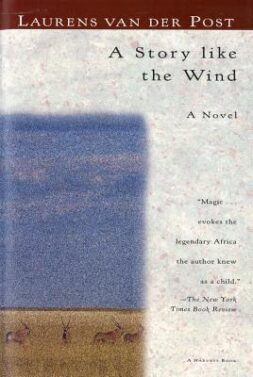
Laurens van der Post’s A Story Like the Wind is an epic exploration of the vanishing magical world of primitive Africa, seen through the eyes of François Joubert, a thirteen-year-old boy living on a remote frontier ranch called Hunter’s Drift. The narrative is grounded in the author’s belief that the “living spirit needs the story for its survival and renewal,” and it serves as a testament to the “magic” that existed in Africa before European interference. François, known to the local Matabele people as “Little Feather,” is raised in an environment where the boundaries between the physical world and the world of myth are porous. His life is defined by his relationships with his parents, Lammie and Ouwa (Pierre-Paul Joubert); his mentor, the legendary hunter Mopani Theron; the Matabele headman ‘Bamuthi; and most significantly, his dog Hintza and a Bushman named Xhabbo.
The World of Hunter’s Drift and the Education of François
Hunter’s Drift is a self-supporting ranch carved out of the virgin bush near the Amanzim-tetse River (the “River of Sweet Waters”). François’s father, Pierre-Paul, was a former Director of African Education who resigned in protest against the government’s discriminatory policies. He established the ranch as a non-racial model of partnership with the Matabele people, particularly the clan of ‘Bamuthi, who serves as the “Keeper of the Ford”. François’s education is unconventional; his father runs a “private school” for him at home to protect his unique personality what Lammie calls “the other person” from being homogenized by colonial boarding schools.
François grows up immersed in the lore of the Bushman, the Amaxosa, and the Matabele. From his old nurse, Koba, he learns the ancient Bushman language, which is filled with onomatopoeic clicks that allow humans to communicate with the natural world. Koba teaches him that the stars are the greatest hunters and that the first people lived in harmony with all creatures until they stole fire from the ostrich. This education makes François uniquely attuned to the “Biblical” character of the African landscape, where nature is seen as a living scripture.
Hintza: The Ridgeback and the Link to Nature
When François is eleven, his father brings him a Rhodesian Ridgeback puppy named Hintza (later shortened to Hin). Hintza is the offspring of Nandi and Dingiswayo, dogs belonging to Mopani Theron. François trains Hintza using the Bushman tongue, discovering that the dog responds instinctively to commands like “tssisk” (to flush game) and “tza” (to chase). Hintza is not merely a pet; he is an “intelligence officer of the night” who monitors the bush and alerts François to any unusual stirrings that the farm’s five mongrel watchdogs might miss.
François spends months teaching Hintza to restrain his “inspired” barking, which the dog views as a form of singing. Through a creative experiment using a gramophone record of “The Whistler and his Dog” and Beethoven’s Moonlight Sonata, François teaches Hintza that silence is the price of admission to music. Hintza becomes “moon-proof,” learning to appreciate the celestial beauty without waking the entire ranch. This training proves vital when Hintza alerts François to a scent he has never encountered before the scent of a “wild” Bushman.
The Coming of Xhabbo and the Secret Cave
The story takes a dramatic turn when Hintza wakes François before dawn with a “tense, high-pitched whimper”. Guided by the dog, François discovers a young Bushman named Xhabbo caught in a heavy steel lion trap. Xhabbo had been on a sacred mission to return to his people’s ancestral cave to report his father’s death. François uses a wooden lever to suppress the trap’s spring and rescues Xhabbo, whose leg is severely mangled. Moments after the rescue, a large male leopard attempts to attack them. François kills the leopard with his great-grandfather’s octagonal muzzle-loader, a weapon he chose over his repeating rifle for its deadlier impact.
To keep Xhabbo’s presence a secret from the Matabele (who traditionally persecuted the Bushmen), François hides him in a secret cave high in the cliffs above the river. This cave, which Xhabbo calls “Mantis’s Place,” is decorated with ancient Stone Age paintings of eland, giraffes, and a mystic encounter between a Praying Mantis and a great serpent. François treats Xhabbo’s wounds with European medicine (iodine and M and B 693), which Xhabbo views as “powerful magic”.
During their time together, Xhabbo explains the concept of the “tapping” an internal vibration in the chest that allows Bushmen to sense things beyond physical sight and sound. Xhabbo warns François that he hears a tapping from a great distance that is “not pleasant,” signaling that his people are in danger and he must return to the desert. Before departing, Xhabbo and François witness a visitation from a Praying Mantis, which they interpret as the god Koeggen-A calling Xhabbo home. They establish a secret call sign a combination of a night plover’s call and a jackal’s bark to signal Xhabbo’s eventual return.
The Crisis of the Father and the Seer
While François is protecting Xhabbo, his father, Pierre-Paul, falls into a mysterious and terminal decline. The Matabele believe he is “bewitched” by the government as punishment for his dissent. When European specialists fail to diagnose the illness, ‘Bamuthi and François decide to consult a renowned Matabele seer and prophet named uLangalibalela (“The Right Honourable Sun-Is-Hot”).
François and ‘Bamuthi undertake a hazardous journey into the bush, leading two heifers Night and Day and Little Finger as gifts for the seer. On the way, they witness a chilling sight: a group of armed men in uniform (“men of the spear”) accompanied by a Chinese observer. These men are massing in the bush for a purpose ‘Bamuthi finds terrifying, though François does not yet understand the full military implications.
At the seer’s kraal, uLangalibalela uses a ritual fire to “open the gates of distance” and see Pierre-Paul’s condition. He identifies the cause of the illness as the “turning of the backs” a spiritual isolation caused by the rejection of Pierre-Paul by his own people. The seer warns that the “Great White Bird” is already drifting outside his body and that time is running out. Despite François providing a strand of his father’s hair for a healing ritual, uLangalibalela eventually returns the gifts, signaling that Ouwa has died. François is devastated, realizing that “common sense” and European medicine were insufficient against the spiritual forces at work.
The Arrival of the Moncktons and the Conflict of Logic
Into this world of grief and omen comes Sir James Monckton and his daughter, Luciana (nicknamed Nonnie). Sir James, a retired colonial governor, has come to develop a neighboring property called Silverton-Hill (derisively known by the Matabele as “Fish-Metal Hill”). Sir James represents the peak of British administrative logic; he is “anti-magic” and dismissive of the superstitions of the bush.
The ideological clash between François and Sir James is established early on when François warns the party not to camp near a clump of “blood trees” where a man had recently tried to hang himself. Sir James dismisses the warning as “rubbish,” though the Cape-colored wagoners in his train refuse to stay there, siding with François. Despite this friction, a deep bond develops between François and Nonnie. François introduces her to the “secret life” of the bush, taking her to a “baboon finishing school” where the elder Adonis teaches the young to count. He explains that even the crocodile has its place in the divine order, often acting as a “dentist” for the birds that clean its teeth.
François nicknames the girl Nonnie (meaning “little mistress”) and begins to view her as a partner in his secret life. Before she leaves with her father on a temporary diplomatic mission to London, they share a moment of “hail and farewell” in the dark, where François realizes that, despite her father’s skepticism, she is “one of us” someone who understands the music of the bush.
The Birds Change Their Tune: Omens of War
Following his father’s death and the departure of the Moncktons, François experiences a period of “infinite distance” and loneliness. He takes refuge in preparing Mantis’s cave as a fortress for a siege, stocking it with military supplies, water, and food in anticipation of an “emergency mobilization”. He builds an altar of white pebbles for a painting of Saint Hubert, the patron saint of hunters and the hunted, which Nonnie sent him.
The atmosphere at Hunter’s Drift becomes increasingly heavy with omens of doom. Mopani Theron and François notice that the birds have “changed their tune,” singing with a frenzy and desperation that Mopani last heard just before the outbreak of World War I. ‘Bamuthi reports similar fears among the Matabele, noting that uLangalibalela has had a vision of stars falling out of their lawful courses.
The Punda-Ma-Tenka road becomes busy with mysterious trucks driven by well-trained Africans in khaki overalls. These men are hostile and view the Jouberts as “settlers” to be eradicated. During a confrontation at the ford, François again spots the Chinese observer hiding in one of the trucks, confirming that a foreign power is organizing an insurgent force. A visit from three “crows of God” (priests from the World Council of Christian Churches) further underscores the isolation of the frontier families; the priests express sympathy only for the “freedom fighters” and view Hunter’s Drift as a feudal relic of exploitation.
The final warning comes from a simple-minded Matabele girl, Langazana, who tells of a black crow that screamed at her to flee, warning that “if you stay in this place much longer you will all be killed”.
The Massacre at Hunter’s Drift
The storm finally breaks on the night the Moncktons return to Hunter’s Drift. François is woken by Xhabbo’s secret call sign the plover and the jackal uttered with extreme urgency. He finds Nonnie already awake and waiting for him, and they slip out into the dark together. They meet Xhabbo and his wife, Nuin-Tara, who have traveled for thirty days from the desert to warn François that “thousands of kaffirs” armed with automatic rifles are massing to kill everyone.
From a high vantage point on the cliffs, François and Nonnie witness the annihilation of Hunter’s Drift. The insurgent army surrounds the homestead and kraals, directing controlled volleys of fire into the buildings. François hears ‘Bamuthi’s final war cry a booming “To me!” before the Matabele leader is cut down by machine-gun fire.
Desperate to find survivors, François and Xhabbo descend the hill and discover that ‘Bamuthi died a heroic death. The Matabele warrior had encountered an advance patrol and managed to kill four armed men with his spear, u-Simsela-Banta-Bami, before he was riddled with bullets. The attackers, in a fit of rage at ‘Bamuthi’s defiance, had fired burst after burst into his dead body. François also finds Mtunywa (Messenger), who is mortally wounded. Before dying in François’s arms, Messenger reveals the extent of the carnage: Lammie, Ousie-Johanna, Amelia, and Sir James Monckton are all dead. Sir James had been shot in the doorway of the house, dying only after killing several attackers himself.
The Final Retreat and the Falling Stars
With the ranch in flames and the survivors being hunted, François, Nonnie, Xhabbo, and Nuin-Tara retreat to Mantis’s Cave. Xhabbo refuses to let them flee immediately, sensing through his “tapping” that the enemy is searching the bush everywhere. From the safety of the cave, the four of them watch the sun set over a world that has been utterly destroyed in a single morning.
Nonnie is overcome with grief but finds comfort in Hintza, whom she realizes is the “first animal to become the friend of man” and a silent witness to their tragedy. Xhabbo tells François to tell his “woman” (Nonnie) that the stars are “stringing the beads” for the dead, watering the night with their tears. He interprets the shooting stars falling over the river as a sign that the spirits are aware of the “bad thing” that has happened and that they are not alone.
The book ends with the four companions retreating into the darkness of the cave a place that François now sees as the “last temple left on earth”. They sit apart, listening to the “tapping” within themselves and the stars, waiting to be shown the way through the wilderness that now lies before them. The “magic” of primitive Africa has been eclipsed by the “ugliness” of modern war, but the connection between the boy, the girl, the Bushmen, and the dog remains a flicker of light in an “utterly dark” night.