
You can listen to the Book Summary Below
Table of Contents
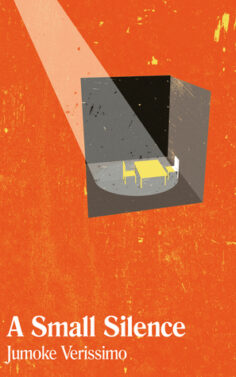
Jumoke Verissimo’s A Small Silence is a lyrical and psychologically dense novel that explores the themes of trauma, memory, and the search for identity in post-dictatorship Nigeria. The narrative centers on Prof (Eniolorunda Durotimi Akanni), a former university professor and human rights activist who is released from prison in 2005 after a ten-year incarceration during the military regimes of the 1990s. Upon his return to his father’s flat in Jakande Estate, Abesan, Prof makes the radical decision to live in total darkness, turning off all lights and retreating into a sanctuary of shadows to escape the “horror” of light that defined his torture in prison.
The novel’s summary is broken down into thematic sections and chronological arcs that trace the convergence of Prof’s life with that of Desire Babangida Jones, a young student whose own history is inextricably linked to Prof’s activist past.
The Return to Shadows: Prof’s Re-entry (2005)
The story begins with Prof’s release from prison during the second term of President Obasanjo. He is collected from his cell by his mother, Maami, and his childhood friend, Olukayode (Kayo). The prison transition is jarring; the bright sunlight makes him wince, and he immediately veils his face with a shirt, a habit developed in prison to cope with strobe-light torture.
Prof rejects his mother’s offer to live in her home, insisting on returning to the Jakande Estate flat he inherited from his father a man who had denied his paternity for most of Prof’s life. Once inside, Prof turns off all the lights, much to the bewilderment and distress of Maami and Kayo. He declares that “the light is not important” and even threatens that he “could kill if the lights come on”.
In this darkness, Prof develops a meticulous routine:
- Sensory Navigation: He moves through the flat like a blind man, counting steps between furniture to avoid grazing objects.
- Recitation: He recites passages from books he memorized to keep his mind sharp.
- Night Strolls: When the “wan light” of the neighborhood becomes too irritating, he takes night strolls around the estate, shrouded from head to toe like a woman in a burqa, using a rusty iron rod as a walking stick.
- The Internal Voice: He is accompanied by Desanya, a name he gave to “The Voice” that first comforted him in solitary confinement. Desanya is a projection of a little girl from Maroko whom Prof had carried during a rally and who reportedly died later.
Prof’s isolation creates a local legend; neighborhood girls rumor that he is a “mad man” who eats cockroaches and rats.
Desire’s Motivation: The Legacy of Maroko
The parallel protagonist, Desire Babangida Jones, is a student at Lagos State University (LASU). Her obsession with Prof is rooted in a childhood trauma. In 1990, she and her mother were residents of Maroko, a low-income settlement demolished by the military government. During the chaotic eviction, Prof had stood on a makeshift podium, speaking for the people. He had briefly carried the young Desire on his shoulders and pushed a book into her hand titled How to be a Nigerian.
This encounter defined Desire’s life. She viewed Prof as a hero who stood up for the people “because of her”. The book spurred a hunger for knowledge; she spent her childhood stealing books from neighbors and employers, eventually amassing a private library of stolen, picked, and borrowed volumes. Her education was later funded by Mama T, a wealthy trader and mother of her roommate, Remilekun, after Desire agreed to impersonate Remi during her GCE examinations.
The Darkroom Dialogues: Desire and Prof
Learning of Prof’s release from a newspaper, Desire begins a persistent vigil at his door. She knocks for seven consecutive nights, despite neighborhood warnings that he is “not normal again”. On the seventh night, Prof finally opens the door.
Their relationship develops entirely within the stifling darkness of Prof’s sitting room. Desire visits every night at 9:00 PM, and they talk until the grandfather clock strikes midnight. These conversations, which Remilekun dismisses as a “dark-room fetish,” cover a vast intellectual landscape:
- Politics: They debate the failure of Nigerian democracy, which Prof views as a system seeking “the dead to bring revival” by electing former military heads of state.
- Poetry: They recite poems together, specifically Niyi Osundare’s Not My Business, and discuss the works of Pablo Neruda and Mary Oliver.
- Personal Philosophy: Prof argues that “darkness is a cypher” and that one can see better in the dark because it is a place where “potentials are created” without external forces.
Despite their intellectual intimacy, the physical tension is palpable. On several occasions, Prof sits on the arm of Desire’s chair, and the accidental brushing of their skin causes both to pull away in a reflex of anxiety.
The Parallel Plot: Ireti (Ghandi Reloaded)
While visiting Prof, Desire encounters a student politician at LASU named Iretioluwa Durotimi, also known as “Ghandi Reloaded”. Desire is immediately struck by the uncanny physical resemblance between Ireti and Prof the same eyes, nose, and tangled hairline.
Desire pursues Ireti, leading to a strange encounter in his room where she attempts to seduce him. Ireti, however, suffers from impotence and anxiety, unable to perform sexually. He eventually confides in Desire his true secret: he is the result of a one-night stand between his mother and Prof many years prior. Ireti’s mother had never told Prof about the pregnancy because he had always insisted he “never wanted a baby”. Ireti carries the burden of being a “born-by-mistake” and spent his life obsessed with his father’s reputation, keeping newspaper cuttings of Prof in his room.
Domestic Trauma: Remilekun and Babangida
The novel provides a stark contrast to Prof’s intellectual isolation through the gritty reality of Desire and Remilekun’s lives in Abesan.
- Remilekun’s Crisis: Remilekun is in a volatile relationship with Mr. America, a man who shuttles between Ghana and Kenya and once joked he would sell his own child for blood rituals. When Remilekun becomes pregnant, she undergoes a traumatic, illegal abortion at the saffron-colored Tayo Clinic in Mushin, with Desire holding her hand through the procedure.
- Desire’s Family Secret: In a moment of deep vulnerability, Desire tells Remilekun a story about how her mother, a prostitute named Fire, “killed” her father, a policeman named Babangida. She describes a night of drunken violence where her mother, after years of being beaten, supposedly smothered or killed him in his sleep. However, the narrative later suggests this may be an “imaginative question” Desire uses to empower her mother’s narrative of resistance.
The Breaking of the Silence
The “small silence” between Prof and Desire begins to fracture as Desire realizes the “madness” of their arrangement must stop. During a visit, she insists that Prof put the lights on, wanting to see his face after months of talking to a shadow. Prof refuses, retreating further into his philosophy of the dark.
The climax of their meetings occurs when Desire reveals the existence of Ireti. She tells Prof: “I met your son, Prof. His name is Ireti and he wants to meet you”. This revelation shatters Prof’s fragile peace, and Desire rushes out of the room, leaving him in a state of internal collapse.
The Reckoning with Maami and Kayo
Following Desire’s departure, Prof’s mental state deteriorates. He calls Kayo, leading to a violent confrontation in the dark. Kayo, who spent the ten years of Prof’s imprisonment struggling to keep Maami alive and unable to find work due to his association with a “subversive,” explodes in rage. He accuses Prof of being “holier than thou” and tells him to “die alone”.
Prof also confronts his mother, Maami, about his own father. Maami reveals a devastating family secret: Prof’s father had accused her of infidelity after she agreed to meet his boss to help him get a promotion. In a fit of rage and self-defense, Maami had struck his father on his penis with a ladle, rendering him infertile. Consequently, Prof was his father’s only biological child, and the other children in the father’s later marriage were “bastards,” a fact the father hid to maintain his social standing. This revelation forces Prof to realize his fight for the “oppressed” was an extension of his own internal battle with being labeled a bastard.
Emergence: From Darkness to Light
In the final chapters, Prof is besieged by the “voices” of Desire, Maami, and Kayo in his head, all collectively shouting “Light! Light! Light!”. He experiences a terrifying psychological battle at the light switch, recalling the “strobe light routine” from prison.
With a “sudden resolve,” he pushes the button, and an amber brightness settles upon the room. The lit room reveals his reality: bookshelves of hardback volumes, a Persian rug, and the grandfather clock. He is struck by the emptiness of the space now that he can see it.
Determined to find Desire, he rushes out of the house in the light of day, unmasked and unburdened by his “burqa” style bedsheet. He wanders the estate, encountering the “rush that seemed injected into the lives of the people”.
The Meeting at the Tap: Reality vs. Imagination
The novel concludes with a daytime encounter at a public water tap in the estate. Prof, now a man with “scars all over his face,” a “thick sponge of white hair,” and a limp, spots Desire.
In the daylight, Prof savors what the darkness had hidden: her “classic guitar-shaped body” and her white T-shirt. Desire, however, is confronted by a man who looks like a “vagabond” and a “kolo” (madman). She sees in his eyes shame and confusion. Although she hears him mutter her name, she hurries away from him, unable to reconcile the “world-renowned professor” of her imagination with the broken man standing in the sun.
The book ends on a note of ambiguous reconciliation. Prof, watching Desire depart, acknowledges that “only imagination can destroy its own creation”. He considers going home to “lift the curtains of his house, so that the lame lights of the moon could walk in,” finally ready to stop hiding from the world.
Key Themes and Symbols
- Darkness as a Candle: Following the Rumi epigraph, darkness is not merely an absence of light but a protective space for the traumatized soul to “master the dark” and understand existence without external force [Epigraph, 1, 251].
- The Persistence of Memory: Characters like Desire and Ireti use memory and imagination to construct “realities” that allow them to survive.
- Institutional Trauma: The novel details the visceral, long-term effects of state-sponsored torture, where light is transformed into a weapon of war.
- Silence as Narrative: Silence is described as a place “where we go to listen to those stories” that cannot be told. It serves as both a barrier and a means of communication between Prof and the world.
- Gendered Strength: The novel posits that “womanhood is a process” and that women like Maami and Desire are the “source of strength” that men wrap themselves around to hide their own timidity.
A Small Silence stands as a “gut-punching” exploration of the human psyche, reminding readers that the boundaries we set for ourselves often become the very quests we must undertake to find freedom.