
You can listen to the Book Summary Below
Table of Contents
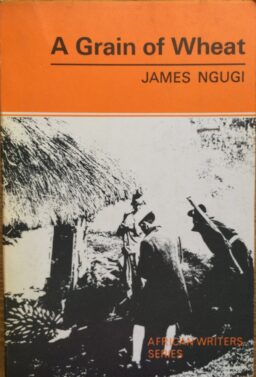
Ngũgĩ wa Thiong’o’s A Grain of Wheat is a seminal work of African literature that explores the complex psychological and social landscape of Kenya on the precipice of its independence from British colonial rule. Set in the four days leading up to December 12, 1963, the novel moves fluidly between the present-time preparations for Uhuru and the harrowing memories of the Mau Mau Emergency in the 1950s. The narrative is framed by a third-person voice that often adopts the collective “we” of an oral storyteller, reflecting the shared history of the Gĩkũyũ community of Thabai. At its core, the book is a moral and political inquiry into the nature of betrayal, sacrifice, and the possibility of regeneration in a land scarred by colonial violence.
The Village of Thabai and the Silent Hero
The novel opens with Mugo, a man living in profound isolation in the village of Thabai. Mugo is an orphan who was raised by a drunken, abusive aunt, Waitherero, whom he once fantasized about killing. During the Emergency, Mugo gained a legendary reputation for his resilience. He was arrested after intervening to stop a policeman from beating a pregnant woman in a labor trench, and he later survived the brutal conditions of the Rira detention camp, where he allegedly organized a hunger strike and refused to “confess the oath” despite obsessive torture by District Officer John Thompson. To the people of Thabai, Mugo is a hermit-hero, a holy man whose silence is interpreted as depth and steadfastness.
As Independence approaches, the Party elders Warui, Wambui, and Gikonyo visit Mugo to request that he lead the Uhuru celebrations at Rung’ei Market. They want him to deliver the keynote speech in honor of Kihika, the village’s greatest forest fighter and martyr, who was hanged from a tree by the colonial authorities. Mugo is paralyzed by this request. The reader soon learns through his interior monologues that his “hermitage” is actually a state of secret sin and debilitating guilt. Mugo was not a collaborator out of conviction, but a man who desperately wanted to be left alone to tend his own shamba. His aloneness is a pathology; he believes he is a messianic figure, yet he is the very man who betrayed Kihika to the British.
Kihika: The Grain of Wheat
Kihika serves as the novel’s moral anchor and the literal “grain of wheat” who must die so that the nation may be born. A charismatic leader who was moved by the biblical stories of Moses and the Children of Israel, Kihika believed that “a few shall die that the many shall live”. He orchestrated the famous raid on the Mahee Police Garrison, a victory that humiliated the colonial government and led to the brutal “protected village” policy, where Thabai was surrounded by a trench and the villagers’ homes were burnt to the ground.
The mystery of Kihika’s capture haunts the village. General R., a forest fighter who served under Kihika, believes Kihika was betrayed by a close contact. On the night of his betrayal, Kihika had sought refuge in Mugo’s hut after assassinating DO Robson. He chose Mugo because Mugo was an outsider with no alliances. Kihika attempted to recruit Mugo into the underground movement, but Mugo, terrified of being implicated in a capital crime and resentful of Kihika’s “arrogant” certainty, decided to turn him in. Mugo walked into the District Office and gave Kihika up to John Thompson, hoping for a reward and security. Instead, Thompson greeted him with contempt, spitting in his face and slapping him, leaving Mugo in a nightmare of self-discovery from which he never escaped.
The Colonial Perspective: John Thompson
The novel provides a searing critique of the imperial narrative through the figure of John Thompson. Thompson arrived in Kenya as an idealist of the Empire, dreaming of a “British nation” where all men were created equal, a vision he detailed in his unfinished manuscript, Prospero in Africa. However, the reality of colonial rule turned him into a torturer. He came to believe that the “Negro is a child” who requires authority and that the Mau Mau were “vermin” to be eliminated.
Thompson’s career was derailed by the Rira massacre, where eleven detainees died under his command during a hunger strike. Though the government whisked him away to Githima to hide the scandal, the event left him demoralized and unfeeling. On the eve of Uhuru, Thompson and his wife Margery are preparing to fly back to Britain. Their marriage is hollow; Margery had a sordid affair with a drunken meteorologist, Dr. Van Dyke, and Thompson is haunted by his failure to sustain the “British Mission”. He represents the imminent departure of white power, which leaves his former African subordinates, like Karanja, in a state of terror.
Domestic Betrayal: Gikonyo, Mumbi, and Karanja
The interpersonal drama of Thabai centers on the triangular relationship between Gikonyo, his wife Mumbi, and their youthful rival Karanja. Gikonyo is a successful carpenter and businessman who was detained for six unheroic years. He had confessed the Mau Mau oath early in his detention, not out of political change, but because he was so consumed by the image of Mumbi that he would have sold the country to return to her. Upon his return, however, he found Mumbi with a child that was not his.
The child’s father is Karanja, a man who chose the path of collaboration. Karanja joined the Home Guard and eventually became a Chief, using his power to protect Mumbi and her family from the worst excesses of the Emergency, but also to pressure her to accept him. Karanja’s belief was that “the whiteman is here to stay” and that one must ward off blows to survive. He ultimately seduced Mumbi by bringing her news that Gikonyo was being released, a moment of “submissive gratitude” that Mumbi immediately regretted.
When Gikonyo returned, he refused to speak of the child or the betrayal, leading to a state of dead silence in their home. He buried his resentment in hard work and wealth-seeking, but he remained empty inside. This domestic tension mirrors the national tension; just as Gikonyo and Mumbi cannot reconcile their pasts, the village cannot move forward without addressing its internal traitors.
The Historical Tapestry: Harry Thuku and Waiyaki
Ngũgĩ interweaves the personal stories with the broad history of Gĩkũyũ resistance. The Movement is depicted not as a sudden event in 1952, but as the culmination of decades of struggle beginning with the arrival of the “stranger with a scalded skin” (the European). The narrator recounts the story of Waiyaki, the warrior leader who challenged the British in the late 19th century and was allegedly buried alive at the coast. His blood became a “seed” for the future movement.
The novel also details the 1923 Procession led by Harry Thuku, a man who challenged the colonial “Pharaoh” and was arrested. Warui recalls the massive line of men and women who marched to the State House in Nairobi to free Thuku, only to be scattered by police gunfire. This historical awareness provides the context for the villagers’ devotion to Jomo Kenyatta, whom they view as a “Burning Spear” and a messiah who sojourned in the land of Pharaoh (England) and returned to lead them to Canaan.
The Climax: The Uhuru Celebrations
The novel reaches its climax on Independence Day at Rung’ei Market. The morning is marked by sports and traditional dances, including a symbolic race between Gikonyo and Karanja. As they run, both men are haunted by their pasts; Gikonyo falls and breaks his arm, a physical manifestation of his inner exhaustion.
The afternoon ceremony is a ritual of memory and judgment. General R. takes the platform and, in a fiery speech, demands that the traitor who led Kihika to his death come forward and repent. The crowd, expecting the hero Mugo to speak, is stunned when Mugo himself walks to the microphone. In a low, clear voice, he confesses: “Kihika came to me by night. He put his life into my hands, and I sold it to the whiteman”.
The confession shatters the village’s illusions. The “holy” hermit is revealed as the ultimate Judas. The silence that follows is “profound,” as the villagers realize that none of them are fit to throw stones. Mugo’s act of honesty is his only true heroic deed; he has “exposed his soul for all the eyes to peck at,” achieving a kind of freedom that his years of secrecy denied him.
Aftermath and Regeneration
In the wake of the celebrations, the village of Thabai is left in a state of anti-climax. Warui and Wambui are puzzled and disappointed, feeling that the “song of freedom” was not as sweet as they had imagined. Karanja, stripped of his colonial protection and rejected by Mumbi, flees Thabai for Githima, realizing that he has lost everything and that “life was empty like the dark”.
Mugo is taken away by General R. and Lt. Koina to face an unofficial trial; his fate is left ambiguous, though it is implied that he accepts his end as the final consequence of his actions. The old woman, Gitogo’s mother, dies on Uhuru day, symbolizing the final passing of the generation that lived through the most acute trauma of the Emergency.
The novel ends with a fragile hope for reconciliation. Gikonyo, recovering in the hospital, finally begins to see Mumbi not as an object of betrayal, but as a person with her own agency and suffering. He is possessed by a desire to carve a new stool for her. This stool will not be a simple gift; it will feature a man and a woman supporting a child, and the woman will be “big with child”. This image represents the regeneration of the community the realization that the future must be built on the difficult, honest opening of hearts rather than the burying of the past.
Summary of Themes and Motifs
- The Sacrifice of the Individual: Like the “grain of wheat” from the biblical verse (John 12:24), Kihika dies to bring forth fruit for the nation. Mugo, conversely, attempts to save himself and becomes “abideth alone” in his guilt.
- The Complexity of Betrayal: The novel suggests that betrayal is not limited to the collaborators like Karanja. Gikonyo betrays his oath for love; the MP betrays his constituents for land; and Mugo betrays a friend for fear.
- The Failure of Language: John Thompson’s idealistic language masks “the horror” of colonial practice. Mugo’s silence is misread as holiness. Only in the final confession does language achieve a “naked” truth.
- The Continuity of History: The struggle for Uhuru is placed in a lineage of resistance going back to Waiyaki. The novel warns that the new African elite may continue the patterns of the old colonial masters (the “MP buying the land”).
- Regeneration Through Pain: The ending suggests that healing only begins when characters like Gikonyo and Mumbi “open our hearts to one another” and accept the reality of what has passed.
Ngũgĩ wa Thiong’o’s A Grain of Wheat remains a powerful testament to the human spirit’s capacity for both profound cruelty and redemptive honesty. By centering the narrative on the internal lives of “peasants and workers,” Ngũgĩ ensures that the story of Kenya’s independence is told not as a grand political triumph, but as a deeply human drama of survival and conscience.