
You can listen to the Book Summary Below
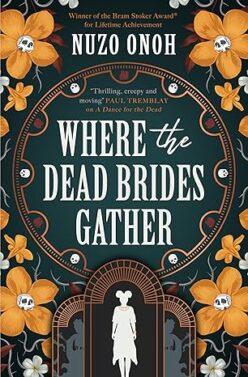
Summary of Where the Dead Brides Gather by Nuzo Onoh
I. The Arrival of the Black Horse and the Overture of Terror
The narrative commences in a rural Nigerian village in 1977, during the festive atmosphere of FESTAC ’77. The peace of the protagonist’s household is shattered when a rich in-law named Bongo brings a massive, powerful black horse to Uncle Gabriel’s house as a pre-wedding gift for her cousin, Keziah. The horse is an awe-inspiring yet terrifying creature, but from the moment it is tethered to a mango tree, it begins to scream with “human anguish and terror”. These chilling shrieks, which sound like “unearthly sounds of raw terror,” affect the village children and cause the protagonist, ten-year-old Akuabata (Bata), to break out in involuntary rashes.
Bata’s family dynamic is defined by the contrast between her mother, Mama-Ada, a compassionate and devout Catholic, and her stepmother, Ọla (Mama-Ejima). Ọla is a “Pancake-Face” a woman who coats her face in thick powder and bright eye shadow to maintain a facade of glamorous, city-bred beauty. Ọla is obsessed with Lagos City and the “Charlie” perfume she claims white women use. Bata’s elder sister, Ada, is fiery and outspoken, frequently clashing with the lazy but beautiful Ọla. Amidst this domestic friction, Bata suffers from “legendary” nightmares of being chased through a misty forest by chalk-colored women who sprint on all fours. These terrors began after Bata survived a near-fatal fall into a ravine at age five an event the village declared a miracle, though it left her spiritually “blighted”.
II. The First Possession: The Sentinel Awakens
The village medicine-man, Dibia, had previously attempted to cure Bata’s nightmares by replacing her mother’s rosaries with charmed cowrie beads and instructing her to sleep with her legs facing the door so her “dreaming-self” could run from malevolent spectres. However, on the night before Keziah’s wedding, the magic fails. While the adults are at Gabriel’s compound for wedding preparations, Bata falls into a deep sleep and experiences her first true possession.
Bata awakens to find herself sitting naked and cross-legged before Keziah’s bedroom door in Gabriel’s house. To her horror, her entire body is coated in a “brilliant white paint” that is actually her skin, hair, and eyes having turned “dazzling white”. She possesses an unearthly power, shoving her mother away with “instinctive” force and finding herself physically “glued” to the floor. As the villagers panic and Keziah finds herself trapped inside her room by an invisible force, Papa (Okeke) arrives and treats Bata with an uncharacteristic “gentleness” and “pity,” sensing she is caught in a supernatural struggle.
The Dibia arrives and recognizes that Bata is a vessel for a spirit. Within her consciousness, a “tall sentinel” takes over. Bata’s body triples in height, and she is garbed in a dazzling red kaftan and gauze veil, becoming a “blood-bride”. She confronts the malevolent spirit of Anene Eze, a “Ghost-Bride” dressed in a mud-stained wedding gown. Through a shared psychic vision, the Sentinel reveals Anene’s past: she was a mistress who hired assassins to kill her lover’s wife, only to be killed herself on her wedding day by the vengeful ghost of the murdered wife. The Sentinel, possessed by the spirit of that same murdered wife, battles Anene with bolts of red flame. Anene attempts to hide within the body of Gabriel’s black horse, turning the animal white and causing its death-throes just as the Sentinel vanquishes her with a charmed Ọji-Ikéngᾲ (Kolanut).
III. The Prophecy of the Bride-Sentinel
Following the battle, Bata wakes up in her room with no memory of the event. Her family treats her with a mixture of “excitement and puzzlement,” and even the usually indifferent Ọla offers her food. Papa takes her to a gathering of the village elders, where Dibia announces a “wondrous phenomenon”: Bata is a Bride-Sentinel. Dibia explains that most Ghost-Brides are harmless spirits who merely want to experience a wedding they missed in life, but others are “evil ghosts” with “vengeful souls” like Anene Eze, who seek to destroy human brides. Bata has become a “living ghost that vanquishes dead ghosts”.
This revelation transforms Bata’s social standing. Uncle Gabriel falls to his knees to thank her for saving Keziah’s soul, and villagers begin besieging her with pleas to protect their own daughters. Despite the “unfamiliar pride” this attention brings, Bata is haunted by the realization that she is “both dead and alive”. Papa, now fiercely protective, promises that she is “protected by both our ancestors and the gods”.
IV. The Sojourn in Ibaja-La: The Realm of Dead Brides
Bata falls ill after the wedding, her body “smeared with chicken blood” as Dibia attempts a purification ritual. During the ceremony, she is visited by Mmuọ-Ka-Mmuọ, the “ghost-collector of the spirit realm”. This towering, oily-black spectre with “multiple cascading faces” and a beard explains that Bata’s body has become a magnet for restless ghosts. To save her, Mmuọ-Ka-Mmuọ takes Bata’s spirit to the dead realm to “acclimatise to ghost-hood”.
Bata arrives in Ibaja-La, “the place where the dead brides gather”. It is a foggy terrain of dazzling whiteness that opens into a “silvery universe” of eternal wedding banquets. She meets Ghost-Brides from every culture: Madison-from-Texas, Jeong-from-Gwangju, Emma-from-Quebec, Guadalupe-from-Mexico, and Aaliyah-from-Dubai. These brides spend eternity “conjuring” sumptuous meals and fashion through the power of their thoughts. Bata learns that brides stay in Ibaja-La until their former grooms remarry, at which point they can exchange vows in the spirit realm and “hurry our reincarnation” to find their “twin-flames” in the next life.
Bata is eventually summoned to The Great Council of Guardians, eight bearded giantesses who all wear the face of Bata’s own mother to put her at ease. They reveal they were once “Seekers” (witches) who sacrificed their own grooms for power and now maintain Ibaja-La and its antithesis, The Wastelands, as a “conscience-project”. The Guardians test Bata’s knowledge of Ghost-Brides such as their sweet scents and silver-grey eyes. Having proved herself a “prodigy,” she is bequeathed The Eight Faces of Devastation: Petrify, Soothing, Fire, Skinning, Melting, Vanishing, Healing, and Annihilation. These powers will remain “hidden inside” her, awakening only when she turns white to face danger.
V. The Horror of The Wastelands
Before leaving Ibaja-La, Bata is approached by Gisèle-from-Paris (Gisèle Dubois), a “Repentant” from The Wastelands. Gisèle had committed suicide after a web of lies involving her sister’s fiancé and had spent years possessing other brides and wrecking lives. Despite her “cool smile,” Bata is repulsed by Gisèle’s blue eyes and the “vile green fumes” and rank odor of “raw chicken and wet dog” she emits.
Gisèle tricks Bata into visiting a vast ravine, where they summon a “mammoth blue frog” that expands to form a bridge to a desolate landscape. Bata realizes with “inexplicable terror” that she is in The Wastelands, the realm of her childhood nightmares. Gisèle reveals she recognized Bata as a Bride-Sentinel and has brought her there to be killed by her “sisters”. The evil Ghost-Brides of The Wastelands, who run on all fours and stink of decay, attack Bata, mauling her body. In a moment of survival, the “icy presence” of the Sentinel awakens. Bata’s faces begin cascading, and she uses her obsidian eyes to release “invisible waves of death,” reducing the “bride-vermin” to heaps of white dust. She uses the Annihilation Face to disintegrate Gisèle before Mmuọ-Ka-Mmuọ arrives to rescue her, weeping for the “great burden” the child must now bear.
VI. Return to the Human World: A Cursed Existence
Bata returns to her body after being dead for three hours. She awakens in Dibia’s shrine to find her eyes are still a “solid silvery hue” and her voice has transformed into a “creepy multitude of voices” that echo with the sounds of the dead. Dibia warns that she has returned in a “spirit state” and will take time to recover. Bata also discovers a new, unwanted power: she can read the thoughts of those near her.
This “affliction” ruins her domestic life. Mama is “driven by fear and confusion,” and Ada abandons their shared room, afraid of having her mind invaded. Papa forbids her from spying on thoughts, threatening to send her to live with Dibia permanently if she continues. Bata lives in “unhappy isolation,” hiding behind dark sunglasses and self-imposed mutism to avoid terrifying her family. Her only comfort is reading fairy tales, in which she sees the “dazzling glory” of her Ibaja-La friends.
VII. The Treachery of Ọla and the Death of a “Pancake-Face”
Nine months later, Papa summons Bata and gives her a “secret assignment”: he wants her to read Ọla’s mind. He suspects Ọla is involved with a man named Ugo of Amadi clan. Bata is torn by guilt, as Ọla is the only one who remembers her eleventh birthday and gives her a gift. However, while putting the triplets to bed, Ọla’s thoughts “bombard” Bata’s head: she is planning to steal Papa’s store keys and money box to run away to Lagos with Ugo.
Ọla catches Bata reading her mind and threatens to send her to work as a “domestic servant in Enugu” if she tells Papa. She forces Bata to accompany her to a midnight meeting with Ugo by the stream. There, Bata reads Ugo’s mind and discovers a “murderous inferno”: he is a serial killer who plans to kill Ọla as soon as he has the stolen money, just as he did with women named Efuru and Gloria.
In a desperate attempt to save Ọla, Bata breaks her silence and speaks in her terrifying voices, warning Ọla that Ugo will “stab you to death”. Ọla, terrified by both the message and the “Discordant” voice, faints. When she wakes, she has descended into “the fever of madness,” believing Bata is a deity and prostrating herself at the child’s feet. Ọla becomes a “leashed dog,” following Bata everywhere and chanting praises to her “Great Spirit”.
The scandal breaks when Dibia reveals that Ugo is betrothed to the chief’s daughter, Amara. Papa, enraged by the “shameful secret,” beats Ọla and pulls her braids, causing her to bite him in a fit of lunacy. The village kinsmen decide Ọla will remain in the compound but decree she must be “flogged naked in the marketplace” as punishment. To escape this “humiliating” fate, Ọla regains a brief spell of sanity, reapplies her famous Pancake-Face make-up, and commits suicide by swallowing a bottle of Phenergan. She is buried as a “cursed corpse” in the Ajọ-Ọfia (bad bush) at midnight.
VIII. The Final Battle in Chief Omenga’s Mansion
Following Ọla’s death, her ghost begins visiting Bata daily, whispering “Help me… I don’t want it”. The haunting only stops when the triplets see her “scary heaven-face” by the door. On Christmas Day, the tension in the village explodes when Papa assaults Ọla’s best friend, Teacher Uzo, for wearing the dead woman’s clothes.
That night, the “unholy stench” of The Wastelands returns. Bata turns white and naked, and she is abducted by eight flying geladas with dazzling red wings manifestations of Mmuọ-Ka-Mmuọ. Mmuọ-Ka-Mmuọ explains that Bata must fight her “final battle” to be set free. She is dropped into the compound of Chief Omenga, where his daughter Amara is being “hauled furiously” across the ground by invisible hands.
Bata transforms into her “mammoth glory,” with a long beard and cascading faces. She sees that Amara is possessed by the vengeful Ghost-Brides of Efuru and Gloria Ugo’s murdered victims. Using the Melting Face, Bata destroys Efuru’s ectoplasmic arms, and then uses the Petrify Face to freeze the ghouls into “frozen holograms of horror”. She annihilates them with her final face just as a third, “righteous” Ghost-Bride appears the spirit of a teenager who died on an abortion table after Ugo abandoned her.
Bata cannot fight this girl, as she has “clean hands.” She uses the Healing and Soothing Faces to calm the spirit, but the girl refuses to leave until she sees Ugo. Finally, the ghost of Ọla appears in her wedding gown. Ọla reveals that Mmuọ-Ka-Mmuọ has offered her a lifeline: she can become the new Bride-Sentinel of the ten villages, allowing Bata to finally be free. Bata willingly relinquishes her powers, her skin returning to “human brownness” and her voice to a child’s pitch.
The “new Bride-Sentinel,” Ọla, summons Ugo. The teenage Ghost-Bride, fueled by “red vengeance,” suspends Ugo from the ceiling and “gores out his heart”. Ọla and the girl vanish, leaving Ugo’s “tortured corpse” on the floor.
IX. Epilogue: The Lawyer and the Guardian
Bata is hailed as the “Saviour of Brides”. Chief Omenga rewards her by sponsoring her education at Queen’s College, Lagos, and eventually at a university in America. Over the years, Bata fulfills her dream of becoming a seasoned lawyer in Lagos and building Papa a storey-building. Her brothers also find success: Nnamdi (Ejima-One) becomes a businessman, Vascot (Ejima-Two) a professional footballer, and Nonso (Ejima-Three) an architect.
On the eve of her thirty-third birthday and her own wedding to Falk (the son of Engineer Tip-Toe), Bata is overcome with terror that the evil Ghost-Brides will return. However, her bedroom is illuminated by a silvery light, and her old Ibaja-La friends Jeong, Guadalupe, Emma, and Aaliyah surround her. They inform her that Madison has already been reincarnated. Bata opens her door to find the ultimate protection: Mmuọ-Ka-Mmuọ and Ọla standing sentinel in the corridor. With a “gentle smile” from her stepmother’s cascading faces, Bata realizes she is finally safe, watched over by the “greatest of Bride-Sentinels”.