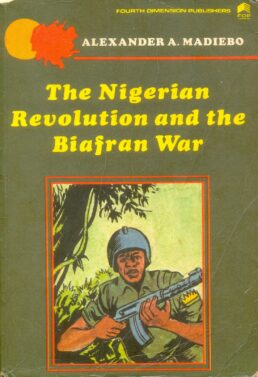
Summary
The Nigerian Revolution (1966): The book begins by detailing the political and military instability of the Federation of Nigeria, rooted in an artificial amalgamation in 1914 and a “Divide and Rule” system introduced by British colonial masters to protect economic interests. Tensions escalated through tribal political parties and rigged elections in the 1960s, leading to the January 15, 1966 coup led by Major Chukwuma Nzeogwu. While the coup successfully toppled the civilian government, it was only partially successful in the South, where General Ironsi took control.
The Counter-Revolution and Secession: Ironsi’s regime attempted to rule through a “policy of compromise,” failing to address Northern fears of Southern domination. This culminated in the May 1966 “Araba” riots and the July 1966 counter-coup, characterized by the systematic massacre of Southerners (especially Ibos) in the North. Madiebo details his own harrowing escape from the North via a goods train water tank to reach the safety of the East. Following the breakdown of peace talks at Aburi, Colonel Ojukwu declared the independent Republic of Biafra on May 30, 1967.
The War (1967–1970): The narrative provides a detailed tactical account of the war, where a poorly equipped Biafran Army faced a Nigerian force bolstered by foreign (especially British and Russian) support. Key military phases include:
- Initial Battles: Confrontations at Garkem, Obudu, and Nsukka showed Biafran bravery but also their lack of anti-tank and artillery capabilities.
- The Midwestern Invasion: A bold but ultimately disastrous move led by Colonel Victor Banjo that failed due to a lack of speed and internal political infighting.
- Sieges and Falls: The loss of major cities like Enugu, Calabar, Port Harcourt, and Umuahia were punctuated by brief, morale-boosting victories, such as the destruction of a Nigerian convoy at Abagana and the temporary recapture of Owerri.
The Final Collapse: By late 1969, the Biafran Army was decimated by a total blockade, lack of ammunition, and widespread hunger. Political paranoia regarding “saboteurs” and the disbandment of effective units like the 12th Division led to a total breakdown in command. Ojukwu departed for a “peace mission” on January 10, 1970, leaving General Efiong to surrender.
Setting
- Time Period: January 1966 to January 1970.
- Geography: Primarily Nigeria and the breakaway Republic of Biafra. Major locations include Northern cities like Kaduna and Kano, and Eastern locations like Enugu, Nsukka, Onitsha, Port Harcourt, Umuahia, and Owerri.
Themes
- Unity vs. Disintegration: The book explores how the lack of a “basis for true unity” among diverse ethnic groups led to the country’s fracture.
- The “Saboteur” Mania: A recurring theme where internal paranoia and political accusations of sabotage were used to explain military defeats, often destroying the careers of competent officers and undermining morale.
- Leadership and Power: Madiebo critiques Ojukwu’s “solo rule” and the lack of collective leadership, arguing that personal political ambitions sometimes superseded the military needs of the state.
- Survival Against Odds: The struggle of the “Biafran common man” to endure for three years under a total blockade and with virtually no weapons.
- Foreign Influence: The role of Great Britain and Russia in supporting Nigeria for economic interests, versus the largely sentimental or inadequate support Biafra received.
Key Characters
- Alexander A. Madiebo: The narrator and GOC of the Biafran Army who attempts to render a “dispassionate account” of the war.
- Chukwuemeka Odumegwu-Ojukwu: The Military Governor of the East and later Head of State of Biafra; portrayed as a complex leader who held absolute control.
- Chukwuma Nzeogwu: The idealistic leader of the January 1966 coup who sought to replace “corrupt politicians” with “honest progressives”.
- General Ironsi: The first indigenous General of the Nigerian Army whose “regime of compromise” failed to prevent the counter-coup.
- General Yakubu Gowon: The leader of Nigeria during the civil war who initially supported secession for the North but later fought for a “One Nigeria”.
- Colonel Joe Achuzia (“Hannibal” / “Air Raid”): A controversial, civilian-turned-officer known for his unorthodox tactics and close relationship with Ojukwu.
- Colonel Victor Banjo: A Yoruba officer who led the Midwestern invasion but was later executed for an alleged attempt to overthrow Ojukwu.
Literary Devices
- First-Person Narrative: As an “authentic eye-witness account,” the book uses Madiebo’s war diary to lend credibility and personal insight into the chaos of the time.
- Imagery: Madiebo uses stark imagery to describe the horrors of the pogroms (e.g., “the headless corpse of an Ibo man”) and the physical toll of kwashiokor (skeletal children).
- Irony: The book notes the irony of Gowon fighting for a united Nigeria after originally planning to secede, and Biafran soldiers needing to use “rattles” to simulate machine gun fire due to ammunition shortages.
- Proverbs and Parables: Characters often speak in proverbs (e.g., Nzeogwu’s “when a strong wind blows, all the grass bends low”) to convey hidden meanings in a tense political climate.
- Symbolism: “Corporal Nwafor” (a captured Nigerian saladine armoured car) became a symbol of Biafran ingenuity and resilience.