
You can listen to the Book Summary Below
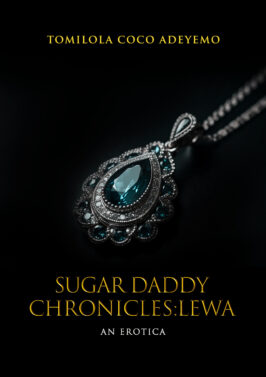
The narrative of Sugar Daddy Chronicles: Lewa by Tomilola Coco Adeyemo is a complex, multi-layered erotica that traverses the dangerous intersections of the Nigerian elite’s “sugar baby” culture, traditional occultism, and the desperate search for love amidst institutionalized betrayal. The story follows Omolewa (Lewa), a twenty-four-year-old graduate from Oyo town, as she is lured into a high-stakes world of prostitution and power by her aunt, Sisi (Funke Alao), only to find herself ensnared in a spiritual and physical battle for her soul.
The Initiation: The Oath at Ajah
The story commences on a tempestuous night in an Ajah mansion, a place defined by its intimidating fences and opulent interior featuring gold chandeliers and a life-sized painting of the orisa Orunmila. Lewa is one of four girls brought there by Sisi to swear an eternal oath of loyalty. This is not a standard business agreement; it is a spiritual contract overseen by Sho (Dimeji Shogbesan), a handsome and terrifyingly cold babalawo who possesses a foreign accent and hazel-brown eyes.
The ritual is grim. Dressed in pristine white, Sho compels Lewa to strip and sit on a mat where he divines her fate using the ọ̀pẹ̀lẹ̀ ifá. He reveals that Lewa is a “good investment,” but he glimpses a darker path in her future a realization that he keeps secret from Sisi but which fundamentally alters the course of his relationship with Lewa. As part of the initiation, Lewa is forced to swear before Yewa, the goddess of the tomb, that any betrayal of Sisi will result in a violent, unrecognizable death. To seal the pact, she is given a concoction of water, alligator pepper, and local gin, which induces a heady, loosened state.
The “final stage” of their unveiling involves a test of sexual prowess. Sisi, a woman in her fifties who maintains a tight, Botox-injected facade, watches as Lewa is instructed to seduce Sho. In a scene that blurs the lines between a job assignment and a visceral awakening, Lewa enters into a threesome with Sho and Sisi. It is here that Sho delivers a chilling lesson: for Sisi’s girls, sex must be mechanical. He warns Lewa not to get lost in the pleasure, for it is merely a job designed to satisfy the client.
The Architecture of the Business
Lewa soon discovers that one of the girls from her group has already died, her body “handled” by a man named Albert. Despite the looming threat of death, Lewa is driven by a crushing sense of responsibility toward her family in Oyo. Her mother, who has not worked since leaving an abusive marriage, treats Lewa as a financial ATM, constantly calling to demand money for rent and siblings’ school fees.
Sho takes Lewa under his wing, acting as both a pimp and a mentor. He takes her to a meeting with Godwin, a marketer in Victoria Island, riding a supercharged power bike that provides Lewa with a thrill akin to a drug high. At the meeting, Sho demonstrates his masterful diplomacy, manipulating Godwin into including Sisi’s girls in high-profile branding campaigns. However, the tension between Sho and Lewa escalates when she questions his flirtations with Godwin’s assistant. Sho reminds her of the power dynamic: “Has it then occurred to you that maybe I have her [Sisi’s] permission to fuck anybody I want?”.
The “office” for these women is their own bodies. They are prepared for a high-profile “Red Party” attended by bank CEOs and politicians. Sho emphasizes that their goal is simple: make everybody happy. If the clients are happy, Sisi is happy, and their survival is guaranteed. He also imposes a strict aesthetic: no cheap clothes from Fashion Nova or Shein, only the finest presentation for the elite.
The Double Life: Madé and the Secret in Ijebu Ode
A significant portion of Lewa’s motivation lies in her secret life. She is married to Madé, a handsome unionist she met in school. They had lost a stillborn child, and their current plan is to raise enough money for a “Japa” move to Canada to escape poverty. Madé is aware that Lewa works for Sisi, though he remains blissfully ignorant of the brutal specifics, believing her role is limited to “modeling and ushering”.
During a visit to see Madé in Ijebu Ode, Lewa attempts to “scrub her morals clean” through the intimacy of her marriage. However, her thoughts are increasingly invaded by memories of Sho. The return to Lagos is marred by a harrowing encounter with Albert, Sisi’s driver. Albert, knowing the secret of Lewa’s husband, attempts to blackmail her. He traps her in the car and assaults her, forcing her to “convince” him not to tell Sisi about her marriage. Lewa, realizing the danger she is in, submits to him, but she threatens to “destroy” him if he ever calls her an asewo (prostitute) again.
The Escalation: Minister Isa and Physical Trauma
Lewa is paired with the Minister of Finance (Isa), a powerful, snobbish Northerner who views her as a “breathing sex doll”. Isa’s relationship with Lewa is defined by a rigid set of rules: she must use cutlery correctly and maintain a “prim and proper” mien, yet his sexual demands are brutal and often involve anal sex and physical aggression.
The situation with Sisi reaches a boiling point when another girl, Bunmi, attempts to rebel. Bunmi, an aspiring influencer who seeks a way out of the oath, clashes with Sisi over money. In a chaotic scene at the house, Bunmi attacks Sisi with a knife, and Lewa is accidentally slashed across the face while trying to intervene. Sho arrives and flings Bunmi across the room, rescuing Lewa and taking her to the hospital.
At the hospital, Sho’s concern for Lewa feels genuine, yet he remains an enigma. He warns Lewa that he knows about her husband in Ijebu and that he could use this information to force a confession out of her regarding Bunmi’s plans to leave. He tells her, “Your whole life is my business”. Shortly after, Lewa is summoned by Isa, who is in a “mood” due to political pressure from the President for his cabinet to step down. In a fit of rage, Isa brutally assaults and rapes Lewa when she accidentally mentions his “home,” an area he considers private. Traumatized, Lewa skips the protocol and calls Sho directly via Instagram DM for help.
The Sanctuary and the Reveal of Sho’s Past
Sho picks Lewa up from Isa’s house and takes her back to his home in Ajah instead of the Lekki duplex. This marks a turning point in their relationship. He introduces her to “Now We Are Free” from the Gladiator soundtrack, a piece of music that highlights their shared sense of entrapment. Under Sho’s care, Lewa experiences her first drag of weed to calm her nerves, and they share an intimacy that goes beyond the mechanical sex Sho previously preached.
In this “cocoon,” Sho reveals the tragic origins of his loyalty to Sisi. Sixteen years prior, as a bright-eyed teenager, Sho had sought out his wealthy businessman father in Abeokuta. Instead of an angel, he found a monster who viewed him as a “stench of poverty” and subjected him to horrific physical abuse with leather belts and award plaques. Sisi, then one of his father’s loud and unrefined mistresses, was the only person who ever intervened, holding his father’s hand back as it was about to strike him. Sho felt an eternal debt to her, a “blood covenant” that turned him into her most loyal enforcer.
The Death of Bunmi and the Web of Organ Trafficking
The fantasy of Lewa’s “baby girl” life is shattered when Bunmi is found dead. Her body is discovered missing all its organs a horrific revelation that Sisi is involved in organ trafficking. Sho reveals that Sisi has a history of such murders, including a former girl named Juliet, who tried to start her own agency. Sho had been dating Juliet at the time and, despite his feelings for her, he had prioritized his loyalty to Sisi, essentially giving Juliet up to her death.
Nkechi, another of Sisi’s girls, reveals to Lewa that Sho is not just a pimp but a “demon” who previously murdered his own half-brother, Lekan. Sho eventually confesses this to Lewa: after his father died, Lekan had him locked up and threatened to destroy him. In a blind rage fueled by years of mistreatment, Sho beat Lekan to death and used his spiritual powers to “compel” a witness into silence.
The Climax: The Duel and the Descent into Chaos
Lewa attempts to return to her life in Oyo to find peace, but Sisi strikes again. Lewa is involved in a near-fatal motorcycle accident, a “warning” that the oath she swore is real and cannot be escaped. Sho reappears at the hospital in Oyo, paying her bills and taking her to a riverbank for a “traditionalist” cleaning ritual to ward off further accidents. He insists she must return to Lagos, for “the next accident might just claim your life”.
Back in Lagos, the truth about Lewa’s husband, Madé, is finally revealed. She tracks him to Yaba, only to find that he has moved on and married a teenager named Jola. Madé is unrepentant; he used the money Lewa earned through her suffering to fund a new life with another woman, claiming that Lewa had become “insatiable” and “like a harlot”. Devastated, Lewa realizes she has lost everything her family, her marriage, and her sense of self.
As Sisi’s empire begins to crumble under a manhunt for organ trafficking involving Isa and other government officials, Sho disappears into hiding. He leaves Lewa with a luxurious Ikoyi apartment and instructions on how to protect herself spiritually. The final chapters depict a city in chaos: Isa is arrested in the UK, Sisi is eventually murdered by the very “devils she ate with,” and Lewa’s story becomes the subject of a bestselling exposé titled Phoenix by Chukwudi Nnamani, a wealthy businessman Lewa had briefly dated.
The Epilogue: An Eternity Later
The novel concludes “an eternity later” in the countryside of Ghana. Sho, who had gone into solitude to seek absolution from the “bad karma” of his life, has been living as a farmer, his hair now in natural locs and his mien one of peace. Lewa, having built a successful career in marketing, finds him by chance.
Their reunion is one of profound emotional release. Despite the years of silence, Sho admits he never returned to her because he didn’t want his “bad karma” to touch her or any future children they might have. Lewa, still wearing the topaz necklace Sho gave her a stone for inner peace forgives him. The story ends with the two of them resolving to live together, wherever they choose, as Lewa declares him her “forever sugar daddy” and the love of her life. The final words of the book affirm their bond as àkosílẹ̀ (destiny), a connection that persists “before, during, and after” the darkness they survived.