
Table of Contents
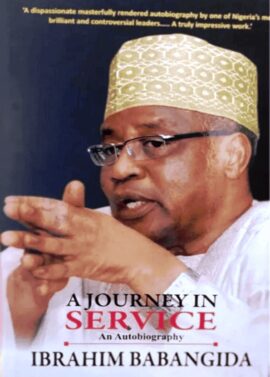
Ibrahim Badamasi Babangida’s autobiography, A Journey in Service, is a comprehensive and reflective narrative detailing the life of one of Nigeria’s most consequential and controversial leaders. Published in 2025, the work provides an insider’s perspective on his path from a modest childhood in Niger State to his eight-year tenure as the Military President of Nigeria (1985–1993). The book is structured into five parts, covering his early years, military training, roles in various coups, the conduct of the Civil War, his radical economic and social reforms, and the contentious events surrounding the June 12, 1993, presidential election.
Part One: Early Years and Formative Influences
Ibrahim Babangida was born in Minna on August 17, 1941, to Malam Muhammadu Badamasi and Inna Aishatu. His father worked as a messenger and interpreter for the colonial district officer, a role that exposed the young Ibrahim to the benefits of Western education and the inner workings of administration. Following his parents’ divorce, he spent time in the rural village of Wushishi, where he recalls the fear of harmattan fire outbreaks and his initial enrollment in a Koranic school. However, his father’s insistence on a Western education eventually led him back to Minna, a town with a rich history as a distribution hub for the Gwari people.
Babangida details his education at the Gwari Native Authority Primary School, where he was nearly rejected for being “too old” until his father provided birth records. He fondly remembers teachers like Malam Awesu Kuta, who inspired his love for English literature, and Malam Yakubu Paiko, who demystified arithmetic through storytelling. These early years were marked by his fascination with the returning servicemen from World War II in 1946, whose uniforms and disciplined march left a lasting impression on him regarding the concept of national service.
In 1957, he entered the Provincial Secondary School, Bida (now Government College, Bida). This institution is noted for producing an extraordinary number of Nigerian leaders, including two presidents and multiple state governors. Babangida was part of the “famous class of ’62,” which included future associates such as Abdulsalami Abubakar, Sani Bello, and Mamman Vatsa. At Bida, he was a versatile sportsman, earning nicknames like “Blockbuster” and “Kulele”. He also showed early leadership and a rebellious streak, leading a “protest” to allow junior students to sleep outdoors during sweltering heat, a move that eventually earned him the position of Head Boy in his final year.
Part Two: Early Military Career and Training
Babangida’s interest in the military was sparked by a career talk given by Captain Yakubu Gowon, an alumnus of his school. Despite his initial desire to study engineering, the political climate of the early 1960s and the encouragement of northern leaders like Sir Ahmadu Bello pushed him and thirteen classmates toward the army. On December 10, 1962, he joined the Nigerian Military Training College (NMTC) in Kaduna as part of Course Six.
The training was grueling and designed to “break” the cadets psychologically. Babangida admits he and Garba Duba briefly considered running away, only to be deterred by Duba’s father, who threatened that they would never find employment elsewhere. After completing his basic training, he was sent to the Indian Military Academy in Dehradun. He chose the Armoured Corps, largely because of his engineering interests and a sentimental attraction to the distinctive Black Beret and French grey and maroon colors of the Indian armored regiments.
Returning to Nigeria in 1964 as a Second Lieutenant, he was deployed to the reconnaissance squadron in Kaduna. It was during this period that he officially added “Babangida” to his name to distinguish himself from those who confused his name “Badamasi” with the Yoruba “Gbadamosi”. He describes his early officer years as a mix of hard work and “partying a lot,” while also participating in operations to quell the Tiv riots and Western Nigeria election disturbances.
Part Three: Governance, Coups, and the Civil War
The book provides a detailed account of the January 15, 1966 coup, which Babangida experienced firsthand in Kaduna. He describes being woken by Lt. Christopher Ugokwe and witnessing the fire at the Sardauna’s residence. While he admits he was too young to fully understand the political motives, he characterizes the assassination of leaders like Sir Ahmadu Bello and Brigadier Zakariya Maimalari as “heinously callous”. He notes that the failure to try the coup plotters fueled the perception of Igbo domination, leading to the “terrible times” of the July 1966 counter-coup.
The Nigerian Civil War
The Nigerian Civil War (1967–1970) serves as a central theme of Babangida’s military service. Serving in the 1st Infantry Division under Colonel Mohammed Shuwa, he commanded the 44th Infantry Battalion. He reflects on the “macho myth” of battle, noting that no amount of training can erase the “shadow of death”. He recounts a “close shave” when he impulsively crawled across a field under heavy fire to save his wounded friend, Garba Duba.
In April 1969, during the advance on Umuahia, Babangida was wounded by a Biafran Ogbunigwe shell. Shrapnel lodged in the left side of his chest, and he describes the sensation of his feet going numb before being evacuated to LUTH in Lagos. His recovery period in the hospital prompted deep reflection on his mortality. Inspired by witnessing General Gowon’s wedding on television, he decided it was time to find a wife. This led to his marriage to Maria Okogwu (later Maryam) on September 6, 1969.
Following the war’s end in 1970, Babangida was involved in rehabilitation work in Umuahia, helping to convert hospitals into rehabilitation centers for wounded Biafran soldiers and starving children. He then transitioned into a teaching role at the Nigerian Defence Academy (NDA), where he mentored the “brightest young men” of the Third Regular Combatant Course, later known as the “IBB Boys”.
The 1975 Coup and the Dimka Affair
Babangida acknowledges his role in the 1975 coup that overthrew General Gowon, citing the administration’s indecisiveness and the “Cement Armada” scandal. He became a member of the Supreme Military Council (SMC) under General Murtala Muhammed.
The most dramatic event of this period was the February 13, 1976 coup attempt by Bukar Suka Dimka. Babangida narrowly avoided assassination by instinctively taking a different route to work. Ordered by General Danjuma to “flush Dimka out” of the Radio House, Babangida, unarmed, entered the building to confront his close friend Dimka. He recalls the tense exchange where Dimka told him he was “lucky to be alive”. After a “frank” discussion failed to produce a surrender, Babangida returned with loyal troops to retake the station in a gun battle. The aftermath led to the execution of many of his close friends, including Major Clement Dabang, which he describes as a “dark phase” that drove home the “futility of war” and the “consequences of failure”.
Part Four: The Presidency (1985–1993)
Babangida assumed the Military Presidency on August 27, 1985, following a coup against Major General Muhammadu Buhari. He justifies the takeover by citing the “draconian decrees” and the personalization of power by Buhari and Tunde Idiagbon, which he believed was factionalizing the military. Unlike his predecessors, he adopted the title “President” to signify his commitment to the presidential system and institutional reform.
Economic Reforms: SAP and the IMF
Confronted with an economy on the brink of collapse, Babangida initiated radical reforms along free-market lines. To ensure popular legitimacy, he subjected the issue of an IMF loan to a nationwide public debate. The consensus was to reject the loan but adopt the “sensible conditionalities” as a homegrown Structural Adjustment Programme (SAP).
Key economic measures included:
- Deregulating the foreign exchange market and floating the Naira.
- Privatization and Commercialization of wasteful government enterprises through the TCPC (now the BPE).
- Liberalizing industries such as broadcasting, banking, and domestic aviation, leading to the birth of private outlets and new-generation banks.
- Creating institutions like the NDIC to protect depositors and the Technical Aid Corps (TAC) to project Nigerian soft power in Africa, the Caribbean, and the Pacific.
Socio-Economic Order and Infrastructure
To cushion the “painful consequences” of SAP, the administration established several grassroots agencies:
- DFRRI: Charged with rapid rural infrastructure development, such as boreholes and earth roads.
- MAMSER: Designed to mobilize the masses for a new social and political order.
- People’s Bank and Community Banks: Aimed at providing micro-credit to the urban and rural poor.
- FRSC: Established to improve road safety.
He also highlights the relocation of the federal capital to Abuja and the massive infrastructural push to ensure the city could host the 1991 OAU Summit on short notice after civil war made Addis Ababa unviable.
Foreign Policy and Leadership Challenges
Babangida pursued an activist, Afrocentric foreign policy. This included leading a 30-nation boycott of the Edinburgh Commonwealth Games to protest British opposition to sanctions against Apartheid South Africa. He takes pride in the ECOMOG intervention in Liberia, arguing that Nigeria had a responsibility to stabilize its neighborhood when the rest of the world was indifferent.
However, his presidency was marred by significant challenges:
- The Dele Giwa Murder (1986): The assassination of the popular journalist by a parcel bomb “shook the nation”. Babangida denies any government involvement, calling the insinuation “cheap and foolish,” but regrets that the mystery remains unsolved.
- The Vatsa Coup Plot (1985): His childhood friend, Mamman Vatsa, was executed for a coup plot that included plans to bomb the Eko Bridge. Babangida describes this as a “personal loss” but necessary for national stability.
- The Gideon Orkar Coup (1990): Rebel soldiers invaded Dodan Barracks, reducing Babangida’s residence to “virtual rubble”. His ADC, Lt-Col. U.K. Bello, was killed while Babangida and his family were extracted to a safe house.
- The OIC Controversy: A misunderstanding regarding Nigeria’s observer status at the Organisation of Islamic Conference nearly “set the nation ablaze” with religious tension.
The Home Front: Maryam Babangida
A dedicated chapter focuses on his life with Maryam Ndidi Babangida. He credits her with excellently marshalling the “home front,” allowing him to focus on his military and political career. He details her transformation of the role of First Lady through the Better Life for Rural Women Programme. By 1991, the program had registered over 7,000 cooperatives and established nearly 1,000 cottage industries, moving the role from a mere “pet project” to a tool for mass mobilization. Babangida notes that Maryam’s death in 2009 has left his life “bifurcated” into the time when she was there and the time since she has been gone.
Part Five: Transition to Civil Rule and June 12
The final sections of the book tackle the complex “political laboratory” of the transition to civil rule. Babangida asserts that his administration conducted the “broadest political consultation ever” through the Political Bureau. Determined to nurture a “new breed” of politicians, he banned old-guard politicians and created a mandatory two-party system (SDP and NRC) to prevent the emergence of ethnic power blocks.
The June 12 Saga and Annulment
Babangida admits that the June 12, 1993, presidential election was the most challenging moment of his life. While he was committed to handing over, he describes being caught in a “national stalemate” fueled by court injunctions and internal military opposition. He reveals that General Sani Abacha and other “inside forces” annulled the election without his prior approval while he was in Katsina for a funeral.
Though he officially took responsibility for the annulment, he justifies the decision as a means to prevent a bloodbath or civil war. He notes that the military was dangerously factionalized, with some threatening that an Abiola presidency could only happen over their dead bodies. He eventually stepped aside on August 27, 1993, handing power to an Interim National Government (ING) headed by Ernest Shonekan.
Reflecting on the event decades later, Babangida acknowledges that M.K.O. Abiola won the election based on collated figures and satisfied all constitutional requirements. He expresses gratification that a later administration recognized Abiola as a “former head of state”. He maintains that he decided to “keep the annulment” to protect the nation’s integrity, choosing the pain of personal vilification over the risk of national collapse.
Retirement and Legacy
Since his retirement to Minna in 1993, Babangida has become a “political oracle,” frequently consulted by politicians and traditional rulers. He expresses pride in the enduring institutions he helped build, such as the FRSC, NDIC, and NDLEA.
In his Epilogue: Letter to the Next Generation, he addresses Nigeria’s “opportunity bomb” the youth. He urges them to seek a deep understanding of the country’s diversity and to build a “national youth consensus”. He concludes that while his administration’s outcomes did not always meet everyone’s expectations, they gave their best to a nation in “desperate need”. He defines the “no-go areas” for the future of the nation: federalism, constitutional democracy, secularity, and unity in diversity.
The book ends as a testimony to a life lived in “service to the nation,” with Babangida standing as a “permanent sentry” for Nigeria’s survival and unity.