
You can listen to the Book Summary Below
Table of Contents
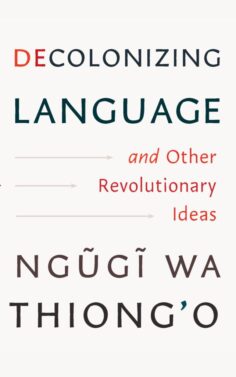
Ngũgĩ wa Thiong’o’s Decolonizing Language and Other Revolutionary Ideas is a profound collection of essays and tributes that explores the enduring impact of linguistic and cultural imperialism on the colonized world, particularly in Africa. The book is divided into two major sections: “Part One: Decolonizing Language,” which establishes the theoretical and historical foundations for his call for a “negation of the negation” in education and intellectual production, and “Part Two: Voices of Prophecy,” which offers personal and professional tributes to the writers, scholars, and activists who have served as the “conscience of Africa” through their resistance and commitment to indigenous knowledge.
Part One: Decolonizing Language
Linguistic Colonialism and the “Colonies of the Mind”
The book opens with an investigation into the historical mechanisms used to suppress native languages and elevate the language of the conqueror. Ngũgĩ uses Ireland as a primary example, noting that it served as England’s first “settler colony” and a laboratory for later imperial practices in Asia and Africa. He cites the 1366 Statutes of Kilkenny, which criminalized the use of Irish by English settlers, and Edmund Spenser’s 1596 treatise, A View of the Present State of Ireland, which argued that forced linguistic assimilation was the most effective means of erasing a people’s memory and subverting their resistance.
This pattern of linguistic erasure was later formalized in India through Thomas Babington Macaulay’s 1835 “Minutes on Indian Education”. Macaulay advocated for the creation of a class of “interpreters” individuals who were “Indian in blood and color, but English in tastes, in opinions, in morals and in intellect” by replacing Sanskrit and Persian with English in the education system. Ngũgĩ observes that this model was exported globally: to Kenya by Sir Philip Mitchell, and to the United States via Captain Richard Henry Pratt, who founded the Carlisle Indian Industrial School under the brutal philosophy of “Kill the Indian in him, and save the man”.
The result of these policies is the creation of “colonies of the mind”. Through a system of “conditioning” involving the reward of glory for excelling in the imperial language and corporal punishment for speaking one’s mother tongue colonial subjects developed a “Pavlovian consciousness”. This trauma has become so internalized that post-independence nations often nationalize these “abnormalities,” viewing European languages as the sole gateway to modernity while viewing their own languages as “enemies of progress”. Ngũgĩ argues that decolonization must involve the “negation of the negation,” where knowledge starts from one’s own base and mother tongues are reclaimed as valid sources of intellectual and artistic inquiry.
The Body as a Field of Knowledge
Ngũgĩ posits that all knowledge begins with the human body, which is the “primary field of knowledge and production”. He argues that all technology is essentially a “projection” of the body’s natural attributes: the computer replicates the brain’s squishy hard drive; the car and spaceship extend the leg; and the telescope extends the eye.
Colonialism sought to destabilize this relationship by demeaning the African body and erasing the memory of its historical achievements in technology and innovation. Ngũgĩ critiques Enlightenment thinkers like Hume, Kant, and Hegel, who claimed that Africa was “enveloped in the dark mantle of the night” and had produced no arts or sciences. This intellectual erasure was followed by the destruction of the African artisan class, which ended the tradition of passing on inherited knowledge from generation to generation. Consequently, many educated Africans grew up believing the “nonsense” that Africa never even invented the wheel, viewing the outsider as the sole source of progress. To reverse this “looting mentality,” the modern African university must adopt a cognitive process built on the principle of “from our base to the world”.
Education Models: Horton vs. Blyden
Ngũgĩ identifies a “great divide” in the vision for higher education in Africa, exemplified by two nineteenth-century Sierra Leonean intellectuals: James Africanus Beale Horton and Edward Blyden.
- The Horton-Asquith Model: This model favored an “undiluted Western education,” viewing European classics and languages as the foundation of excellence. This vision triumphed in the establishment of colonial colleges like Makerere and Ibadan, creating an elite class that remained “exiles at home” and “beings for others”.
- The Blyden-Hayford Model: Blyden and J.E. Casely Hayford argued for an education system that freed the mind from “despotic Europeanizing” and made African languages and history integral to the curriculum. They envisioned the university as a seat of African learning that would give leadership to African thought and development.
Ngũgĩ describes language as the “memory bank of a people” and the carrier of their spiritual strength. When literature is written in imperial languages, it becomes “parasitic,” sucking blood from African languages without giving anything back. He calls for a “network, not hierarchy” approach to education, where all languages are recognized as “treasuries of history, beauty, and possibility” linked by the common language of translation.
Part Two: Voices of Prophecy
The second half of the book celebrates the individuals who have acted as the “conscience of Africa”. Ngũgĩ emphasizes that these intellectuals are not a new creation; they are part of a lineage that includes Egyptian seers, West African griots, and Swahili poet-intellectuals like Muyaka bin Haji.
Literary Luminaries: Achebe, Soyinka, and Mũgo
- Chinua Achebe: Ngũgĩ describes Achebe as a mythical figure who “bestrides generations and geographies”. Achebe’s Things Fall Apart served as an inspiring model for African writers to tell their own stories and put away “complexes of denigration”. As the editor of the African Writers Series, Achebe was instrumental in the emergence of modern African literature.
- Wole Soyinka: A “Renaissance figure” and Nobel laureate, Soyinka is lauded for his unwavering stand against tyranny. Ngũgĩ highlights the profound impact of Soyinka’s prison memoir, The Man Died, which became a “testament of hope” for political prisoners in Kenya. Soyinka’s famous line, “The man dies in him who keeps silent in the face of tyranny,” serves as the “conscience of Africa”.
- Mĩcere Mũgo: Mũgo is celebrated as a “pathfinder” and the first Kenyan woman to earn a PhD in literature. She and Ngũgĩ collaborated on the play The Trial of Dedan Kĩmathi, a major intervention in reclaiming Kenyan history from colonial perspectives. Mũgo’s “onion theory of orature” emphasizes the layers of depth and participation found in oral traditions.
Political and Social Activists: Abdalla, Mazrui, and Mandela
- Abdilatif Abdalla: One of the greatest poets of the Kiswahili language, Abdalla was imprisoned for sedition after publishing the clandestine pamphlet Kenya: Twendapi? (Kenya: Where Are We Going?) in 1969. His prophetic question continues to challenge generations to discuss the structural changes needed for genuine democracy.
- Ali Mazrui: A “global African,” Mazrui made Africa visible in the highest echelons of intellectual production. Although they differed on politics, Ngũgĩ admired Mazrui’s “triple heritage” analysis integrating indigenous, Muslim, and Christian influences and his defense of human rights.
- Nelson Mandela: Ngũgĩ refers to Mandela as an “African Prometheus” whose endurance in prison symbolized the infinite capacity of the human spirit to resist. In their meetings, Mandela focused on the role of books in buoying the spirits of political prisoners. Ngũgĩ notes that Mandela’s release in 1990 was a global victory against the “color line” and a rejection of neocolonial arrangements.
Publishing and Feminism: Chakava and Ogundipe
- Henry Chakava: As the CEO of East African Educational Publishers, Chakava is praised as a “model of development in Africa”. He showed immense courage by publishing Ngũgĩ’s Gĩkũyũ works despite assassination attempts and government harassment. Chakava created a model for a self-reliant African publishing industry that works from its base in Africa rather than exporting raw literary material to Europe.
- Molara Ogundipe: A pioneer in “dialectical African feminism,” Ogundipe utilized a Marxist perspective to analyze the “six mountains” of oppression facing African women. She argued that the liberation of women is a necessary condition for the “humanization” of society as a whole.
Conclusion: The Education of the Imagination
Ngũgĩ concludes with a tribute to Es’kia Mphahlele, who believed that writers serve as both a “mirror and the conscience of their society”. Mphahlele emphasized the “education of the imagination,” arguing that the arts are the essential “food” that prevents the human soul from shriveling. For Ngũgĩ, the ultimate goal of decolonization is to empower the “ordinary man and woman who speak their language,” allowing them to connect with the globe without delinking from their own worlds. By drawing from the “magic fountain” of native tongues, Africa can “leap into tomorrow” and help light the way for a more inclusive humanity.