
Table of Contents
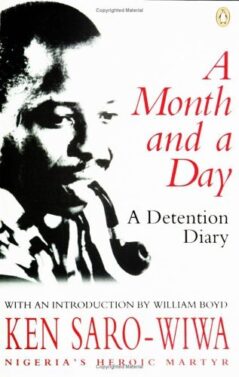
Ken Saro-Wiwa’s A Month and a Day: A Detention Diary is a powerful, posthumously published memoir that serves as both a record of his 1993 imprisonment and a definitive manifesto for the Ogoni people’s struggle against ecological devastation and political marginalization. The book is framed by an introduction from the British novelist William Boyd, who identifies Saro-Wiwa as a prolific writer, publisher, and producer of Africa’s most popular soap opera, Basi & Co., who was ultimately a victim of a “judicial process” that was internationally condemned as a sham. Saro-Wiwa was an innocent man who used his talents to enable a small ethnic minority to confront their tormentors, leading to his execution by the military regime of General Sani Abacha on November 10, 1995.
The UTC Junction and the Commencement of the Ordeal
The narrative begins on June 21, 1993, at the busy UTC junction in Port Harcourt. Saro-Wiwa describes how his car was suddenly flagged down by an armed security man, marking his fourth arrest in just three months. Despite his adamant refusal to descend from his car, superior officers ordered his chauffeur to perform a U-turn and follow them in a convoy to the offices of the State Security Service (SSS). The atmosphere in the SSS building was ominous, defined by a “crummy” and run-down environment that reflected the general state of public property in Nigeria.
Saro-Wiwa was subsequently taken to the State Intelligence and Investigation Bureau (SIIB), where he was asked to write a statement regarding his activities on June 12, 1993, the day of the presidential election. The Ogoni, under the leadership of the Movement for the Survival of the Ogoni People (MOSOP), had boycotted this election to protest their lack of representation and the constitutional expropriation of their resources. Saro-Wiwa notes the irony of being interrogated by a senior police officer from Sokoto whom he characterizes as one of the “indigenous colonizers” from the north while the lower-ranking staff from the “slave areas” of the south were often more sympathetic. During this initial detention, he engaged in a civil conversation with an Izon police officer who expressed sympathy for the travails he had suffered.
The Journey in “The Coffin”
The most physically grueling aspect of his initial detention was the road journey from Port Harcourt to Lagos. Saro-Wiwa was ordered into a Peugeot J5 passenger bus, which he refers to throughout the book as “The Coffin”. The vehicle reeked of petrol, as it carried several jerry cans of fuel due to a national shortage, making him feel physically ill. The journey lasted roughly twelve hours, during which Saro-Wiwa remained wide awake, reflecting on the tremendous courage shown by the Ogoni people in the months since he had begun his agitation.
He was accompanied by Kenneth Ogbeifun, an Assistant Commissioner of Police and a history graduate who treated him with a measure of respect born of education. Upon arrival at Alagbon Close in Lagos, the headquarters of the Federal Investigation and Intelligence Bureau (FIIB), Saro-Wiwa was struck by the filth and “grimy” nature of the reception area. There, he was visited by his lawyer, Dr. Olu Onagoruwa, and various family members and friends who provided him with food and comfort. Despite Saro-Wiwa’s offer to pay for airfare for the entire party to return to Port Harcourt for a court hearing, the police insisted on another long road journey.
The return trip included a stop at Abagana Police Station to pick up two other Ogoni detainees: N.G. Dube, a member of the MOSOP Steering Committee, and Kabari Nwiee, a local youth leader. The trio was eventually deposited at the Imo State Police Command in Owerri on the night of June 23.
The Roots of the Struggle: A Historical Context
While Saro-Wiwa lay idle in the “illegal detention” of the Owerri cell, he used the time to document the history of his commitment to the Ogoni cause. His concern was an “article of faith” nurtured since primary school and codified in his 1968 pamphlet, The Ogoni Nationality Today and Tomorrow. He reflects on the Nigerian Civil War (1967-1970), noting that the conflict was fundamentally about the control of oil resources belonging to the ethnic groups of the Niger Delta. During the war, he had identified with the Federal government to avoid the Ogoni’s continued enslavement within a secessionist Biafra, eventually serving as the Administrator for Bonny.
However, the post-war era did not bring the prosperity he had hoped for. Instead, the military government centralized power, facilitating the “purloining” of Ogoni resources while paying mere lip-service to federalism. Saro-Wiwa spent the late 1970s and early 80s building a limited financial base through trading and property to ensure his family’s security before dedicating himself fully to the Ogoni cause. By 1983, he turned to writing and publishing, believing that literature in a critical situation must be interventionist. He describes the writer as a “l’homme engage” an intellectual man of action who must establish direct contact with the masses.
The Birth of MOSOP and the Bill of Rights
The formalization of the struggle began in 1990 with the formation of the Movement for the Survival of the Ogoni People (MOSOP). Saro-Wiwa was instrumental in drafting the Ogoni Bill of Rights, which was presented to the Nigerian government in October 1990. The Bill outlined twenty points of grievance, including:
- The fact that the Ogoni have provided the Nigerian nation with over thirty billion dollars in revenue but have received nothing in return.
- The total lack of representation in Federal institutions.
- The complete degradation of the Ogoni environment, turning the homeland into an “ecological disaster”.
- The fact that the Ogoni people wallow in “abject poverty and destitution” despite the wealth of their land.
Saro-Wiwa spent 1991 and 1992 mobilizing the Ogoni masses through a “scientific” methodology of public education. He toured the six Ogoni kingdoms, outlining the case for political autonomy and environmental restitution. He was particularly encouraged by a meeting in Kpor, where a “sea of faces” responded with overwhelming enthusiasm to his message of resistance. This mobilization culminated in the mammoth protest march of January 4, 1993, which involved an estimated 300,000 people. This peaceful demonstration was a “liberation day” where the Ogoni surmounted the psychological barrier of fear.
The “Vultures” and the Role of Shell
The narrative identifies two primary enemies of the Ogoni: the Nigerian military dictatorship and the multinational oil companies, specifically Shell. Saro-Wiwa accuses Shell of waging a “deadly ecological war” where no blood is spilled but the land and people die. He notes that Shell’s contribution to community development was “negligible” and “insulting” compared to the environmental harm they caused. Minutes of Shell meetings that came into his hands revealed that the company was closely monitoring “key players” like himself to ensure they did not “embarrass” the organization.
Compounding this external pressure was the internal betrayal by a group Saro-Wiwa calls the “vultures” a section of the Ogoni elite who collaborated with the government for personal gain. This group, which included figures like Albert Badey and Edward Kobani, issued public statements denouncing MOSOP and supporting the government’s efforts to allow Shell to lay pipelines without compensation. Saro-Wiwa reflects on his long-standing friendships with these men, particularly Kobani, expressing a deep sense of betrayal when they used their influence to subvert the movement.
Life in the Owerri Cell: Stench and Sanity
The heart of the “detention diary” describes the dehumanizing conditions of the Owerri cell. The room was located next to a guardroom from which “intermittent howls” emanated. The environment was defined by:
- A “stinking odour of human waste” from a nearby bathroom.
- A lack of light, with only a beam from the corridor fluorescent tube providing visibility.
- A relentless presence of mosquitoes, bedbugs, and fleas.
- The “ghoulish song” of inmates Praise God, hallelujah! repeated ad nauseam.
Saro-Wiwa maintained his sanity through sheer will-power, radio news from the BBC, and his constant companion: his pipe. He describes detention as a place where “injustice stalks the land like a tiger on the prowl” and being at the mercy of “buffoons” is the ultimate injury. During this period, he was assailed by the sight of a twelve-year-old boy being held in the cell with adults, a manifestation of the system’s “moral decrepitude”.
He was visited in Owerri by his brother Owens, a medical doctor who became a tireless activist for the movement, and Professor Claude Ake, a prominent intellectual whose visit provided significant psychological comfort. To pass the time, Saro-Wiwa wrote poetry, including the “Prison Song” and a National Anthem for Ogoni, which emphasized justice and the strength to “shame our enemies”.
The “True Prison” and Final Reflections
As his health deteriorated due to a heart condition, Saro-Wiwa was eventually moved to a police clinic, which he found to be a marginal improvement despite its “crudely hung” curtains and non-functional shutters. In July 1993, he was finally brought before a magistrate, Mrs. D, whom he characterizes as a “government hangwoman”. The charges were sedition and unlawful assembly based on the alleged design of an Ogoni flag and anthem. The magistrate refused bail and committed the “MOSOP Three” to Port Harcourt Prison, also known as “Alabama City”.
During this final phase of detention, Saro-Wiwa composed the poem “The True Prison,” in which he argues that the real prison is not the leaking roof or the measly rations, but the “lies that have been drummed into your ears” and the “cowardice masked as obedience” in the souls of his countrymen. He notes with horror that one-third of the 1,200 inmates in Port Harcourt Prison were Ogoni people, most of whom had been forgotten by the judicial system.
Release and the Dimension of Genocide
Saro-Wiwa was finally released on bail on July 22, 1993, as a result of intense international pressure from organizations like Amnesty International, Greenpeace, and the UNPO. The instruction for his release did not come from the court, which “no longer mattered,” but from the Vice-President, highlighting the total subversion of the law.
The book concludes on a somber note. While Saro-Wiwa was thankful to have “got off lightly,” he notes that on July 15, 1993, 132 Ogoni men, women, and children returning from Cameroon were waylaid and cruelly murdered by an armed gang. This event signaled that the “genocide of the Ogoni” had taken on a new and more violent dimension.
Thematic Summary of “A Month and a Day”
- The Writer as Activist: Saro-Wiwa’s career transition from the pedagogical satire of Basi & Co. to the “interventionist” role in MOSOP is a central theme. He believed his writing was the only talent that enabled his people to confront their tormentors.
- Internal vs. External Colonialism: The book argues that the Ogoni are victims of “domestic colonialism” where a tiny Northern elite transfers the wealth of the delta to non-viable states in the North.
- The Ecological War: Saro-Wiwa frames environmental pollution as a lethal weapon used by Shell and the government to drive the Ogoni to extinction.
- Non-Violent Resistance: Despite the state-sponsored violence against them, Saro-Wiwa remained a steadfast advocate for non-violent struggle, believing that the “moral claim” of the Ogoni was their greatest advantage.
- The Failure of the Elite: A recurring critique is aimed at the “educated Ogoni” and the “Nigerian elite” who remained silent or collaborated with the military for “crumbs from the master’s table”.
The diary remains a “poignant account” of a man who was mentally prepared for the worst but hopeful for the best, concluding that through his struggle, he had already achieved the “moral victory”.