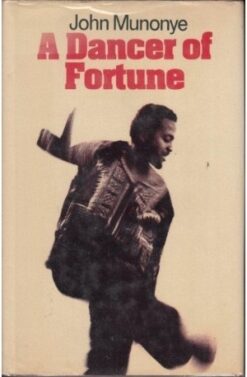
John Munonye’s A Dancer of Fortune is a vibrant and satirical exploration of the patent medicine trade in Nigeria, centered on the charismatic and “engaging rascal,” Ayasko (Aya Ijeroko). Ayasko is a professional dancer whose unique talent for attracting crowds makes him an indispensable marketing asset to various medicine dealers in the town of Dekko. The novel traces Ayasko’s career as he navigates the cutthroat rivalries of the “Big Four” dealers Sabanco, Marabu, Avarido, and Eddy Chindi while managing the domestic pressures of his ambitious wife, Bessie, and eventually transforming himself from a mere “advertising tool” into an independent entrepreneur who outwits the entire industry.
Part I: The Philosophy of the “Pocket” and the Ebara Spectacle
The novel introduces Ayasko as a man whose mouth is “always as busy as his feet”. Working for Avarido Medicals, Ayasko presents a cynical but pragmatic philosophy of the trade: medicine is not just for the diseases of the body, but for the “diseases of the pocket”. He argues that a dealer should continue to sell medicine even when it has lost its potency to cure a physical ailment, because its sale will still “cure” the financial ailment of the dealer’s pocket. This pragmatism is illustrated when Avarido holds up a bottle of merged, potency-lost tablets, and Ayasko encourages him not to throw them away, noting that manufacturers are wise because they tell patients to see a doctor if the illness continues, rather than offering a refund.
Ayasko’s primary value lies in his “dancing feet”. Avarido’s shop, though located in a high-density area, requires the spectacle of Ayasko to expand its name and reach customers beyond the local vicinity. The novel provides a detailed account of a marketing expedition to Ebara Market. The campaign is led by Ogoroba, Avarido’s short, solid, and “inimitable” salesman, who uses a loudspeaker to demand the attention of the crowd, promising something “interesting” and “indescribable”.
When Ayasko performs, he is a “compelling presence”. At Ebara, he wears a riotous outfit: a striped shirt, yellow-and-red trousers so tight they seem painted on, a wide straw hat with colorful frills, and dark sunglasses that cover half his face. He dances to the “Money Monger Calypso,” his favorite tune, employing a “limp grace” and “mazy movements” that leave the spectators spellbound. This spectacle allows Ogoroba to pitch Avarido’s products, such as Dentocream (to mimic Ayasko’s sky-white teeth) and Osteopar, a medicine claimed to cure everything from bone disease to infertility. The campaign is a massive success, resulting in a stampede of buyers and leaving Avarido’s cash box “poured into… like sand”.
Part II: The Domestic Tension – Ayasko and Bessie
The public success of the dancer is contrasted with his private domestic struggles. His wife, Bessie, is a “sensible girl” who comes from a wealthy family background her father was a businessman with five wives and many children. Bessie feels she “married down” to a “market clown” and is constantly pushing Ayasko for social mobility. She is “frantically anxious” to see him better placed in life and views his profession of “writing with his feet” as an odd and undignified waste of his talents.
Their home is a single, over-large room screened with a curtain for privacy, where they live with their two children, Abel and a younger son. Bessie frequently critiques Ayasko’s exuberant “masquerade” outfits and urges him to find a more “human” profession. She is particularly concerned about his lack of financial stability, noting that despite his high earnings and commissions, there is little sign of savings or a better home.
The history of their marriage reveals Ayasko’s “forthright, fearless” nature. When they first met, he was a “tramp” with no abode, but Bessie was captivated by his dark, hairy skin, fast speech, and “endless humor”. When he proposed, her mother was so outraged she threw a stout pestle at him, which he nimbly dodged while laughing. Despite the family’s initial rejection, the arrival of two healthy male children eventually made the community forget the scandalous nature of their union. However, Bessie continues to harbor a deep resentment toward the patent medicine dealers, specifically Marabu, who is her mother’s relation and who she believes Ayasko should have stayed with to settle down.
Part III: The Patent Medicine Wars of Dekko
The novel details the “bitter and deep-rooted” rivalry between the major dealers. The trade is defined by a lack of formal pharmaceutical training; Avarido admits he never went to school but “knows good medicine” from his years of serving another dealer, Njerika. This “war” involves the use of aggressive advertising, signboards with “dancing neon lights,” and even the manipulation of the police.
Before joining Avarido, Ayasko served Sabanco and Sons and then Marabu Medicines. Ayasko left Sabanco because the proprietor, Sebastine Okora, lied by claiming to have sons (he only had daughters) and sold only limited products like Aspirin and Mentholatum. He left Marabu because of the man’s ill temper and his attempt to force Ayasko to sing a specific song that insulted his rival. Ayasko’s defection to Avarido was the “winning stroke” that allowed Avarido to eclipse Marabu in the Dekko market.
In response, the rivalry turned toward police harassment. Two plain-clothes policemen searched Avarido’s house and dispensary, a move Avarido reciprocated by having the police visit Marabu. During these raids, the police removed injection tubes, capsules, and even Marabu’s patent medicine dealer’s license. This environment of “hate, intrigue, and bad blood” was fueled by the high profit margins of the small tablets.
Part IV: Internal Conflict – Ogoroba, Marianna, and the Plastic Models
Within Avarido Medicals, a second conflict brews. Ogoroba, the salesman, and Marianna, Avarido’s mistress and secretary, are intensely jealous of Ayasko’s influence and high wages. Ogoroba, who believes himself the ordained successor to Avarido, views Ayasko as a “pestilence of a creature” and a “security risk”. Marianna, who holds a “protective title” of personal secretary, shares this hostility, especially after Ayasko publicly refers to her as “Avarido’s Pillow” a term that suggests her status as his sexual companion.
Ogoroba and Marianna hold a “council of war” with Avarido, urging him to get rid of the dancer. They argue that Ayasko is becoming too powerful and dictatorial. Ogoroba proposes a radical alternative: replacing Ayasko with plastic models. He suggests using inanimate images to advertise, thereby saving money on wages and eliminating the need for a human dancer.
Avarido, though initially hesitant because he fears a rival like Deo Volente will pick Ayasko up, eventually yields to the pressure. He concocts a plan to grant Ayasko a wage increase while simultaneously cutting down the number of days he is allowed to perform, thus reducing his total take-home pay. This decision marks the beginning of Avarido’s downfall.
Part V: The Disaster at Kara and the “Germ” Scandal
The transition from human advertising to plastic models culminates in a disastrous trip to Kara. Kara had recently been ravaged by a smallpox epidemic, leaving the population in a state of morbid fear and superstition. Ogoroba, seeking to prove the effectiveness of the plastic models, ties two toys to the vehicle’s bumper: one representing “sickness” (yellow skin, bloated cheeks) and one representing “health”.
The experiment fails spectacularly. When Ogoroba raises a plastic model in the Kara market square, the crowd reacts with horror. They believe the objects are “germ-breeding charms” intended to re-infect them so that Avarido can sell more medicine. Influenced by a local figure named Dandadinenu (Election Machine), who points out that the models are not the real, human Ayasko, the crowd turns into a violent mob. They attack the vehicle with stones, hammers, and unripe mangoes, and Ogoroba and the driver are forced to flee, leaving the vehicle and all the drugs behind.
The news of the Kara disaster spreads through Dekko like “bird droppings from the cloudless sky”. Avarido is labeled a “germ-breeder” and a “notorious killer”. His reputation is shattered, and business comes to a standstill. Ayasko uses this opportunity to make his final defection, delivering a mysterious “story of the he-goat” to his new prospective employer, Eddy Chindi, signaling his intent to move on.
Part VI: The Rise of Deo Volente and Ayasko’s Gambit
Eddy Chindi, the proprietor of Deo Volente Medicine Stores, represents a new generation of dealers. He is young, smart, and better educated, having spent seven years in a seminary before his uncle Elosia lured him into business with the promise of capital. Despite his education, Chindi initially lacks the “public relations” instincts of the older dealers at least until he recruits Ayasko.
Ayasko’s recruitment by Chindi is a masterpiece of manipulation. Ayasko visits Chindi’s house, admiring his modern furniture and television set, and subtly reveals that Avarido is now “selling without Ayasko” using plastic models. Chindi, desperate to capture the market, offers Ayasko a job. However, Ayasko refuses to fix a wage immediately, instead accepting “advances” and “allowances,” which allows him to build a sense of unquestioned loyalty and trust with Chindi.
Ayasko takes over the “Deo Volente” brand and begins a campaign of total domination. He trains two boys, Erico and Alaska Bebe, to be “young wizards of music and dancing,” effectively creating a mobile marketing troupe. He also persuades Chindi to ignore the unofficial “code of conduct” between dealers and move into rival territories, such as Aspirin (Sabanco’s specialty) and pediatric medicine (Avarido’s specialty).
Part VII: The Ayasko Medical Stores and the Final Transformation
The novel’s most significant twist occurs when Ayasko moves beyond being an employee. Under the guise of setting up “Deo Volente Extensions,” Ayasko secures rooms in a new building at 110 Okenze Street. However, the community soon begins to see advertisements and radio announcements for “Ayasko Medical Stores” a brand owned and operated by the dancer himself.
Ayasko has learned everything from his various employers: how to source drugs from “smugglers, hospital hands, and store attendants”; how to run a dispensary; and how to use his own fame as the ultimate trademark. He sets up shops in strategic locations: Okenze Street for workers, Wariko for the commercial center, and Dunuko Street directly facing the General Hospital to exploit prescriptions and leakage.
Bessie is overjoyed by this transformation. She finally has her “own medicine store,” and she believes the “leg-flinging” will stop. Ayasko, however, maintains that for an old man, “the head dances better than the foot,” implying his new role as a businessman is just a different kind of performance.
Part VIII: The Legal Reckoning and the Moral Lesson
The novel concludes with a high-profile court case brought by Eddy Chindi and his lawyer, Landa, against Ayasko for trademark infringement or breach of contract. The precincts of the court are packed with Ayasko’s fans, many wearing imitation “Ayasko dresses” and sunglasses.
In a symbolic moment, the four rival dealers Sabanco, Marabu, Avarido, and Chindi are assembled in one spot for the first time. They stand in a circle, looking like “mere husks of human beings in impressive attire”. Lanson, the manager of King’s Chemist, delivers a blistering summary of the situation: he points out that Ayasko is a “clever fellow” who used each dealer in turn to destroy the other, and has now successfully captured the market for himself.
The case effectively ends not with a legal judgment but with a social one. Ayasko and Bessie arrive at the court in a taxi, acknowledging the cheers of the crowd with pride and dignity. Even the police presence is undermined, as Ogoroba is seen conferring with a detective about a pistol he was secretly carrying. Ayasko waves a general “good morning” to his former employers, the “Engaging Rascal” having finally achieved the fortune and status he sought.
Major Themes and Literary Elements
- The Power of Dance and Music: The novel emphasizes that the hearts of the people of Dekko are “all music”. Ayasko’s success is a direct result of this cultural value, which the medicine dealers exploit for profit.
- The Conflict of Traditionalism vs. Modernity: This is seen in the contrast between the uneducated “Big Men” like Marabu and Avarido and the seminary-trained Eddy Chindi. However, the book suggests that “street smarts” and public relations (Ayasko) are more effective than formal education alone.
- Social Mobility and Gender Roles: Bessie’s character represents the intense pressure on Nigerian men to provide ” Senior Service” comfort. Her desire for a “two-room apartment” and “expensive lace” drives much of the plot’s momentum.
- Satire of the Medical Profession: The book mocks the lack of regulation in the patent medicine trade, where dealers give themselves titles like “Personal Secretary” or “Personal Physician” and dispense “powerful and painful” injections without training.
- Fortune and Opportunism: The title reflects the central theme fortune is not just found; it is “danced” for and seized through the strategic use of other people’s greed.
A Dancer of Fortune remains a classic of African literature for its sharp wit, its vivid depiction of Nigerian urban life in the mid-20th century, and its complex portrayal of a character who turns his marginal status as a “clown” into a source of immense power and wealth.