
You can listen to the Book Summary Below
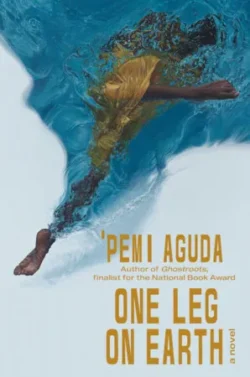
Summary of One Leg on Earth by ’Pemi Aguda
I. The Overture: The Fruit and the Bridge
The narrative of One Leg on Earth begins with a section titled “Fruit,” which serves as a chilling prologue to the atmospheric mystery of Lagos. It centers on Miriam Aiki, a woman who has endured thirteen years of desperate prayer, physical hardship, and spiritual appeals to conceive. At thirty-eight, she is finally six months pregnant, experiencing what the narrator describes as an “ugly joy” a bliss so heavy and potent it causes physical nausea. While stuck in a typical, grueling standstill on Third Mainland Bridge with her husband, Victor, Miriam is overcome by a sudden, misplaced euphoria.
To the shock of the surrounding commuters and her husband, Miriam exits the vehicle, skips between the stalled cars, and dances with a “frothing joy”. Ignoring Victor’s frantic calls, she skips to the edge of the bridge and launches herself belly-first into the Lagos Lagoon. This act is not portrayed as a moment of despair, but as a “flight” into the arms of something welcoming, setting the stage for a city-wide phenomenon that will haunt the rest of the novel: the systematic, seemingly ecstatic suicides of pregnant women in Lagos.
II. Yosoye’s Arrival and the New Lagos Life
The core of the novel follows Yosoye Bakare, a recent university graduate who has moved from the relatively quiet city of Ibadan to Lagos for her mandatory National Youth Service Corps (NYSC) year. Yosoye is a reserved, hesitant speaker who has spent much of her life feeling like a “hollow outline” of a person, an outsider even within her own family. She views Lagos as a crucible for transformation, a place where she can finally “become a new woman” and demand things from life.
She rents a tiny, shoddy “self-contained” apartment on the mainland, defined by its cantaloupe-colored walls, upside-down power outlets, and the constant noise of neighbors through the thin walls. In her first week, driven by a desire for adventure, she goes to a local “joint,” drinks a Star Radler, and engages in a spontaneous, somewhat detached sexual encounter with a stranger in a cheap motel. This encounter, characterized by the man’s refusal to use a condom and his subsequent disappearance into the “ravenous tide” of the Lagos night, will provide the catalyst for Yosoye’s internal transformation.
Yosoye is assigned to work at Jegede & Kyari Design (JKD), a prestigious architecture firm whose site office is located in Omi City a massive, 5.3 million square meter patch of land currently being reclaimed from the Atlantic Ocean. Omi City is a surreal, white landscape of sand and wind, shielded by a nine-meter-high sea wall. It is here that Yosoye first encounters the firm’s hierarchical and often cold professional environment.
III. The Architecture of Power: Omi City and JKD
At JKD, Yosoye is initially an errand girl, relegated to moving technical drawings and buying “puff-puff” for the designers. She interacts with a colorful cast of colleagues:
- Adam: The haughty, bug-eyed receptionist who enjoys hazing the “intern”.
- Gbenga: A muscular, loc-wearing senior designer who serves as a paternal, though often irritable, mentor to Yosoye.
- The Designers (Feyi, Chisom, Simisola, Ike): A group of ambitious young professionals who are deeply invested in the “purity” of Omi City’s vision.
- The Architect (Jegede): The firm’s leader, a “crazy genius” with a cold gaze and a polka-dot bowtie, who views the reclaimed land as a “pure blank slate” free from the “corruption” of Lagos history.
Yosoye is disoriented by the blankness of Omi City, which feels like a “separate mass, suspended in space,” disconnected from the concerns of the mainland. The city is guarded by Jonah, a reticent security man in a wide-brimmed straw hat who refuses to show his face or acknowledge the office staff.
Early in her tenure, Yosoye is nearly fired after The Architect catches her sleeping at her desk. However, she has just discovered the “double lines” of a pregnancy test. When The Architect learns of her condition, his reaction is unexpectedly reverent. Invoking his grandmother’s belief that a pregnant woman an “aboyun” exists in a liminal space between heaven and earth (“Ẹsẹ̀ kan ayé, ẹsẹ̀ kan ọ̀run”), he sees her pregnancy as a “good omen” for the city JKD is “gestating”. He decides to keep her on staff, tasking her with writing the “voice” of the city to make its technical plans accessible to private investors.
IV. The Geography of Grief: The Suicide Mothers
As Yosoye’s body begins to change, her focus is drawn to the escalating crisis of the “suicide mothers.” The phenomenon, which the government and official media largely ignore or treat as disconnected events, thrives in the “digital realm” of blogs and social media. Yosoye becomes obsessed with tracing the patterns, scouring the internet for the names and faces of the dead: Aunty Salome, Miriam Aiki, Ose Enahoro, Aissatou Jubril, Rukkaya Sidi.
This obsession is fueled by a traumatic event: while walking alone at night, Yosoye witnesses a gathering at a canal where a pregnant woman has just drowned herself. The reactions of the bystanders are a mix of reverence and condemnation, labeling it a “bad death” that shames the family name. This sight haunts Yosoye’s dreams, which begin to feature the drowned women as a “vortex of joy” rather than a source of horror. In these dreams, the women hold and welcome her, their collective existence “annihilating” Yosoye’s lifelong loneliness and making her feel, for the first time, like she belongs.
Yosoye’s sensitivity to the crisis is heightened by her body’s “Bluetooth frequency” of awareness. She begins to hear a “swarm song” a humming, vibrating sound that she later discovers is shared by the artist Beloved. This song represents a shared “dread” and a “pull” toward the water that the women seem unable to resist.
V. The Maternal Ghost: Olabisi and Ibadan
A significant portion of the novel explores Yosoye’s fractured relationship with her mother, Olabisi, a seamstress in Ibadan. Olabisi is a woman who “absorbs information to kill and memorialize it inside herself”. Her parenting style was defined by a formal, distant brand of “togetherness” that left Yosoye feeling like a foreigner in her own home.
A central metaphor for this disconnection is the story of Mandy. As a child, Yosoye had an imaginary friend named Mandy. One day, Olabisi, terrified by her daughter’s “reaching for what isn’t there,” shouted at Yosoye to stop the “nonsense”. She returned from the market with an oversized stuffed elephant, also named Mandy, and forced Yosoye to touch it, declaring, “Your mother is what is real“. This act replaced Yosoye’s internal world with a tangible, but ultimately hollow, physical object a gesture Yosoye recognizes as her mother’s failure to truly “see” her.
When Yosoye visits Ibadan to announce her pregnancy, Olabisi is disapproving and fearful, warning her that Lagos “warps your wants” and that the best option is to leave. Olabisi reveals her own history of being “tricked” by the mirage of Lagos after a musician abandoned her with Yosoye in her womb. She views the city as a “squat demon” that lures innocent people down its throat.
VI. The Aesthetics of Dread: Beloved and the Art of Drowning
Back in Lagos, Yosoye enters the orbit of Beloved, a tall, bald, and striking artist with a flattened cheekbone. Beloved is a woman of immense power and “shakara” who has conquered Lagos through her art. Her paintings often feature “oversized clouds” threatening tiny stick people, capturing a sense of ambient dread that resonates with Yosoye.
Beloved acts as a mentor and temptress, introducing Yosoye to the “sexy” side of Lagos while simultaneously probing her “unknowable” internal life. However, their relationship reaches a breaking point when Beloved attempts to glamorize the suicides. Beloved views the women’s choice to die as the “ultimate proof that your body belongs to you” and an act of “artistic transcendence”. She suggests that Yosoye’s baby is merely a “ticket” into a glorious circle of powerful women.
Yosoye, who desperately wants to use her baby to “fill the hole” of her own hollowness and find “cheesy, TV-style love,” is repulsed by Beloved’s vision. Beloved dismisses Yosoye’s aspirations as “ordinary,” telling her that a baby can never fill such a void. This betrayal makes Yosoye realize that Beloved may have been “making art” out of Yosoye’s suffering all along.
VII. The Hidden History: Eti Omi and the Displaced
While JKD prepares for a massive groundbreaking ceremony for Phase One of Omi City, Yosoye begins to uncover the “metaphoric sins” upon which the city is built. Through Endurance, her okada (motorcycle taxi) driver, she learns the truth about the land JKD has “resurrected”.
Before Omi City was sand, it was Eti Omi, a vibrant, generations-old waterfront community of fisher people who lived on stilts over the marsh. The Lagos State government, in collaboration with private interests, destroyed Eti Omi in a three-day siege of bulldozers and chainsaws to clear the way for development. Endurance reveals that Jonah, the security guard, is a survivor of Eti Omi. Jonah returned from work to find his home in ruins and his young son crushed under the wreckage. He took the job at JKD because he “killed his family” and wants the designers to see him every day “so you people can never forget”.
Yosoye realizes that JKD’s architectural plans are a form of “fiction” that deletes the past to sell a future to the elite. She feels a “righteous, petulant” indignation and decides to sabotage the firm’s public image. She sends an anonymous tip to a popular blogger (LagosJusticeNinja), revealing that four pregnant corpses were recently found on Omi City’s coast and were being “covered up” for PR reasons.
VIII. The Breaking Point: Groundbreaking and the Laugh
The novel reaches its climax during the ceremonial groundbreaking of Phase One. The event is a grotesque display of wealth and consumption, with investors and designers celebrating “on top of graves” while the city outside is paralyzed by the suicide crisis.
The Architect, unbothered by the rumors Yosoye leaked, offers her a full-time writing job. He wants her to write a “profile” on herself to be used in the firm’s newsletter, effectively turning her into the “face” of Omi City to prove that the city is safe for pregnant women. He characterizes her as a “liminal figure” with an “instinct for the future”.
Yosoye, struck by the absurdity and hypocrisy of the situation, begins to laugh. It is a “demented,” unstoppable rumble that takes over her whole body. In her mind, her “sisters” the dead pregnant women step out of the shadows and join her in a collective chorus of laughter that surrounds The Architect and Gbenga. She realizes that she no longer wants the “brand of future” they are selling.
IX. The Descent and the Return
Driven by a “meeting” of past, present, and future, Yosoye marches to the waterfront. In a state of “giddy” surrender, she walks into the Atlantic Ocean, feeling the waves “rope her ankle” and draw her in. She experiences a moment of total fullness, where her “hollowness” is finally filled by the water and the welcoming embrace of the dead women.
However, the narrative takes a brutal turn into reality. Yosoye is found and hauled out of the water by “restraining hands”. The experience is defined not by transcendence, but by intense physical agony as she suffers a miscarriage on the wet sand. Her “future” seeps out into the reclaimed land, blood “crawling to the ocean” to meet the “past losses buried in the deep”.
The novel concludes with Yosoye returning to Ibadan to live with Olabisi. In the aftermath of her “foray into water,” she and her mother find a “sticky,” quiet form of reconciliation. For the first time in nearly two decades, they sleep in the same bed, their “breaths syncing” in an acknowledgment that “a mother is what is real”.
Key Insights and Thematic Elements
1. The Body as an “Outline” and “Mass”
Throughout the novel, Yosoye describes herself as a “hollow outline”. She views her pregnancy as a “little dark spot” that will eventually “shade her in” until she becomes a real person with grounding mass. This internal struggle with identity is mirrored in the city of Lagos, which is also an “outline” being filled in by reclaimed sand a process that Yosoye eventually rejects as a “work of dangerous imagination”.
2. The Metaphor of Water
Water is the novel’s most powerful and ambiguous symbol. It is:
- The Unconscious/Spiritual Realm: A place where the “suicide mothers” find a collective, homogeneous existence.
- A Weapon of Erasure: The force the government uses (and reclaiming the land from) to destroy communities like Eti Omi.
- The Ultimate Future: As Yosoye reflects during her swim, “Everybody’s future was water… To water they would surrender”.
3. The Failure of “Careful”
Yosoye is constantly warned to “be careful” by her mother, by strangers on the bus, and by Kiitan. The novel posits that “careful begat isolation and boredom” and that the women who jump are those who have chosen a “powerful,” albeit tragic, form of agency over a life of “ongoingness” and “routine”.
4. The “One Leg on Earth” Philosophy
The Architect’s grandmother’s proverb “Ẹsẹ̀ kan ayé, ẹsẹ̀ kan ọ̀run” is the philosophical anchor of the book. It frames pregnancy as a liminal state that makes women “bridges” between worlds. While The Architect uses this to justify the corporate “gestation” of Omi City, Yosoye eventually interprets it as a call to rejoin the “heaven” (or the deep) where the women who truly see her reside.
5. Resilience of the Displaced
The “Bridge” coda highlights the resilience of those Lagos has abandoned: the three little girls who hold protest signs for money they use to buy “hot balls of joy” (puff-puff). They, like the “mud women” who wear their history as an “interruption” and a “warning,” represent a Lagos that persists despite the “vanity spires” and “vetting systems” of the elite.
The book ends on a note of “sticky memory”, suggesting that while Lagos may have “no memory,” the bodies of its citizens and the earth they walk upon remember everything.