
You can listen to the Book Summary Below
Table of Contents
I. The Frame: The Rusted Chocolate Tin and the Birth of Memory
The narrative of Empty Cages is built upon the shifting, often unreliable sands of memory, triggered by a physical object: an old, rusted Cadbury’s Milk Tray chocolate tin. The narrator, Fatma, now a woman in her sixties, finds this tin in a drawer, wrapped in a scuffed plastic bag. It is crammed with old poems written when she was twelve or thirteen words that have faded over time, mirroring the way her childhood has become a “strange and tiresome” distance.
The tin serves as a metaphor for the family’s declining fortunes. Once an expensive imported gift likely brought by her father’s wealthy Saudi students in 1969 it was a symbol of pride and a “joyful tin” that made an eleven-year-old girl feel special. In her childhood, she would curl up with her cat, Meesho, under a heavy blanket to feast on the chocolates, a rare treat her parents and two older brothers, Ragi and Ramzi, mostly left for her. Years later, the tin is empty, its silvery bottom rusted, and its lid no longer closes flush. The narrator refuses to fix it, just as she refuses to “fix” her memory, which she admits is “full of holes”.
The narrator’s childhood is punctuated by deaths both literal and symbolic. One of her earliest vivid memories is her brother Ramzi waking her in the middle of the night to bury their cat, Meesho, who had been bitten by a snake. They buried him in the back garden under a bedroom window and recited the Quran. Years later, a poppy plant sprouted on that spot; her mother, fearing the legal implications of growing poppies, eventually burned it with kerosene. Finally, after her mother’s death, the narrator buried her mother’s last blood-stained bandages and the galabiyya she died in at that same spot, discovering to her horror that maggots were already feeding on the remaining flesh. This cycle of burial and decay sets the tone for a story that seeks to “scrape away the scab” of the past so the wound can finally heal.
II. The Father: Professional Pride and Private Shame
The narrator’s father was a man defined by a “heavy corpse” of a dream. A brilliant mathematician, he had to abandon his dream of becoming an engineer to support his own siblings and father. He worked as the best math teacher in Heliopolis despite having only a diploma rather than a degree. His professional pride was immense; he often mocked other teachers and boasted of his daughter’s academic and musical achievements to his colleagues.
However, this public face was marred by a private addiction to alcohol (brandy and beer). The narrator’s life is shadowed by “a lifetime of shame in a split second” when she recalls seeing her father staggering, “completely sloshed,” at a metro station, calling her name while she was with friends. She ignored him and walked away, a moment of betrayal and shame that she could never “vomit up”. At home, the father’s alcoholism led to domestic degradation; he would water the plants in his underwear in view of the neighbors, leading the narrator to scream at her mother that she wished he would “just die”.
The father was also consumed by jealousy, likely rooted in his first wife’s infidelity. He doted on his middle son, Ramzi, but was “cruel” to the eldest, Ragi, from childhood. He often told the narrator that the only reason he hadn’t divorced her mother was “because of you kids,” a statement that made her want to kill him. His professional life ended in failure when he turned up “completely hammered” to an interview for a lucrative teaching job in Algeria, causing the dream of financial stability to disintegrate. He eventually died of a “cardiac event” (though the family kept the true circumstances sensitive) shortly after a final, humiliating illness where he was struck with uncontrollable vomiting and diarrhea.
III. The Mother: Suad, the Martyr and Protector
The narrator’s mother, Suad, was a woman of “downward mobility” who had come from a wealthy background. Her father had lost his fortune in the stock market, and her first marriage to a prosecutor had ended in a “nasty divorce” caused by the interference of her sisters-in-law. She married the narrator’s father out of a sense of “coming to terms with destiny”.
Suad was the “paragon of tenderness,” dedicating her life to her “tribe” of three children. She was also a woman of secrets. After being publicly humiliated and kicked out of her brother’s house when she tried to borrow money, she attempted suicide by swallowing sleeping pills and was subsequently hit by a car. She kept this trauma from her daughter for years. She also endured her husband’s alcoholism, allowing him to drink at home “to avoid any more scandals”.
The mother’s life was later defined by her battle with thyroid cancer, which she initially believed (based on a doctor’s misdiagnosis) was a “rare fungus”. The narrator became her primary caregiver, a role that involved a “futility given structure by time”. The narrator learned to change the mother’s bandages, dealing with deep, tunnel-like wounds that extended to the bone. Suad remained resilient and religious, taking refuge in writing her own autobiographical novel and listening to her daughter’s poetry. She eventually fell into a two-month coma, waking once to scream that Ragi was dead, before dying on the narrator’s thirty-sixth birthday.
IV. The Eldest Brother: Ragi, the Tyrant and the Ghost
Ragi is the most polarizing figure in the narrator’s life. In his youth, he was a “tyrannical” presence who insisted on formal family meals and assembly of an impressive library, yet he was an academic failure. He refused to take his university entrance exams for five years, spending his days in cafes while lying to his father that he was studying math in Assiut.
Ragi inherited his father’s dream of engineering but lacked the discipline to pursue it. Eventually, his mother manipulated the family finances signing IOUs to loan sharks to buy him a plane ticket to Germany. In Germany, Ragi’s life was a “mess” of fake documents and debts. When the narrator visited him in Germany as a teenager, it was the “worst days of her life”. Ragi kept her in “solitary confinement,” forbidding her from writing to their mother and leaving her without money for food while she stayed awake until dawn to wake him for work. This period drove the narrator to a suicide attempt; Ragi’s only response was to tell her to “go die somewhere else”.
Following this, the narrator sent him a “Vendetta Letter,” declaring he was no longer her brother. Ragi disappeared for over thirty years, leaving his mother in a state of perpetual heartache. He returned to Egypt only after her death, a gaunt, broken man who had spent decades working as a cook. His return was not the reunion the narrator hoped for; he remained peevish, mocking her academic success and claiming her PhD was “insignificant”. He eventually moved into a nursing home, abandoned by Ramzi, and died shortly thereafter.
V. The Middle Brother: Ramzi, the Favored and the Practical
Ramzi was “Daddy’s favorite,” a handsome boy with green eyes and blond hair who became a dermatologist. As a teenager, he was popular and “macho,” often getting into street fights with Palestinian students over the honor of Egyptian girls. Unlike Ragi, Ramzi eventually succeeded in medical school, though he struggled initially.
Ramzi’s life was defined by his marriage to Buthayna, a woman from a village background whose uncle had become wealthy in the ceramic tile business. This marriage created a rift in the family; Buthayna was often snide about the narrator’s “lunatic” family, and Ramzi frequently took her side over his mother and sister. Ramzi moved to Saudi Arabia to earn a fortune, sending home fixed sums of money for his mother’s care, but often with a sense of “harsh” resentment that he was being forced to accept “charity” when the narrator’s cousins helped with medical bills.
In his later years, Ramzi became increasingly religious and judgmental, growing a “musk-scented beard” and complaining about the narrator’s “bohemian” lifestyle. He provided the funds for his mother’s treatments but refused to pay for chemotherapy, stating he “just can’t” afford it despite his wealth. Ramzi died four months before the narrator’s final reflections, a death that finally allowed her to write the book.
VI. The Narrator’s Education and “The Birth of Memory”
The narrator’s own journey is one of academic struggle and artistic awakening. Born in Suez in 1958, her early memories are of beach cabins and a “secret language” shared with an Italian boy named Massimo. Her education began under the shadow of trauma, including sexual abuse by a neighbor named Saad and a relative named Auntie Fatma. These incidents were suppressed by her mother, who made her “swear by the holy book” never to speak of them.
In school, she was a star student until high school, when the “advanced classes” and the trauma of her family life caused her to drop from the top of the class to tenth. She initially studied psychology but dropped out during her first divorce. She later switched to business to help her first husband but found the formulas “meaningless”.
Finally, encouraged by a psychiatrist friend of Ramzi’s, she returned to university to study Arabic literature and poetry. She faced systemic humiliation from her department chair, who vowed she would never get a position because she was a “bohemian poet” and didn’t attend lectures because she was caring for her dying mother. Despite this, she earned her MA and PhD, becoming a university lecturer and a recognized poet achievements her brother Ragi dismissed as “delusional”.
VII. The “Farces” of Marriage
The narrator’s personal life was marked by two disastrous marriages. Her first was a secret marriage at nineteen to her boss, Dr. Mahmoud, a wealthy engineer with a PhD who was old enough to be her father. Mahmoud was “married, and he’s one of those guys who likes to use young women for fun,” a warning the narrator ignored because she was “madly in love”. The marriage was a “farce”; Mahmoud eventually fled to Libya to avoid his first wife and his debts, leaving the narrator with divorce papers after three years of absence.
Her second marriage was to an artist who wrote film scripts and plays. Her mother warned her he was “uncouth,” a prediction that proved true when he moved into their small apartment and began a psychological and physical war against the narrator and her mother. He would intentionally cook food the mother disliked and eventually attacked the narrator with knives. After she fled to a friend’s house, she returned to find the apartment “stripped bare” he had even ripped the light switches off the walls and shredded all her clothes.
VIII. The Decline and the Final “Empty Cages”
The family’s residential history tracks their “declining fortunes”. They moved from the “villas” of Alf Maskan, which eventually went “downhill,” to a high-rise in Nasr City, and finally to a rental apartment in Nozha, Heliopolis. Each move represented a loss of status and space.
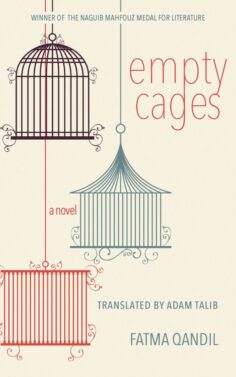
The “empty cages” of the title refer to a literal event: after her mother’s death, the narrator found her garden filled with dozens of empty chicken cages stored there by a stranger. This felt like “open season” on her home, as if it no longer belonged to her. In a fit of rage, she lugged the cages to the roof herself, an act that finally drove the intruder away.
The novel concludes fifteen years after the narrator finally sold the family home to a developer who demolished it to build a high-rise. She moved to a new house, tearing up the old rental contract and shredding her brothers’ photos and letters in an “eruption of loathing” to ensure nothing followed her.
The final chapters are a “Bang… bang… bang” of back-to-back deaths: Ramzi, the landlord Mr. Ahmad, and the old nanny Auntie Saadeya all die within four months of each other. The narrator realizes that everyone she has written about is “dead” some literally, some “dead to me”. She has written the book to separate herself from her “distant roots” and the “rotten stump” of her past before she dies herself. The “curtain is about to rise” on the narrator’s own final act, leaving her in a house of “dust” and “empty cages,” finally present for the first time in her life.