
Table of Contents
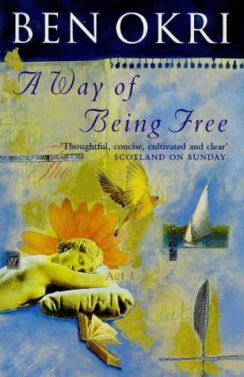
Ben Okri’s A Way of Being Free is a profound collection of semi-poetic essays and meditations that explore the intersections of art, politics, storytelling, and the essential nature of human freedom. Originally written as “notes to myself” or “private meditations,” the volume functions as a “suite” of thoughts that consistently turn on the question of how to preserve freedom in a world that often seeks to narrow it.
The following is a detailed, section-by-section summary of the book’s core concepts and arguments.
The Role of the Poet: “While the World Sleeps”
The book begins with an inquiry into the adversarial but necessary relationship between the poet and the world. Okri argues that the poet must be a “widener of consciousness” who exists in the “odd corners” and “dark places” where others do not care to look.
- Resistance to the Unyielding World: The world is naturally resistant to the poetic, and it is only through “searching and moulding” that reality is transformed into song and metaphor. Poets move against the “tidal crowds of everyday events” to show humanity the “falseness of our limitations”.
- The Conflict with Legislators: Okri critiques the “acknowledged legislators” politicians, religious leaders, and the powerful who prefer facts, statistics, and mysteries that can be coded or legislated. These figures often demand that poetry be partisan or serve specific causes, but Okri warns that forcing poets to limit their world is a “crime against life itself”.
- The Survival of the Spirit: The essay suggests that many people resist the poetic because they fear their own truths. However, the poet acts as an alchemist, helplessly siding with the “greatest good” and the “most just future”.
The Creative Process: “Newton’s Child” and “Creativity and the Minotaur”
Okri delves deeply into the mechanics of inspiration and the mindset required for true artistic creation.
- The Spirit of Play: In “Newton’s Child,” Okri advocates for approaching creativity in the spirit of play rather than with “businessman’s solemnity”. He believes that the wonders of literature are born from a “marriage between play and discipline”.
- The Mystery of the Book: He makes a distinction between writing that is merely “ambitious” and the highest kind of writing, which belongs to the realm of grace. Truly great books are those that “inexplicably create powerful feelings” and continue to “keep re-creating themselves” in the reader’s consciousness long after the reading is finished.
- Confronting the Animal Within: In his analysis of Picasso’s Minotauromachy, Okri views the Minotaur as a symbol of the animalistic or “irrational self” that has gone out of control because we failed to transform it. He points to the figure of the little girl with a candle as a symbol of wisdom, love, and purity of heart that can confound horror.
The Power of Narrative: “The Joys of Storytelling” (Parts I, II, and III)
Throughout three distinct sections, Okri explores why storytelling remains a fundamental human necessity, especially in a “fractured age”.
- Storytelling as Survival: Storytellers were the original masters of enchantment, using myths to “code the world” and help communities live through the darkness. They are the “living memory of a people,” preserving legends, cures, and dreams.
- The Role of the Reader: Okri emphasizes that reading is a “co-production”. The writer provides abstract marks on a page, but the reader’s mind creates the world, characters, and continents.
- Transgression and Truth: In Part II, he describes storytelling as a “double-headed axe” that is always subversive. True art involves “transgression” breaking frontiers or saying something so true that it “SHRIEKS” and upsets the complacency of tyrants.
- Aphorisms on the Story: In Part III, Okri provides a series of powerful fragments, such as “To poison a nation, poison its stories” and “Homo fabula: we are storytelling beings”. He asserts that stories are a form of resistance and one of the highest forms of human creativity.
Political and Spiritual Freedom: “The Human Race is Not Yet Free”
This section, dedicated to Salman Rushdie, argues that the most pernicious threats to freedom are manufactured realities and “overwhelming orthodoxies”.
- Redreaming the World: Okri posits that because everything can be imagined, it can be redreamed. Human beings have the “necessity of transformation,” and when we refuse to face our deepest truths, those truths become “monsters in our sleep”.
- The Failure of Institutions: He critiques religions and ideologies that have lost touch with “noble love” and “basic compassion,” becoming instead empty shells of dogma that unleash “beastly wars”.
- The Primacy of Love: Ultimately, Okri argues that the only thing worth living for is love for one another, for life, and for our destiny. This creative love is what can “thaw the frozen streams within” us.
Literary and Historical Analysis: “Leaping out of Shakespeare’s Terror”
Okri provides a unique critique of Shakespeare’s Othello, focusing on the psychological and racial dimensions of the play.
- The Isolation of the “Other”: He argues that Othello’s color is central to the tragedy; he is a man isolated by his complexion and “marked by his history” in a society that views him as an exotic but empty vessel.
- Iago as the Internal Enemy: Iago is portrayed as a “lonely and bitter man” who represents those who cannot accept the “other” because they cannot accept themselves.
- The Necessity of Vigilance: Okri concludes that the play is about “opening the doors of consciousness to more of reality”. He suggests that when victims stop seeing themselves as victims and discover the power of transformation, new historical possibilities are born.
Reflections on History and Global Justice: “Amongst the Silent Stones” and “Redreaming the World”
The final sections of the book expand the focus to the global scale of human interaction and the legacy of colonialism.
- The Silence of History: Okri notes that history is essentially silent; it is we who must make it speak with “clear eyes”. He laments that while we explore distant planets, we have not yet learned to see one another as human beings with “continents of similar desires”.
- The Interconnectedness of Fates: He argues that the fates of the oppressed and the oppressor are bound together forever. The “contemporary victors” often forget that by imposing their will, they surrender the right to their own space.
- A Universal Civilization: The book concludes with the hope that the “unvalued” and “unheard” can help create a new era of human history. This involves the “egalitarian triumph” of learning how to live and love again, striving toward the “first truly universal civilisation”.
A Way of Being Free stands as an “incantatory” and “soulful” defense of the imagination. It asserts that the ultimate goal of all art and human striving is to achieve a state of tranquility and grace, where one can “sing their unique songs” through even the most ambiguous times.