
Summary
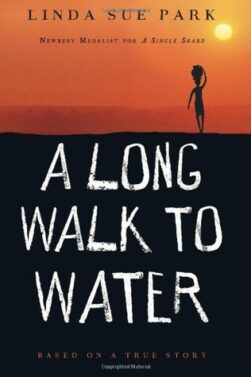
A Long Walk to Water tells the intertwined stories of two Sudanese children from different time periods and tribes. Salva Dut, an eleven-year-old Dinka boy in 1985, is forced to flee his village, Loun-Ariik, when the Second Sudanese Civil War reaches his school. He embarks on a harrowing journey across southern Sudan, Ethiopia, and Kenya, facing threats from lions, crocodiles, and rebel soldiers. Over the course of fifteen years, Salva transforms from a frightened child into a leader of over 1,200 “Lost Boys,” eventually being relocated to Rochester, New York, for a new life.
Parallel to this, Nya, an eleven-year-old Nuer girl in 2008, spends seven months of every year walking eight hours a day to fetch water for her family. Her life is defined by the constant struggle for survival against heat, thorns, and contaminated water that makes her sister, Akeer, dangerously ill. The two stories converge when a crew led by a Dinka man revealed to be the adult Salva arrives in Nya’s Nuer village to drill a water well. This well provides clean water, ends Nya’s long daily walks, and allows for the construction of a school and clinic, effectively bridging the centuries-old conflict between their tribes.
Plot
- Exposition: In 1985, Salva is at school when gunfire erupts, forcing him to run into the “bush” without his family. In 2008, Nya begins her daily routine of carrying a plastic container to a distant pond for water.
- Rising Action: Salva joins various groups of refugees, bonds with a friend named Marial, and is reunited with his Uncle Jewiir, who becomes the group’s leader. He endures the death of Marial (to a lion) and the murder of his uncle by Nuer looters. After six years in an Ethiopian camp, he is forced across the crocodile-infested Gilo River and leads 1,200 boys to Kenya. Meanwhile, Nya’s family moves to a lake camp where they must dig in the mud for water, and her sister falls ill from the dirty supply.
- Climax: Salva is chosen to go to America, where he eventually receives an email informing him that his father is alive in a Sudanese clinic. He travels back to Sudan to reunite with his father, who has been ill from waterborne parasites.
- Falling Action: Inspired by his father’s illness, Salva starts a nonprofit, “Water for South Sudan,” to drill wells. In Nya’s village, the “iron giraffe” (drill) successfully strikes clean water.
- Resolution: Nya realizes that the man providing water to her Nuer village is a Dinka. She approaches Salva to thank him, and they introduce themselves, symbolizing hope and tribal reconciliation.
Setting
- Southern Sudan (1985 & 2008): The primary setting, characterized by extreme heat, seasonal shifts between the rainy and dry seasons, and treacherous landscapes like the Akobo Desert and the Nile River.
- Ethiopia (Itang Refugee Camp): Where Salva spends six years until the government collapses in 1991.
- Kenya (Kakuma and Ifo Refugee Camps): Salva lives here for several years, describing Kakuma as a “prison” surrounded by barbed wire.
- Rochester, New York (1996–2003): A stark contrast to Sudan, featuring paved roads, electricity, and freezing winters that Salva finds bewildering.
Themes
- Perseverance and Survival: Salva’s mantra, “one step at a time,” helps him survive the desert and lead others through years of wandering.
- The Transformative Power of Water: Water is a source of conflict (between Dinka and Nuer), a source of disease (Akeer’s and Salva’s father’s illness), and ultimately the source of life and peace.
- War and Displacement: The narrative explores how conflict destroys families and creates “Lost Boys” who must find new ways to define “home”.
- Tribal Reconciliation: The ending emphasizes that shared human needs like clean water can overcome deep-seated ethnic animosity.
Characters
Major Characters
- Salva Dut: A Dinka boy who survives incredible loss and hardship to become a leader and humanitarian. He is based on a real person.
- Nya: A young Nuer girl whose life revolves around the daily “long walk” for water until Salva’s well changes her future.
Minor Characters
- Uncle Jewiir: Salva’s uncle and a former soldier who protects the refugee group until he is murdered by Nuer tribesmen.
- Marial: A boy Salva’s age who becomes his first friend on the journey; he is killed by a lion in the Atuot region.
- Akeer: Nya’s younger sister who suffers from a waterborne illness.
- Mawien Dut Ariik: Salva’s father, a village judge who never gave up hope that Salva was alive.
- Michael: An Irish aid worker in the Kenya camp who teaches Salva English and volleyball.
- Chris and Louise Moore: Salva’s adoptive “American family” who support him in Rochester.
Literary Devices
- Juxtaposition: The author places the stories of Salva and Nya side-by-side to highlight the similarities in their struggles across different decades and tribal lines.
- Simile: Park uses similes to describe the war and technology, such as the jet plane veering away “like a sleek evil bird” and cars crawling “like ants in a line“.
- Metaphor: Nya describes the drilling rig as an “iron giraffe,” reflecting her perspective of a modern machine through a familiar natural lens.
- Foreshadowing: Marial’s “wise” insistence that they are walking to Ethiopia foreshadows the years of exile Salva will endure there.
- Symbolism: The orange headscarf symbolizes Salva’s memory of his mother and his fading hope of finding his original family. Water itself serves as a symbol of both death and renewal.

