
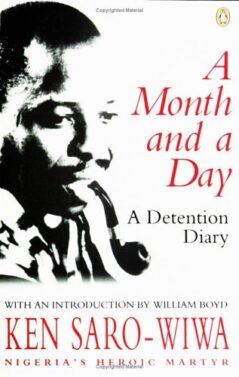
Summary
A Month and a Day: A Detention Diary is the final memoir and political testament of Ken Saro-Wiwa, a celebrated Nigerian writer, businessman, and human rights activist. The book serves as a firsthand account of his 1993 imprisonment by the Nigerian military regime, which lasted for exactly one month and one day. Beyond the details of his incarceration, the diary interweaves Saro-Wiwa’s reflections on the history of the Ogoni people and his leadership of the Movement for the Survival of the Ogoni People (MOSOP).
The narrative centers on the struggle of the Ogoni, a small ethnic minority in the Niger River Delta whose land was being destroyed by the “ecological war” waged by multinational oil companies, primarily Shell. Saro-Wiwa details how decades of oil extraction led to “slow genocide” through pollution and gas flaring, while the Nigerian government siphoned billions in revenue and returned nothing to the local communities. The book highlights Saro-Wiwa’s commitment to non-violent resistance, culminating in the historic January 4, 1993, “Ogoni Day” protest where over 300,000 people marched peacefully to demand political autonomy and environmental justice. The diary concludes with his release in July 1993, though an introduction by William Boyd notes Saro-Wiwa’s subsequent arrest in 1994 and his execution in 1995 following a sham trial.
Plot
- The Arrest: On June 21, 1993, Saro-Wiwa is intercepted by security forces on an expressway in Port Harcourt. It is his fourth arrest in three months, ostensibly related to the Ogoni boycott of the June 12 presidential elections.
- The Road to Lagos: He is transported by road for twelve hours in a reeking Peugeot J5 bus he nicknames “the Coffin” to Alagbon Close in Lagos. During this time, he is deprived of food and kept in grimy, “cobwebby” conditions.
- The Transfer to Owerri: After making statements in Lagos, he is driven back toward the delta but dumped at the police headquarters in Owerri. Here, he is reunited with fellow Ogoni detainees N.G. Dube and Kabari Nwiee.
- Reflection and History: While languishing in a lightless, mosquito-infested cell next to a stinking bathroom, Saro-Wiwa reflects on the formation of MOSOP, the drafting of the Ogoni Bill of Rights (1990), and his international efforts to gain support from the UN and organizations like Greenpeace.
- Health Crisis and Legal Battles: Saro-Wiwa’s health deteriorates, exacerbated by boils and a pre-existing heart condition. His lawyers, including Dr. Olu Onagoruwa and Ledum Mitee, fight for a court-ordered transfer to a hospital.
- The Clinic and the Midnight Maneuver: He is finally moved to a police clinic, but the military regime attempts to abduct him at midnight to transfer him to a different prison in Enugu. A firm hospital matron and the absence of a police squadron leader foil the attempt.
- Release: Following intense international pressure from Amnesty International and the British media, Saro-Wiwa is released on bail on July 22, 1993.
Setting
- Port Harcourt, Nigeria: The urban center of the Niger River Delta where Saro-Wiwa’s activism was headquartered.
- Ogoniland: The ancestral home of the Ogoni, described as an “ecological waste land” reeking of sulfur and lit by orange gas flares. Specific locations like Bori (the headquarters) and Mogho are focal points for rallies.
- Detention Centers: Including the State Security Service (SSS) offices in Port Harcourt, the “notorious” Alagbon Close in Lagos, and the squalid cells of “Alabama City” (Port Harcourt Prison).
- Time Period: Primarily June to July 1993, during the transition-to-democracy era of dictator Ibrahim Babangida.
Themes
- Environmental Genocide: The central argument that oil extraction is destroying the physical and cultural existence of the Ogoni people.
- Internal Colonialism: Saro-Wiwa asserts that after British rule ended, Nigerian “black colonialists” (the ethnic majorities) simply replaced them, exploiting the resources of minority groups like the Ogoni.
- Non-Violent Resistance: Saro-Wiwa’s unwavering belief that “the word is power” and that peaceful mass mobilization is the only moral way to confront tyranny.
- Betrayal: The conflict between the committed MOSOP activists and the “vultures” the Ogoni elite and traditional rulers who collaborated with the military regime for personal gain.
- The Power of the Writer: The belief that a writer must be an homme engagé (an intellectual man of action) who uses their talent to enable the oppressed to confront their tormentors.
Characters
Major Characters
- Ken Saro-Wiwa: The protagonist and narrator; a writer and leader of the Ogoni people who is “determined as iron” to save his people from extinction.
- Dr. Garrick Leton: The first President of MOSOP; an educated man who later resigns from the movement after disagreements over the election boycott.
- Edward Kobani: A long-time friend and activist who helped found MOSOP but became a “vulture” by siding with the government against the movement’s radical stance.
- General Ibrahim Babangida: The military dictator of Nigeria, referred to by Saro-Wiwa as a “conman” and “Monster of Minna”.
- N.G. Dube and Kabari Nwiee: Saro-Wiwa’s fellow detainees and “MOSOP Three” members who shared his suffering in the Owerri cells.
Minor Characters
- William Boyd: Saro-Wiwa’s friend and a British novelist who wrote the introduction and advocated for his release.
- Owens Saro-Wiwa: Ken’s brother and a medical doctor who provided medical supplies and support during detention.
- Dr. Olu Onagoruwa: A prominent human rights lawyer who represented Saro-Wiwa.
- Mr. Inah: A police officer described as “lugubrious” and a “man Friday” to the security services.
- The “Vultures”: A group of government-paid traditional rulers and politicians who issued communiques denouncing Saro-Wiwa’s activism.
Literary Devices
- Metaphor: The Peugeot J5 detention bus is consistently called “the Coffin,” representing the death of freedom and the physical danger of the regime.
- Symbolism: Green twigs are used by the Ogoni as a symbol of the environment and their peaceful intentions.
- Satire: Drawing on his background as a satirical journalist and playwright, Saro-Wiwa mocks the “undignified bearing” and “inefficiency” of his captors.
- Diary Format: The use of specific dates and immediate reactions creates a sense of urgency and intimacy, making the reader experience the boredom and terror of detention alongside him.
- Foreshadowing: Throughout the diary, Saro-Wiwa speaks of being “mentally prepared for the worst” and writing his will, foreshadowing his eventual execution.
- Allusion: Frequent biblical references, particularly comparing the Ogoni struggle to the Israelites’ flight from Egypt, to provide moral weight to the cause.

