
You can listen to the Book Summary Below
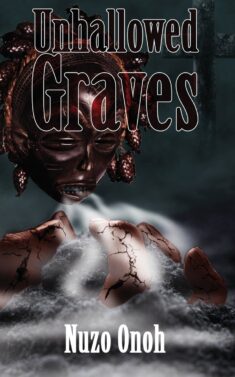
Unhallowed Graves by Nuzo Onoh is a seminal work of African Gothic horror, composed of three haunting novellas that explore the intersections of West African mythology, generational trauma, and the supernatural. The book delves into the “unhallowed” spaces where the living and the dead collide, often through themes of betrayal, ritual, and the heavy price of survival.
I. The Unclean: The Tragedy of Desdemona and the Tree of Truth
The Trial in Ukari Forest
The first story, “The Unclean,” opens in the Ukari Forest at 9:00 PM. The protagonist, Desdemona (Desee), is kneeling beside the putrid, bloated corpse of her husband, Agu. She is undergoing a “trial by corpse,” a traditional ritual where a widow must spend three nights alone with her husband’s body to prove she did not kill him. Desee is trapped within a salt-lined boundary set by witchdoctors, under the watchful branches of the Iroko tree, known as the Tree of Truth the final arbiter of justice in Ukari.
Desee reflects on her “accursed” status as a widow without a son, describing herself as “exposed to the flings and thumps of the merciless force of nature”. She recalls the events that led to this nightmare, beginning with her marriage in 1953.
The Marriage to Agu
Desee was a bright, light-skinned girl with an education that her father, Ukah, intended to use to “command a good bride price”. She hoped for a career in teaching, but her father married her off to Agu, a short, arrogant, and wealthy trader from the Onori clan. Desee felt an immediate “soul rejection” of Agu, sensing they were antagonists in a previous life.
Her marriage was a “matrimonial hell”. After four years without a child, she was subjected to abuse by Agu and his three “fat sisters”. Agu’s eldest sister, Uzo, eventually took Desee to a witchdoctor who branded her an Ogbanje (a cursed water-spirit) and a “daughter of the river Niger”. This revelation turned the entire village against her. Agu responded with extreme physical violence, dragging her by the hair and beating her with belts and birch whips.
Desee fled to her father’s house, seeking protection. However, her father refused to take her back, telling her she was her husband’s “chattel” and demanding she return to Ukari to avoid the “dishonour of a divorce” and a dowry refund.
The Miracle of Ebuka and the Viper’s Strike
Desee’s mother and sister, Goneril (Gono), secretly directed her to Pastor Brother Ezekiel of the Cherubim and Seraphim Church. Through a ritual involving animal sacrifice and consecrated water, Desee conceived a son, Ebuka (Chukwuebuka). For a time, her status improved; she was “Mama Ebuka,” a woman who had fulfilled her calling.
This bliss ended on the eve of the New Yam festival when Ebuka was killed by the venomous viper Echieteka. Desee was devastated and broke a sacred taboo by holding her son’s lifeless body for hours. Ebuka was buried in Ajo-ofia (the bad bush), a desolate place for the “unclean” dead whose names are to be forgotten forever.
The Dark Ritual of Ogbunigwe
Desperate to bring Ebuka back, Desee turned to a powerful and terrifying witchdoctor named Ogbunigwe, “he that kills in multitudes”. Ogbunigwe agreed to help her through reincarnation, but demanded a steep price: blood and the hair of the dead.
Desee made a terrifying midnight journey to Ajo-ofia, guided by the ghost of Ebuka. She witnessed the “soulless inhabitants” of the bad bush mothers with rotten fetuses and victims of suicide. She eventually dug up Ebuka’s bones to retrieve a clump of his immortal hair. To complete the charm, she also had to steal hair from Nwanna, the infant son of Agu’s second wife, Enu.
The Price of Blood and the Final Judgment
Ogbunigwe’s charms worked to an extent: Agu became obsessed with Desee again, but his genitals developed a festering, grotesque infection involving moles, spikes, and pus. Meanwhile, Nwanna died of a sudden illness. When Desee confronted Ogbunigwe, he revealed the truth of the occult trade: “A life for a life, a son for a son”.
Agu eventually died of the infection in Desee’s bed. Accused of witchcraft and murder, Desee was forced into the forest for judgment. On her final night, the ghosts of the forest emerged. She saw Ebuka, but he rejected her, screaming that she had lied because he did not belong to Agu’s bloodline and was doomed to Ajo-ofia forever.
The Tree of Truth suddenly came alive as Agu’s rotting corpse rose from the mat. In a final, gruesome scene, the zombie-ghoul of her husband physically and spiritually assaulted her, pulling her soul into the “foul and restless fold” of the dead.
II. Night Market (Oja-ale): The Diplomat’s Descent into the Undead Trade
The Encounter on the Road
The second story follows Alan Pearson, a British commercial attaché living in Lagos. While driving back from Benin City during a thunderstorm, Alan insisted his driver, Olu, pick up a drenched girl on the roadside. Olu was terrified, identifying the girl as a “Quarter-to-Dead” a person who has sold their life at the Night Market (Oja-ale).
Alan, dismissive of “superstitious mumbo-jumbo,” ignored Olu’s warnings. However, the girl exhibited an unexpected, “metal clamp” strength when she touched Alan’s arm. She eventually escaped the car, but not before Alan glimpsed her face: a mummified skull with a yawning black hole for a nose. She stole Alan’s wife’s lilac M&S cardigan.
The Lore of Oja-ale
Olu explained the mechanics of the Night Market: it is a place where the dead trade with human lives. People can buy money, fame, or health, but each transaction costs a quarter of their life. When a person reaches “Quarter-to-Dead,” they begin to smell of decay and their skin becomes like an ancient corpse. These individuals eventually return as “Come-backs” beings with albino eyes who must hide behind sunglasses.
Laura’s Sacrifice
Alan soon suffered a “ghastly” car accident that killed the old man and the driver he had hired to find the Night Market. Alan survived but was left blind, paralyzed from the waist down, and suffering from amnesia.
His wife, Laura, was devastated. The “evil thing” from the road began haunting their house, wearing her stolen cardigan. The creature promised Laura she could “buy back” Alan’s memory, his legs, and his sight at the Night Market.
Laura made three separate trades:
- A quarter of her life for his memory.
- A quarter of her life for his legs.
- The remaining half of her life for his eyesight.
By the time Alan regained his sight, he found that Laura had withered into a “shrivelled mummy” and committed suicide via sleeping pills to spare him the sight of the “ghoulish nightmare” she had become.
The Come-back in Bisi’s Body
Alan returned to England with Laura’s ashes, but was contacted by his former secretary, Bisi, who was livid. Bisi revealed that Laura’s ghost had tried to use her life to return. Alan flew back to Lagos and was met by Bisi at his home.
In a shocking twist, Bisi revealed she was Laura. Laura’s spirit had purchased Bisi’s body in a single transaction at the Night Market, leaving Bisi’s soul trapped in Laura’s former stall. Laura now inhabiting Bisi’s “sexy” body mocked Alan, showing him she had no shadow and revealing albino eyes behind her sunglasses. She was a “spoiled, tainted” Come-back, a warped spirit in the body of the woman Alan had once lusted after.
III. Our Bones Shall Rise Again: The Rebirth of a Witchdoctor
The Betrayal of Oba
The final story is a multi-generational epic centered on Oba, a great witchdoctor, and his son Obinna. The first part begins with Oba being awakened by the Izaga drums of the ancestors, signaling an imminent death in the village. Oba lived with his two sons: the indolent Uchenna and the mute, psychic Obinna.
Oba’s power was rooted in his Lifestone, a blood-drenched pebble embedded in a pulsating human heart (the Obi-Dimpka). He was betrayed by his first wife, Ugodiya, and her brother, Obianuju, who sought to bring the “dead god” (Christianity) to the village. Obianuju stole the Lifestone, rendering Oba powerless.
During a raid by “white demons” (slave traders), Oba’s second wife, Uzo, was decapitated by Obianuju. Oba and his kinsmen were captured and taken onto a slave ship. On the ship, the Great Goddess of the River (Agbomma Orimiri) called to them, promising their “bones shall rise again”. Oba and his men chose to walk into the sea, choosing a “watery grave” over servitude.
Obinna and the River Ghouls
Sixteen years later, Obinna was a grown man living in exile in the village of Ojoto with his grandmother, Nnedi. Obinna possessed the gift of the “second eye” (the ability to see death-dates and read minds) but was haunted by “river ghouls” the chained skeletons of his father and kinsmen who begged to be “brought home”.
A Python deity visited Obinna and transported him to the undersea realm. There, he reunited with the spirit of Oba, who instructed him to retrieve the Lifestone from Ugodiya so they could finally achieve reincarnation during the Feast of Alusi Onwu.
The Theft of the Lifestone
With a charm of invisibility provided by Nnedi, Obinna returned to his father’s old compound. He found it desecrated: the Great Shrine Tree had been felled, and Obianuju and Ugodiya were living in an incestuous affair under a wooden cross. Obinna successfully retrieved the Lifestone from its hiding place under a grinding stone.
Nnedi and Obinna then performed a dark ritual in Ajo-ofia to extract a fresh heart from a corpse to house the Lifestone. Obinna provided his own blood to re-animate the stone, which began to pulsate with life.
The Resurrection and the Final Revenge
During the Night of Alusi Onwu, Obinna entered the river and allowed the chained ghouls to take the Lifestone. The Lifestone embedded itself in Obinna’s heart, and Oba’s spirit took possession of his son’s body.
Oba (in Obinna’s body) returned to the village, now possessing the power of speech. He confronted Obianuju and Ugodiya, revealing his true identity and killing them both with a knife. However, a mob of villagers, led by the treacherous Uchenna (who claimed Oba was a “bastard” trying to steal his birthright), descended upon him.
Oba was beaten to death, his Lifestone rolling away. In his final moments, he crawled to the stump of the Great Shrine Tree and buried the Lifestone beneath its roots, ensuring he and Obinna would remain together for eternity.
The Epilogue: The Twins of Nnenna
The legend of Oba’s return lived on. Obinna’s bride, Nnenna, died giving birth to twin boys. One twin (missing a right ear) was a mute charm-maker of immense power; the other had the second sight and was a brilliant artist. The artist twin created a haunting drawing of the chained skeletons under the river the only piece of work he refused to give to the white men, keeping it hidden in the secret shrine of Alusi Onwu.
Key Thematic Components Across the Book
- Lore and Cosmology: Onoh utilizes traditional Igbo concepts such as Chi (personal god), Ogbanje (spirit children), and Ndichie (venerated ancestors) to create a world where spiritual laws are as rigid as physical ones.
- The Weight of Taboo: In “The Unclean,” the breaking of the taboo regarding dead children triggers a communal curse, illustrating the protagonist’s isolation from her society.
- Gender and Power: The female characters Desdemona, Laura, and Nnedi exercise power in unconventional ways. Nnedi is a “man-woman” who holds higher status than many village men, while Laura uses her own life as a currency for Alan’s.
- Colonialism and Religion: The “white demons” and their “dead god” are portrayed as a disruptive force that destroys traditional harmony, as seen in the betrayal of Oba and the “civilized” arrogance of Alan Pearson.
- Vengeance and Reincarnation: The dead are never truly gone; they seek justice through reincarnation (“The Unclean”), possession (“Night Market”), or ancestral return (“Our Bones Shall Rise Again”).
Unhallowed Graves serves as a meticulous accounting of the price of the supernatural, suggesting that in a world of ancient gods and spirits, every desire whether for a son, health, or justice demands a sacrifice in blood.