
You can listen to the Book Summary Below
Table of Contents
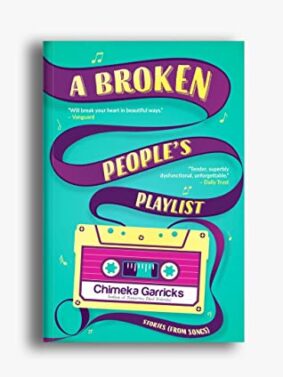
Chimeka Garricks’ A Broken People’s Playlist is a profound and emotionally resonant collection of twelve interconnected short stories set primarily in the city of Port Harcourt, Nigeria. The book is unique in its structure, as each story is written “under the influence” of a specific song, creating a literary “playlist” that explores themes of love, loss, betrayal, redemption, and the “God-sized hole” in the human soul.
Lost Stars (Adam Levine)
The collection begins with the story of Sira, a high-powered Lagos lawyer, and Kaodini, an “accidental farmer” in Port Harcourt. Their love story is told in “fragments” over the course of nearly two decades. They first met in 1997 when Kaodini worked in his father’s bakery, and their bond was cemented on a night when Sira sought refuge in his room after being beaten by her boyfriend, Victor, and rejected by her own father. On that night, they shared a meal of bread dipped in Milo, which became a lifelong symbol of comfort.
Though they drifted apart as Sira moved to Lagos for her career, they remained each other’s “One Who Got Away”. During a visit to Port Harcourt for her sister’s wedding, Kaodini proposes to her while cutting her hair in his bathroom. Sira initially refuses, fearing she would resent giving up her partnership at a law firm to move back to Port Harcourt. However, after realizing her professional success feels “empty,” she calls Kaodini to accept his proposal. Tragically, later that day, Kaodini is killed in a motorcycle accident when a commuter bus swings into his path. The story ends two years later, with Sira living in Kaodini’s apartment, struggling with insomnia and eating only bread dipped in Milo as she processes a grief that feels like an “ancient confusion”.
Music (Erick Sermon & Marvin Gaye)
This story introduces Tukwashi, a teenager growing up in a home defined by the “poison in the air” between his parents. His father, a physics professor, is a compulsive womanizer who uses music specifically Victor Uwaifo’s ‘Guitar Boy’ as a “dagger” to taunt Tukwashi’s mother. The conflict reaches a climax when the mother destroys a highlife mixtape Tukwashi had spent months creating, and the father subsequently leaves the family to live with his mistress, Ms. Ukor.
Tukwashi finds his own identity as a DJ, working at Music Factory Studios under the mentorship of “Big S”. Despite his mother’s attempts to prevent him from playing at parties, Tukwashi discovers he has a “gift” for reading a crowd. At a party for Ivy League alumni, he encounters his father and Ms. Ukor. Despite his loathing for the mistress, Tukwashi uses the opportunity to “blackmail” his father into giving him a cheque for his university fees. He then takes over the turntables, playing a 63-song playlist of Soul, Funk, and Disco that cements his reputation as DJ TT.
Hurt (Johnny Cash)
Priye, an oil service executive, navigates the final days of his younger brother, Dami, who is dying of an inoperable brain tumor. Dami, the over-pampered “favorite” of their mother, had been a “lazy, entitled man” who once stole 196 million naira from the family company, leading to a four-year estrangement from Priye.
Dami insists on organizing his own “living funeral” so he can hear what people will say about him before he dies. During a trip to Lagos, Priye meets Dami’s estranged wife, Joy, to ask her to attend the funeral. Joy reveals the horrific truth: Dami had beaten her “like a slave” for three years, causing a miscarriage and broken bones. Priye is devastated by this revelation, realizing that his mother had enabled Dami’s worst impulses. Dami eventually dies and is cremated. The story concludes with Priye paying Dami’s “post-death benefits” to Joy, admitting that he is trying to “buy penance” for the years he spent not talking to his brother over money while a “monster” grew in Dami’s head.
Song for Someone (U2)
Ukela, a brilliant architect with a history of self-harm and trauma, meets her father, B.B. (Chief Buduma Benson), at a restaurant-bar. Ukela was a “bastard” child whose mother was B.B.’s secretary; B.B. provided for her financially but was a “phantom” who never visited her, even after her mother died when she was eleven.
The narrative reveals Ukela’s deep scars, including a public humiliation by her fiancé, Victor, who discovered a sex tape she had made with a former lover, Opus. She eventually finds a different kind of connection with Jolomi, a recovering alcoholic whom she met at a clinic after a Tramadol overdose. Jolomi is the first man to challenge Ukela’s “self-sabotage” and “daddy issues,” telling her she needs to “unfuck [her] mind” and stop offering sex as the only thing she has to give. At the meeting with B.B., Ukela finally introduces Jolomi as the man who “already takes care” of her, signaling a path toward healing.
In the City (Brymo)
This is a tragic story of police corruption and the vulnerability of marginalized people. Corporal Enenche, a policeman on the verge of quitting for a better job, chases a drug peddler in white sneakers through the alleys of Asiama Waterside. Enenche, who is superstitious and plagued by nightmares, has decided not to kill anyone during his final three weeks on the force.
However, the police team, led by the corrupt Sergeant Shehu, arrests Godson, a 20-year-old hairdresser who also happens to be wearing white sneakers. Though they realize Godson is an “antelope” and not the drug dealer they sought, they rob him and search his phone. They discover gay pornography on the device, leading to a brutal assault. To pad their statistics, the police frame Godson for an armed robbery on Banham Street and take him to a cemetery to be murdered. Enenche, despite his vow, does not stop the execution, though he refuses the “lizard” role of pulling the trigger. He later discards Godson’s sneakers, which he had stolen, because they are “bad luck”.
I Put a Spell on You (Nina Simone)
Buddha (Ebuka) confides in his friends, Alex and Tonse, that his “equipment” (penis) has stopped working with every woman except his wife, Moji. He believes Moji has “jazzed” him after a failed attempt to cheat with a girl in Abuja.
The story takes a satirical turn as the men debate the reality of “jazz” versus scientific explanations like erectile dysfunction. In a final twist, it is revealed that Moji did provide Alex’s girlfriend, Soibi, with a substance to put in Alex’s food to make him propose. The women have collaborated to use “jazz” to ensure fidelity and commitment, with Moji promising Soibi another “spell” to ensure Alex’s intern at work begins to “smell like fowl shit” to him.
I’d Die Without You (P.M. Dawn)
This story explores a man’s grief over the loss of a child. After five years of marriage and two IVFs, his wife’s water breaks at 25 weeks, and the baby is delivered stillborn. The man takes the baby, whom they named Adesuwa, and carries her in an Adidas shoebox as he wanders Port Harcourt, trying to find a place to bury her.
The narrative interweaves this present grief with a memory from 1996, when he forced a house-girl named Comfort to have an abortion. He realizes that his inability to cry for Adesuwa is linked to the “premium bastard” he was as a teenager. He eventually buries the shoebox in the garden of his best friend Ekiyor’s parents. Two years later, when his son is born, he finally breaks down in tears, crying for “his late father, for Comfort, for the unnamed one, and for Adesuwa”.
Beautiful War (Kings of Leon)
Kenwi and Wobia have a marriage built on a rule of “gall-bitter” truth-telling. This rule is tested when Kenwi admits to a three-month affair with Tamara, a subsea engineer on his oil platform. When Wobia asks what Tamara did better, Kenwi brutally honest response that Tamara “swallowed” during oral sex shatters the remains of their intimacy.
Wobia seeks advice from Kenwi’s brother’s wife, Kokoma, who reveals her own “equalizer”: she once told her husband, Tonse, that she had slept with an ex-boyfriend in revenge for his affairs. Kenwi eventually breaks up with Tamara, but Wobia refuses to reconcile immediately. The story ends with Kenwi realizing he has lost the “life force” of the Wobia he knew, and he is left praying for a miracle to bring her back.
River (Leon Bridges)
This story is a meditation on the trauma of “confra” (secret cult) culture in Nigerian universities. The narrator recounts his deep friendship with Jon, which began in 1993. They were initiated into a confra together in 1994, seduced by the “ice-cold” status it provided.
However, the narrator quickly becomes disillusioned by the “bullshit” of the cult and its violent reality. Jon eventually finds redemption through love for his girlfriend, Biboye, and plans to quit the cult. Tragically, Jon is killed in an ambush at a hostel while wearing the narrator’s burgundy shirt. Decades later, the narrator still suffers from “bird-shit” grief that strikes without warning. He finds solace in writing a “prayer journal,” pouring out the truth of his “ungrieved grief” for Jon and his own father.
Love’s Divine (Seal)
JJ (Justin) is a talented 16-year-old footballer who is scammed by Jerry, a fake agent who promises him trials with LA Galaxy in exchange for 250,000 naira. JJ steals the money from his parents’ ATM accounts to pay the fee.
At the same time, his parents, Onis and Grace, reveal that Onis is not his biological father. His real father was Dami (from “Hurt”), who had abandoned Grace when she was pregnant. Dami’s brother, Priye, visits to apologize and offer JJ a trust fund. When Priye discovers JJ has been scammed, he uses it as a “consequence for foolishness” lesson, lending JJ the money to pay back his parents but insisting it be treated as a loan. JJ reads a final letter from Dami, who acknowledges that “fatherhood is never only about blood” and urges JJ to be Onis’s son.
Desperado (Eagles)
Tukwashi (now a radio host) struggles with alcoholism and the news that his ex-wife, Arese, is remarrying. Their marriage in London had ended due to Tukwashi’s drug-fueled infidelities and a public scandal involving an overdose in a hotel room.
Through a series of phone calls, Tukwashi finally reveals the root of his addiction: he was sexually abused as a seven-year-old by the family’s house-help, Mercy. He admits that he “liked it” at the time, a confession that has haunted his self-worth for years. Arese encourages him to get professional help. Tukwashi realizes that while he may never be with Arese again, he is finally “at peace” with her and ready to start “weaning [himself] off alcohol” for his new partner, Idara.
You Suppose Know (Bez ft. Yemi Alade)
The final story is told by Deola, a cardiologist who treats Mr. Osaro Ngofa, Tonse’s father. Osaro and his wife, Nimi, are an inseparable couple whose constant bickering masks a deep, legendary love. They share the story of their meeting in 1971, when Nimi represented herself in her own divorce from an abusive husband, and Osaro “stalked” her until she agreed to marry him.
Nimi reveals that her first husband had “raped” her, a trauma she escaped through divorce. The story takes a tragic turn when Nimi dies of a ruptured brain aneurysm. Osaro, who “doesn’t know how to live without her,” spends his final months spraying her signature perfume on her side of the bed and waiting to join her. The book concludes with Deola and her husband, Kaniye, reflecting on the brevity of life and the need to “love your love” while they can.
Themes and Conclusion
In his Author’s Note, Garricks explains that music saved his writing after a period of creative block. The collection serves as a “broken people’s search… for redemption” and a reminder that the things that truly matter are love, family, and music. By setting these stories in Port Harcourt, Garricks aims to capture the essence of a city he carries in his heart, offering a “playlist” of the human experience that is both “haunting and memorable”.